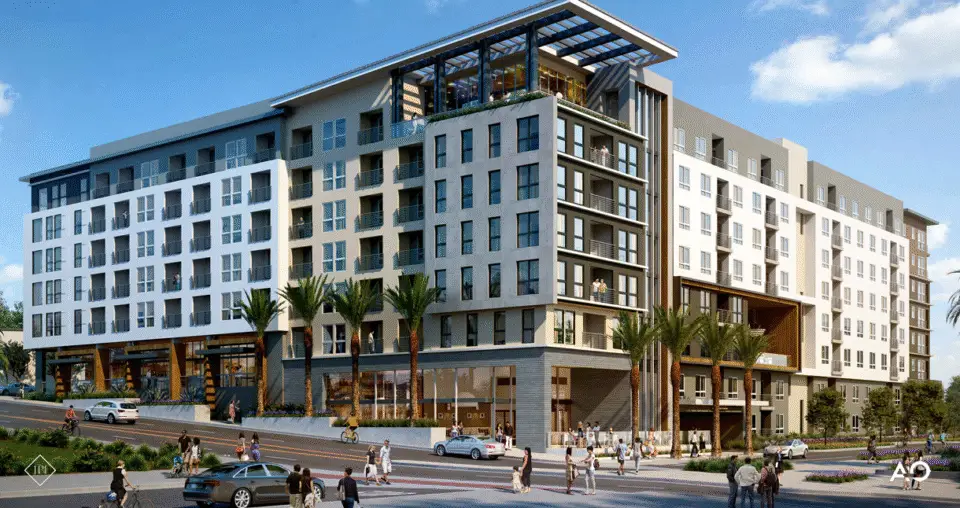
OCEANSIDE — The City Council has approved another high-rise, high-density mixed-use apartment complex in downtown — this time directly across the street from Oceanside High School.
The 901 Mission Avenue project will replace a 1.51-acre vacant lot bordered by Mission Avenue, Horne Street, Seagaze Drive and Clementine Street with an eight-story building featuring 273 apartments, including 28 units reserved for low-income households.
The development will join several other high-density projects nearby, including a proposed 230-unit project at 801 Mission, a delayed 206-unit project at 810 Mission, and the recently approved 401 Mission Avenue project, which will replace the Regal Theater with 332 units.
Another nearby project, 712 Seagaze Drive, will feature 179 all-affordable studio apartments in an eight-story building. The city has also delayed its final decision on the Oceanside Transit Center redevelopment, which, if approved, would add another 547 residential units.
At 901 Mission Avenue, 54 housing units will be 479-square-foot studios, with six reserved as affordable and 48 at market rate; 142 one-bedroom units ranging from 609 to 863 square feet, with 14 affordable and 128 market rate; and 77 two-bedroom units ranging from 1,052 to 1,186 square feet, with eight affordable and 69 market rate.
The ground floor will include a leasing office, lobby and 4,006 square feet of space for future commercial use.
Four stories will be devoted to a parking garage with 322 off-street spaces — 294 reserved for residents, providing at least one per unit, and 28 for commercial or other uses.
Although not required to include that much parking because the site is within a half-mile of the Oceanside Transit Center, the developer opted to do so to ease concerns about parking constraints and offer an added amenity for residents. Street parking will still be allowed and is not included in the parking count.
Although the city enacted a downtown density cap in December 2023, the project is exempt because developer JPI Companies submitted its application a month earlier.
The project also invokes the state’s density bonus law, which allows additional units, waivers and concessions for developments that reserve at least 10% of their units as affordable.
In early 2024, the City Council increased the local affordable housing requirement to 15%, but, like the density cap, that change does not apply (and reverts to the 10% standard) because the application was submitted before the change took effect.
JPI is also behind the Jefferson Ocean Creek project, which is building 295 units near the Crouch Street Sprinter Station, including 30 low-income homes, with completion expected by the end of 2026.
During an Oct. 15 public hearing, Colin Hofmann, JPI’s director of development, said the company aims to “foster communities, not break them down,” while building housing and retaining residents.
“We’re very proud to boast across our portfolio nationwide an over 83% retention rate for residents due to our communities and what we bring to the residents,” Hofmann said.


Hofmann said the company has been working with Oceanside Unified School District to ensure future commercial tenants will not distract or pose a nuisance for students. The project site sits directly across Horne Street from the high school.
He said the new development would improve the area by replacing a vacant lot he described as “a prime spot for afterschool fights” that has also seen growing homeless activity.
“This site is an awesome opportunity to connect the Eastside to the downtown district,” Hofmann said. “We’re looking at this as a gateway — especially in the city’s cultural corridor.”
Hofmann added that rental rates are being set with consideration for Marines who rely on housing vouchers while stationed locally, noting that more than 80% live off base.
Amenities will include a courtyard with a pool and hot tub, an open-air kitchen and barbecue area, a fitness center, bike storage, electric vehicle charging (with at least half of the parking EV-ready), a clubhouse, coworking space and a rooftop deck with solar and barbecue areas.
Landscaping will feature native trees and drought-tolerant plants — no palms — along with an urban canopy and garden buffer between pedestrians and vehicles. The Mission Avenue frontage will include benches and short-term bike and e-bike parking to complement future retail.
While some residents said the project’s design was appealing, others criticized its size and limited affordable housing.
“We do not have a housing crisis, we have a housing affordability crisis,” said Diane Nygaard of Preserve Calavera, a local environmental nonprofit. “This is one of six huge density bonus projects that will change our downtown forever.”
The development, in addition to the several neighboring high-rise projects in the downtown area, signals a dramatic shift toward taller, transit-oriented housing in the city’s core.
Nygaard noted that despite the new construction, the city remains behind on state-mandated very low- and low-income housing while exceeding state requirements for above-moderate units.
Development Services Director Darlene Nicandro said roughly 667 affordable units are coming soon through projects including 712 Seagaze, South River Village, Murka, Coast Village, Olive Park Apartments and another development at Mission and Roymar.
The council ultimately voted 4-1 to approve the project, with Deputy Mayor Eric Joyce dissenting, citing air quality, traffic and safety concerns.
“Five stories with people who can look into a campus full of children is creepy,” Joyce said. “It doesn’t make sense to me… I just don’t think we have answered the questions around safety.”
Mayor Esther Sanchez said previous plans for the site included buildings of similar size and noted the Oceanside Coastal Neighborhood Association supported the project.
Councilmember Jimmy Figueroa, who voted in favor, also voiced concerns about affordability and student safety, urging staff to coordinate with the school district.
“There are conversations we can have with the school district SROs (school resource officers), the principal, the assistant principal,” Figueroa said, noting he’s observed security guards directing traffic before and after school hours near the high school. “I would be interested in what they may have to say.”