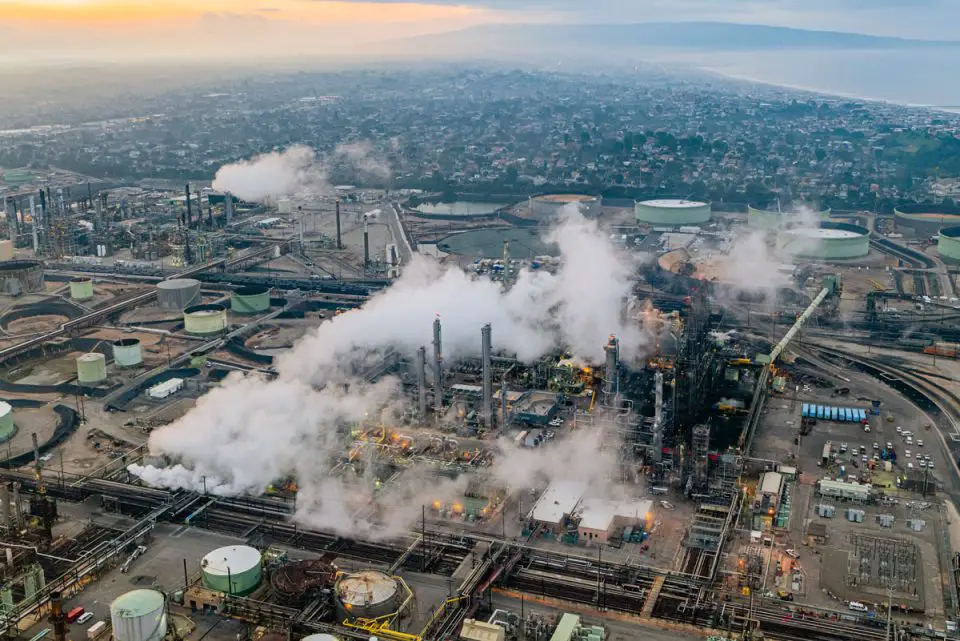
In 1991, California had more than 40 refineries. By the end of 2026, it will have fewer than 11. Of those, only five are large enough to matter. Phillips 66 shuttered its 147,000-barrel-per-day Los Angeles refinery in December. Valero’s Benicia facility will close in April.
Now, Chevron has warned of possible closures at its Richmond and El Segundo facilities, citing CARB’s Cap-and-Invest amendments as a potential death blow to California refining.
In a letter to Governor Gavin Newsom, Chevron’s president, Andy Walz, put it plainly: the proposed regulation “will cripple the survivability of the state’s remaining refineries, which will result in California losing the entire industry.”
Sacramento’s response has been consistent: this is a transition. EV adoption is rising, petroleum demand will follow it down, and refineries closing now are simply getting ahead of an inevitable market outcome. In this telling, the gap will close on its own.
Before accepting that assurance, it is worth examining its assumptions, because each of the three fails.
The timeline argument fails first, demolished by the auto industry itself. Ford, General Motors, and Stellantis have collectively written off more than fifty billion dollars in EV investments – the largest capital destruction in the industry’s history. Ford killed the F-150 Lightning.
GM halted two battery plants and announced a “significant pullback” in EV demand. Stellantis canceled its electric Ram pickup and brought back the HEMI V-8. Even Tesla is pivoting toward AI and robotics as unit sales decline for the second straight year.
The federal EV tax credit expired last September, and with it, the artificial demand on which Sacramento’s projections depended. California is closing refineries on a demand-decline timeline that the auto industry itself has now repudiated.
The demand-decline argument fails entirely when applied to the military. The Pentagon is not transitioning to electric aircraft or battery-powered naval vessels. Military petroleum demand is not declining — it is an operational requirement that California’s EV adoption curve does not touch. Sacramento’s transition narrative was not written with thirty-plus military installations in mind.
The smooth-landing assumption is the most dangerous of the three. Even if demand were to fall to match reduced supply, the transition period, likely decades long, would still be one of extreme vulnerability. There is no plan for the gap. There is only the facile assurance that it will be tolerable, despite the arithmetic.
What elevates this beyond poor energy policy is a principle Sacramento appears to overlook: energy security is the foundation of national security, and national security is the foundation of everything else.
Not metaphorically, structurally. Economies function because goods move, hospitals operate, water flows, harvests reach tables, and soldiers fly to theaters of war, all because petroleum is refined and delivered somewhere in the chain. Strip that away, and California becomes very fragile—vulnerable to disruption from without and incapable of defending itself from within.
California is dangerously exposed. It has no inbound oil pipelines. With inadequate domestic supplies, we rely on refineries in India and South Korea, among the few equipped to produce California’s unique fuel specifications. Tankers cross five thousand miles of ocean in two to four weeks.
When supply disruption occurs – a refinery fire, a port closure, a conflict in the Persian Gulf – there is no backstop. There is only waiting, and whatever remains in the tanks.
Travis Air Force Base, a major hub for any Pacific theater contingency, receives its jet fuel via pipeline from Chevron’s Richmond refinery, one of the two now threatening closure. Under surge conditions, Travis carries fewer than three days of fuel inventory.
That is not a margin. It is a countdown. Chevron’s El Segundo refinery produces roughly 40 percent of Southern California’s jet fuel. Its closure will hollow out the aviation fuel supply from Vandenberg to San Diego.
The federal Defense Production Act authorizes the President to direct private companies to prioritize production for national defense, and the Office of Legal Counsel confirmed on March 3 that such an order preempts conflicting state law. Chevron’s warning supplies the trigger; the national security finding supplies the authority. The Administration can act in Washington.
If it does, 39 million Californians will benefit — whether or not Sacramento approves.
Sacramento may call federal intervention an overreach. That would be a strange charge from a government dismantling the energy foundation of the largest state in the union — on a promise it cannot keep, on a timeline the auto industry has abandoned, and toward an alternative energy future that keeps receding.
They call it a transition. What that actually means will be the subject of another column.
Garvin Walsh, retired from a career at investment banks on Wall Street, is a resident of Cardiff-by-the-Sea. He is an elected member of the San Diego County Republican Central Committee.