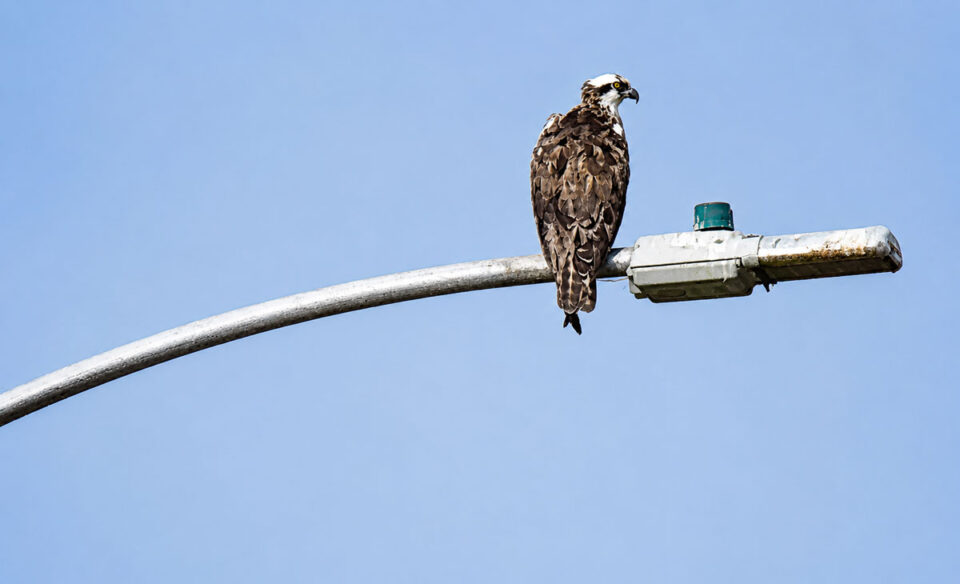
ENCINITAS — Camille Clemens has seen many people build homes and move to Encinitas in her 51 years as a Cardiff resident.
Clemens bought her home in 1975, more than 10 years before the city incorporated, and told The Coast News that many of her neighbors have remained the same over that time. They watched the population grow from around 5,000 in 1970 and 10,000 in 1980 to more than 60,000 residents in 2025, according to the U.S. Census Bureau.
But in April, one family new to the area caught her eye.
“When you’re driving down Manchester, you’re looking at traffic, but you’re also looking at the birds,” she said.
Clemens noticed a pair of ospreys had begun building a nest atop a power pole along Manchester Avenue near MiraCosta College’s San Elijo Campus and Saints Constantine and Helen Greek Orthodox Church.
“That’s when we started watching the process,” Clemens said. “It was really smart — mom and dad did a good job, because it’s so ideally suited by the lagoon where the fish supply is.”
While other North American raptors eat fish, ospreys are unusual for their dependence on the food source. The species developed reversible outer toes and barbed pads on the soles of their feet to help grip slippery fish, according to Cornell University’s All About Birds ornithology lab.
Ospreys are commonly seen around bodies of water and have been known to build nests atop man-made structures, a behavior that has contributed to the species’ recovery. Osprey populations dwindled in the 1950s and ’60s, in part due to chemical pesticides, but have rebounded to a global population of around 1.2 million, according to the Partners in Flight Database.
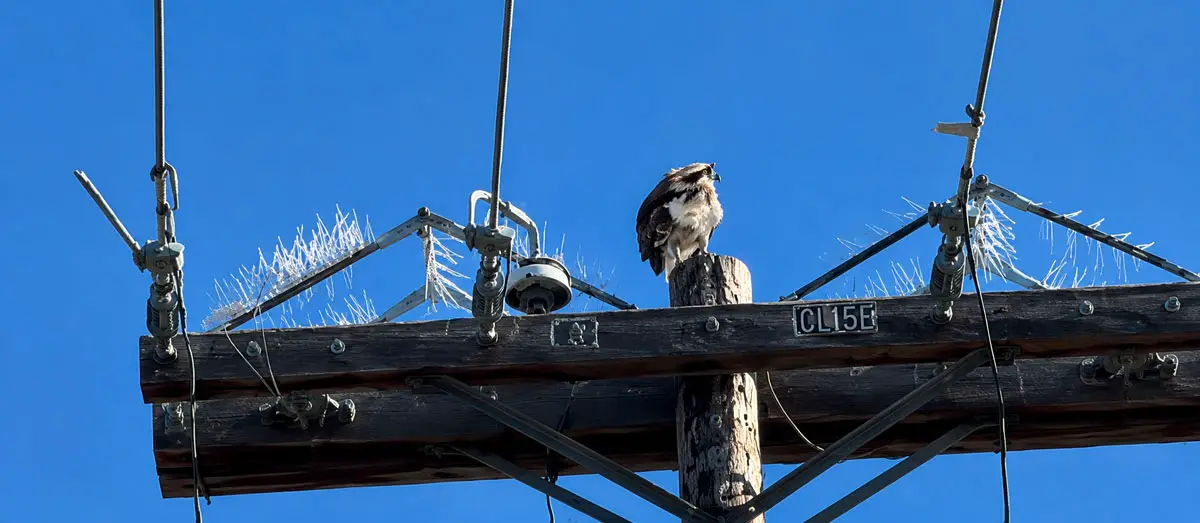
Ospreys are known to return to the same nest during their 15- to 20-year lifespans, adding twigs, sod and other building materials each year, according to Cornell. Nests can reach depths of 10 to 13 feet.
Clemens describes herself as “a neighborhood observer” who likes to “pay attention to details” but is not a formally trained birder. Still, she and her neighbors took an interest in the new osprey family, which included several new additions that hatched this summer.
Then, one day in late July, the nest was gone. A social media post showed that one of the birds had returned to the power pole, even though the nest was no longer there.
“That was their home,” Clemens said.
What happened to the nest?
Because the nest was located on one of its power poles, San Diego Gas & Electric also took an interest in the new Encinitas residents.
Alex Welling, a spokesperson for SDG&E, told The Coast News that nests so close to active electrical equipment pose a serious safety risk.
“Those nests can be extremely flammable,” Welling said. “When it comes to safety, that’s our No. 1 priority. And I’m not just talking about fire safety, but environmental safety.
“We’re really careful when it comes to protecting our resources — our ecological resources.”
SDG&E applied for and received a special use utility permit from the U.S. Fish and Wildlife Service to remove the nest. The Coast News verified the permit with the service, an agency within the U.S. Department of the Interior.
A Fish and Wildlife Service spokesperson said such permits are fairly common for power line infrastructure.
The spokesperson also said the agency worked with SDG&E for two years to develop the Avian Protection Plan.
Welling said the program includes bird-safe designs for new infrastructure as well as retrofitting existing facilities to ensure the safety of raptors, migratory birds and other avian species.
“These measures help reduce bird interactions with electric equipment, supporting wildlife protection, system reliability and wildfire risk reduction,” he said.
Welling added that SDG&E was the first utility company in the state to develop a habitat conservation plan, which includes more than 40 endangered or threatened species in its coverage area.
He said the utility’s internal team of biologists and avian experts monitored the nest for two months, “waiting for the nest to be inactive” and acting only after the “eggs were hatched and the [three] chicks were fully fledged.”
The utility also partnered with Nature Collective to ensure the young ospreys’ health.
“They’re a fantastic organization, they do such great work with that lagoon and educating the community,” Welling said.
Nature Collective biologists observed one of the young ospreys sitting atop a nearby light post holding a fish, confirming it had found a way to hunt and feed itself.
The group has also said it is exploring other long-term solutions.
Clemens said she understood the fire risk but wished solutions other than removing the nest had been enacted.
She said her dream would have been for SDG&E to deactivate the pole and route power another way while documenting the effort in a way similar to the Big Bear bald eagle livestreams.
“If it doesn’t have any electricity, the fire danger is nil,” Clemens said. “I would still love to see a pole close enough to rebuild and a camera.
“With all of that silliness that we don’t have that much control over, there’s something like this that’s local that could’ve been a counterbalance.”