

ENCINITAS — The city has urged Gov. Gavin Newsom to veto a state budget measure that could prevent Encinitas from redesigning portions of Santa Fe Drive after lawmakers approved the legislation in the closing hours of the legislative session.
State Sen. Catherine Blakespear, D-Encinitas, recently inserted a provision in Senate Bill 114, part of a broader budget “trailer bill” revising several years of state spending, that specifically bars Encinitas from altering completed portions of the Santa Fe Drive Corridor Improvements Project.
The language was incorporated into SB 114 on Aug. 28, three days before lawmakers approved the bill earlier this week. The proposal, now awaiting the governor’s signature, followed Blakespear’s SB 569, separate legislation that sought similar restrictions on removing bike lanes statewide but died without receiving a final Assembly vote.
The budget provision attaches new conditions to $3.09 million in state funding awarded to Encinitas for the roadway improvements in 2023. The same language appeared in the measure’s Assembly counterpart, AB 114, which died on the Senate floor.
The policy is narrowly tailored to Encinitas and designed to prevent the city from removing a barrier-protected bike lane approved during Blakespear’s tenure as mayor and later built with state funding she helped secure as a senator.
Blakespear defended the measure as a safeguard for a state-funded safety project and argued that the city’s planned redesign would make the corridor more dangerous.
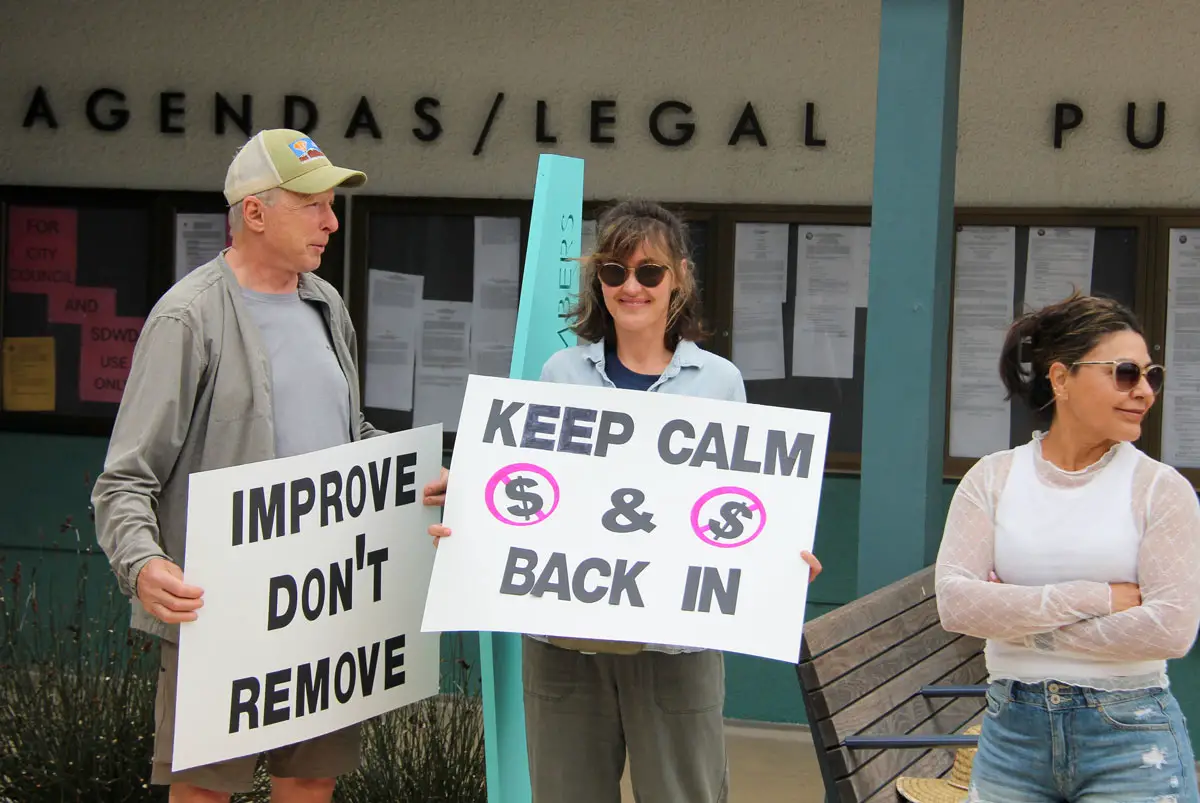
“The idea that we should improve, not remove, remains the same,” Blakespear told The Coast News. “The (Encinitas) City Council majority’s proposed removal of the barrier-protected bike lane will unquestionably reduce safety along that corridor and put bicyclists back alongside traffic, protected only by a white line.”
Mayor Bruce Ehlers, however, sharply criticized the move, accusing Blakespear of using an end-of-session legislative maneuver to accomplish what she had sought through SB 569: imposing state restrictions that would hamstring the city’s planned redesign of Santa Fe Drive.
“A former mayor of Encinitas is trying to force her will on a duly elected council,” Ehlers told The Coast News. “My problem is the subversive nature of her tactics.”
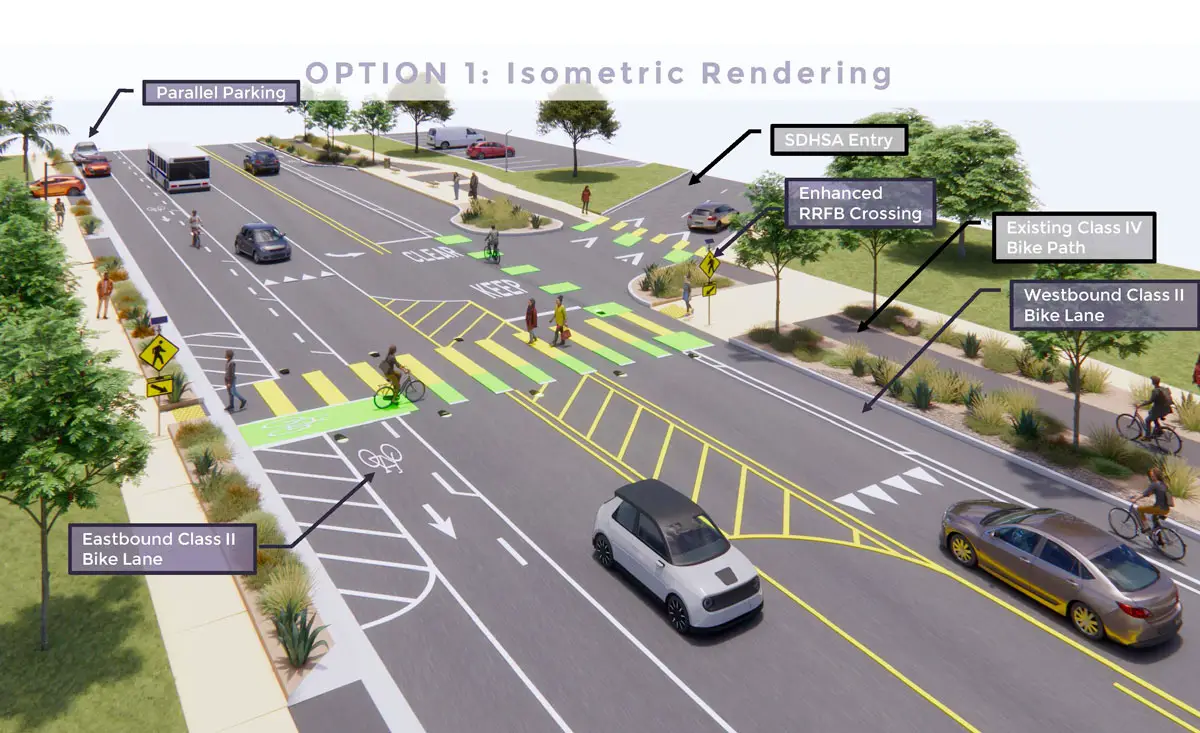
The original Santa Fe Drive Corridor Improvements Project narrowed vehicle lanes to 10 feet, added back-in angled parking and installed separated bike lanes with protective barriers. It also included pedestrian improvements and traffic-calming measures intended to reduce speeds and improve safety near San Dieguito Academy, the city’s largest high school.
Under SB 114, Encinitas could not remove or modify the protected bike lanes for at least five years after the project’s completion. From five to 15 years, the city could remove all or part of the bikeway only if it repays the full $3.09 million and demonstrates that the changes would provide equal or greater safety, accessibility and mobility for pedestrians and cyclists.
As a budget-related bill, SB 114 can take effect immediately if signed by the governor.
Blakespear said her efforts reflect a longstanding commitment to pedestrian and bicycle safety, not an attempt to override the current council.
“The through line of all my public service is to try to make it safer to bike and walk on our streets,” Blakespear said. “I’m grateful to be able to ensure that Santa Fe will remain a safer corridor and the city won’t be able to revert or change it to an unsafe roadway.”

While citing other examples in cities around the state, Blakespear acknowledged that the Santa Fe Drive controversy helped shape SB 569, which originally addressed homeless encampments and was initially supported by the Encinitas City Council.
On June 11, Blakespear used a procedure known as “gut and amend” to replace the bill’s contents with language governing changes to bicycle infrastructure statewide.
Although SB 569 did not specifically mention Santa Fe Drive, the project fit the type of state-funded bikeway the revised legislation sought to protect from removal. Encinitas opposed the amended bill, as did several other local groups concerned about local control.
Supporters, including San Diego County Bicycle Coalition and SanDiego350, argued the measure was needed to prevent cities from removing safety improvements because of political pressure or changes in elected leadership.
Ehlers traveled to Sacramento to oppose SB 569 before the Assembly Transportation Committee, where he learned that even if passed, the bill would not retroactively prevent the city from proceeding with its Santa Fe Drive redesign.
SB 569 advanced to the Assembly floor but was moved to the inactive file on Aug. 31 without receiving a final vote, effectively killing it when the legislative session ended.
The provision in SB 114, however, applies directly to the $3.09 million appropriation from the state’s Active Transportation Program for the Santa Fe Drive Corridor Improvements Project.
“This is her second sleight of hand she’s used to usurp control of our own streets,” Ehlers said.
Blakespear said the conditions are consistent with those imposed under the Active Transportation Program and disputed the city’s claim that it should be free to remove infrastructure built with state money.
“(The council majority) thinks they have the ability to do anything they want,” Blakespear said. “But the state has the ability, as it does for matters of statewide concern, to keep our streets safe.”
“The proposed removal of the protected bike lane along Santa Fe Drive was retribution against me, and it came at the expense of community safety,” Blakespear said.
On Aug. 29, the city sent a letter asking the governor to line-item veto the Santa Fe Drive provision. The city argued that no such restrictions were attached when it accepted the money, describing the new conditions as changing “the rules in the middle of the game.”
“When the City accepted the appropriation and when the City entered into contracts with Caltrans for the project, there were no stipulations attached to accepting the funding,” the letter states. “The amendments … three years after the appropriation … put the City and our residents in an impossible position.”
The city also contended that the provision amounts to retroactive and special legislation targeting a single municipal project.
Budget trailer bills, which make changes tied to state spending, became more common after California voters approved Proposition 25 in 2010, allowing them to pass by a simple majority rather than a two-thirds vote.
Critics argue that the process can be used to enact major policy changes late in a legislative session with limited public scrutiny. In response, voters approved Proposition 54 in 2016, requiring bills and amendments to be publicly available online for at least 72 hours before a vote.
For Ehlers, the late addition of the Santa Fe Drive restrictions exemplifies what makes the trailer bill process controversial: Policy can be inserted in the closing days of a legislative session, leaving local governments and the public little time to respond.
“She is using devious methods to impose her past mistakes on her own electorate,” Ehlers said. “Bottom line.”
Santa Fe Drive debate
The legislative battle is the latest chapter in the dispute over Santa Fe Drive.
Planning for the corridor began in 2015 and continued through Blakespear’s tenure as mayor from 2016 to 2022. After winning her state Senate seat, Blakespear helped secure about $3.1 million in state funding for the project.
Construction of the western phase began in January 2024 and finished in April 2025, about nine months behind schedule.
Upon completion, the redesigned roadway quickly became controversial. Some residents and city officials raised concerns about congestion, emergency vehicle access, parking and conflicts among motorists, cyclists and pedestrians, prompting the city to terminate the eastern phase contract.
Staff evaluated the completed western phase through site visits, video monitoring and a survey of more than 1,000 people. The review found support for the bike lanes, sidewalks and midblock crossing but widespread dissatisfaction with back-in parking, narrow travel lanes, traffic and emergency access.
The U.S. Postal Service even suspended delivery to 24 homes along Santa Fe Drive after determining the reconfigured roadway was unsafe for carriers.



4 comments
Blakespear – so slimy and power hungry. Ever notice how her helmet rides too low on her forehead? Compare it to the other riders. She doesn’t want her face covered in front of the camera. She doesn’t even use the bike lanes she clings to so desperately.
Pituco1 you must not drive our streets, or you would have noticed that the potholes are being filled and the streets are repaved a full year ahead of Kranz’s foot dragging schedule.
Leucadia drainage is finally being fixed correctly, not with the in adequate Band-Aids Kranz proposed. The last time there was severe flooding Kranz visited ruined businesses and homes after Ehlers did and identified himself as simply “Tony with the city,” not as mayor.
Your “sleight-of-hand“ claim against Ehlers is false. Unlike Blakespear and Kranz before her, he conducts the public business in the public eye.
I’m surprised Mayor Bruce isn’t in favor of sleight of hand. That seems to be his specialty.
IMO he shouldn’t be constantly inserting himself in regional campaigns if, as he stated, he will be mayor of Encinitas and not seek higher office.
Focus on filling potholes and hoping the drainage in Leucadia is completed before heavy rains begin.
Catherine Blakespear.
The grift that keeps on grifting.
Vile human being.