ENCINITAS — The Encinitas City Council continued its discussion of e-bike safety on Aug. 19, directing staff to explore additional education, enforcement and infrastructure measures as the increasingly popular mode of transportation raises concerns about rider and pedestrian safety.
The council did not adopt new regulations but asked staff to examine several possibilities, including dedicated routes for children traveling to school, restrictions on bicycle use on certain trails, additional law enforcement strategies and potential changes to state law that could expand the city’s regulatory authority.
Other options outlined in the staff report included prohibiting e-bikes in city parks, restricting their use on sidewalks, requiring riders to dismount when yielding to pedestrians and establishing a nighttime e-bike curfew for minors younger than 16.
Unlike several cities in the county, including neighboring Carlsbad and San Marcos, Encinitas has not prohibited children younger than 12 from riding Class 1 or Class 2 e-bikes under the authority granted by Assembly Bill 2234.
The San Diego County pilot program allows local governments to enact such restrictions through Jan. 1, 2029. According to the staff report, six cities in the county have adopted a minimum riding age of 12.
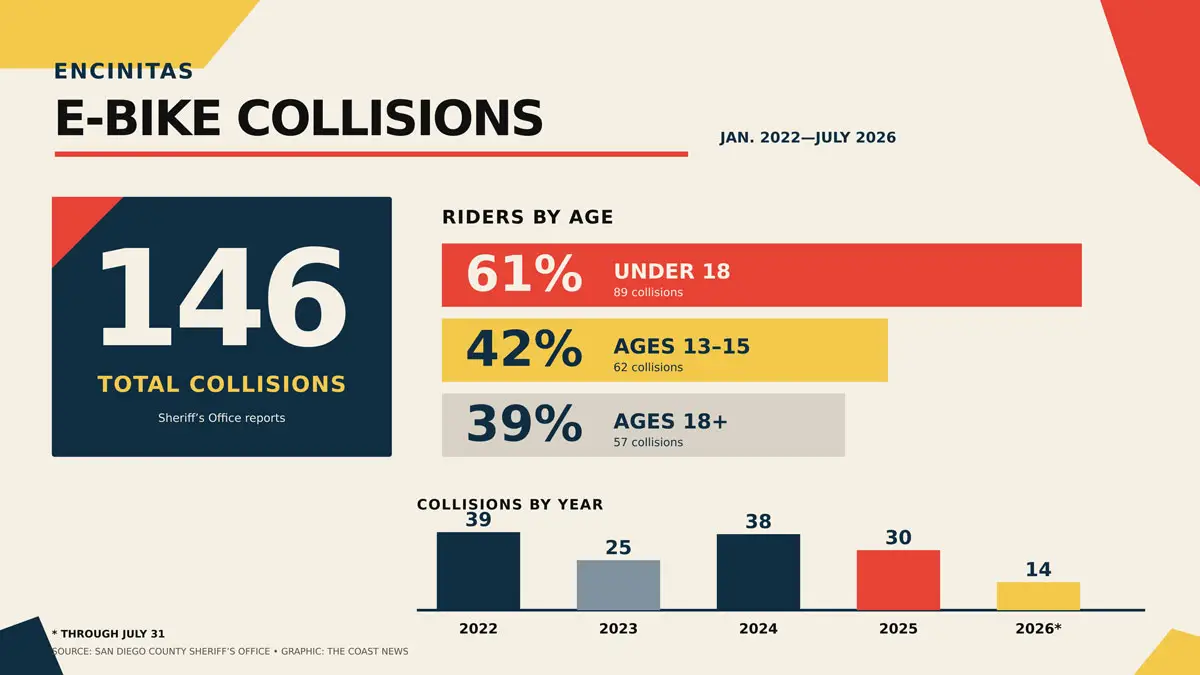
Sheriff’s Office data showed 146 e-bike collisions in Encinitas from Jan. 1, 2022, through July 31, 2026. The annual totals were 39 in 2022, 25 in 2023, 38 in 2024, 30 in 2025 and 14 during the first seven months of 2026.
Of the 146 collisions, four involved children ages 10 and 11, while six involved 12-year-olds.
Riders ages 13 to 15 accounted for 62 collisions, or more than 42% of the total. That age group was involved in more documented collisions than all riders 18 and older, who accounted for 57.
Seventeen additional collisions involved riders ages 16 and 17. Altogether, riders younger than 18 were involved in 89 of the 146 collisions, or about 61%.
Capt. Shane Watts of the North Coastal Sheriff’s Station said that of the 14 e-bike collisions reported through July 31 this year, seven involved adults and seven involved minors. The Sheriff’s Office also documented 13 collisions involving conventional bicycles during the same period.
Two of the e-bike cases involved riders in their 70s falling from their bikes, which is classified as rider fault, Watts said.
He said only three of the remaining 12 collisions were determined to be the e-bike rider’s fault.
“That’s really part of the conversation,” Watts said. “As we have more of these ebikes on our roadways, we also need to enter the conversation of making sure that our drivers are more aware as they’re passing an e-bike, that’s not the same as passing a pedal bike because that e-bike’s going 20 miles an hour.”
Under state law, Class 1 e-bikes provide pedal assistance up to 20 mph, while Class 2 models can use a throttle and are also limited to 20 mph. Class 3 e-bikes provide pedal assistance up to 28 mph and may be operated only by riders 16 and older, who must wear helmets.
All three classes must have operable pedals and motors producing no more than 750 watts.
City officials also distinguished legal e-bikes from electric off-highway motorcycles, sometimes marketed or described as e-bikes. Vehicles without operable pedals or with motors and speeds exceeding legal e-bike limits cannot be operated on streets, sidewalks, bike lanes or bike paths, according to the staff report.
Encinitas already allows the Sheriff’s Office to impound bicycles for reckless operation or unsafe passenger transport. City and state laws also prohibit carrying passengers on bicycles not designed for them, and first-time offenders may be allowed to complete an approved safety course instead of paying a fine.
The city offers two safety classes each month at the Encinitas Community and Senior Center. The program includes an hour of classroom instruction, an hour of riding practice in the parking lot and a supervised ride on nearby streets.
Councilmember Joy Lyndes said she would like to see similar classes for motorists to help drivers better understand how to share the road with e-bike riders.
Deputy Mayor Jim O’Hara agreed that the city should use all available tools, including social media, libraries, community centers, pamphlets, banners and point-of-sale locations, to communicate with road users.
“I think the city itself – for vehicles and for riders – needs to do a huge public education push,” he said.
Councilmember Luke Shaffer said he would like the city to explore “dedicated roadways for bikes to be on where we can push the schools, push the parents, push everybody to start using those roads” without cars as a safety measure.
Shaffer added that while his children do not ride e-bikes, he would prefer that they follow safe practices and avoid interactions with vehicles.
“If they are on one, if they chose to do that, I told them to ride on the sidewalk if necessary because I’d rather keep them alive and pay the ticket than watch my kid die,” he said. “These roadways are for adults doing adult things and following all the laws of our road.”
Ultimately, Shaffer said parents bear most of the responsibility for ensuring minors ride e-bikes safely.
“That is your job. That is your job – your job, not our job,” he said. “We’re trying to do our part, but you have to do the job back.”
O’Hara agreed that the city should further explore Shaffer’s proposal for dedicated bikeways.
“Clearly we need to designate safe routes to school and that’s a discussion we need to have in more depth,” he said. “I’d really like to get that discussion going and really dedicate [meeting time] to the idea of where kids will be, where they should be and how we can keep them safer in any capacity going to and from school.”
Lyndes, a landscape architect, said the city should consider prohibiting both e-bikes and pedal bikes on certain types of trails because “bikes can really create erosive situations which degrade the quality of the trail.”
“Certainly we want our bike riders to be safe and certainly if there aren’t vehicles around them that’s safer, but I know not all of our trails are equal and not all of our trails are designed equally,” she said. “Some are trails that are narrow and meant more for wildlife viewing or to get out in nature. Also I believe that bikes – any kind of bike – and animals don’t mix, whether that’s wildlife or dogs. So even though we say trails and we think we all know what we mean, we’ve got lots of different kinds of trails.”
Mayor Bruce Ehlers said he would like the city to conduct additional at-fault analysis to better understand the causes of collisions.
“We’re going to actually have to have some honest investigations that look at who caused the problem and what do we do to change that behavior wherever it is. So the at-fault analysis, it’s hard. It’s hard when people are hurt, certainly when people are killed. It may take years to correlate that data and really get to the bottom of it.”
Councilmember Marco San Antonio said enforcement could be an effective tool and suggested that the Sheriff’s Office conduct e-bike enforcement operations similar to its monthly operations targeting motorists.
“Kids start to go, ‘Dang I got a ticket,’” San Antonio said. “‘They’re out there, they actually are watching us now.’ That becomes, for me, another deterrent for them to start acting right. I just think there needs to be a way that these kids are accountable as well as the parents that that ticket is coming.”
Watts said enforcement, education and a visible law enforcement presence would remain part of the effort.
“I’ve said it many times: I’m committed to vision zero,” Watts said. “That will always be my goal to have vision zero. That comes a lot from me and that’s the enforcement, the education and being present out there.”
O’Hara and Ehlers said they would support lobbying state lawmakers to allow Encinitas to participate in AB 1778, a pilot program currently limited to Marin County.
The law allows local governments in Marin County to prohibit riders younger than 16 from operating Class 2 e-bikes and require all Class 2 riders to wear helmets. The pilot program is scheduled to remain in effect through Jan. 1, 2029.
Others warned about the potential consequences of adding too many laws.
Resident Judy Berlfein said during public comment that the city should be careful to avoid “unintended consequences” from any new regulations.
“Let’s think about what we want for our kids,” Berlfein said. “I think we want autonomy and independence. We want everyone to be safe and not just kids, we want old people to exercise also. So let’s ban as few things as possible and focus on our goals.”
Resident Molly Hintlian said she worried that additional laws could be difficult to communicate to road users.
“My biggest concern with signs is sign blight,” Hintlian said. “We have so many signs happening in our city. I just don’t know how we’re going to fit more signs telling people … not to ride on the sidewalk.”
Shaffer also questioned whether additional regulations could be effectively enforced.
“We can put out more rules, and now people are just breaking more laws,” Shaffer said. “And I don’t really see [the Sheriff’s Office] being able to really enforce the totality of what we’re putting here. So, we’re going to come up here and make a bunch of laws that ultimately come back to the same parents, schools, dedicated roads, all the same things that need to happen anyway.
“You’re not going to save any more lives if they’re just going to be breaking the rules anyway. I’m all about creating more rules if we want to, but we’re just going to have that many more people breaking more rules.”