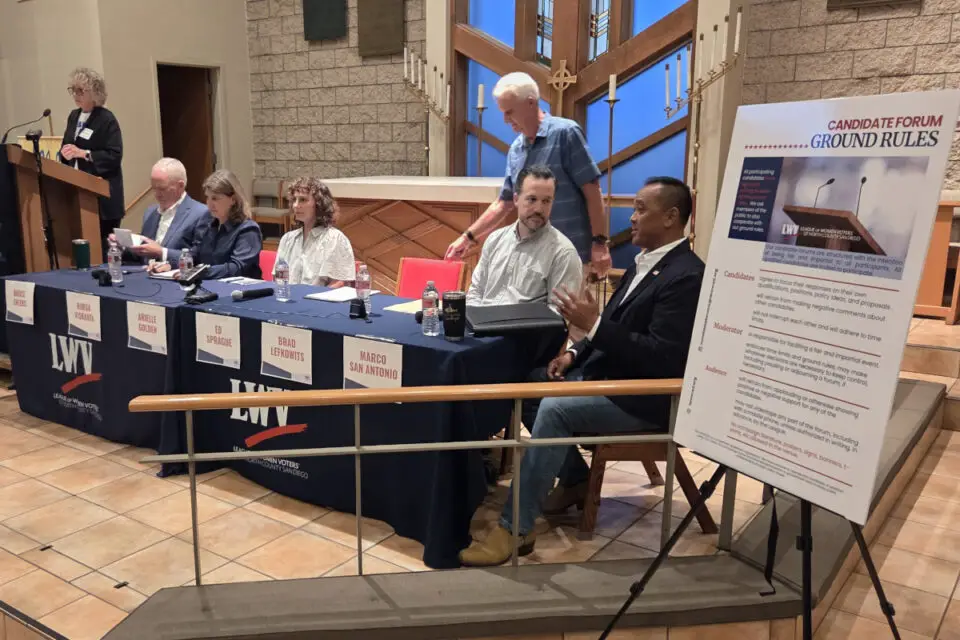
ENCINITAS — All six candidates for Encinitas City Council, including the two running for mayor, showed up Thursday evening to answer voters’ questions at St. Andrew’s Episcopal Church.
Concerns about public safety, new development and homelessness not only dominated the submitted questions but were also prominent in the candidates’ opening and closing statements.
Organized by the nonprofit League of Women Voters of North San Diego County and hosted by St. Andrew’s, the Sept. 17 forum attracted a full house of interested residents.
A moderator read the questions and explained during the opening that, with many overlapping questions among the 52 submitted ahead of time and only 90 minutes for the program, many had been combined into a single, but perhaps more complicated, question.
Attendees were asked not to applaud or boo during the forum, but to wait until the end to applaud all the candidates for showing up. That rule mostly held, although spontaneous cheering broke out briefly after one answer early in the program before the moderator reminded everyone of the event guidelines.
Candidates were timed during their responses, and the order in which they answered questions was randomized throughout the evening. Each candidate was given one minute for an opening introduction.
Councilmember Marco San Antonio, who is running for the District 4 seat, said he comes from an immigrant family and has lived in Encinitas since he was 5. As a teenager, he worked for years at his father’s sign business on Coast Highway 101, which he later took over.
Arielle Golden, who is seeking the District 3 seat, said she moved to town 13 years ago and is raising her family here. She identified street safety as one of her priorities.
“I want to make our streets safer,” she said.
Ed Sprague, also seeking the District 3 seat, told the audience he moved to Cardiff with his family in 1977. He said preserving local control over development and making streets safer are his main priorities.
Mayoral challenger Rimga Viskanta said her experience serving on two school boards gives her a proven track record of improving finances and turning “deficits into surpluses.” She also said safer streets are a priority.
Brad Lefkowits, who, like San Antonio, is running for District 4, introduced himself as a small-business owner. He said housing is a top priority and challenged calls for local control without a broader strategy.
“Simply repeating the phrase ‘local control’ is not a plan,” Lefkowits said.
Bruce Ehlers, seeking another term as mayor, said he wants to preserve Encinitas’ small-town beach atmosphere and that opposing excessive development is key. He also emphasized his record in office.
“I get stuff done,” he told the crowd.
The first question, which candidates were given 90 seconds each to answer, asked which priority they were willing to sacrifice among building new housing, maintaining the city’s character, keeping up with infrastructure maintenance, improving traffic and keeping taxes low.
San Antonio was selected to answer first and said he would prioritize road maintenance, including drainage systems.
“These are paramount to keeping our city running,” San Antonio said.
Golden explained that city leaders must weigh competing priorities, but added that she would like to address the city’s fee structure.
“The business of running a city is always a balance of all these,” Golden said.
Sprague disagreed with the premise of the question and suggested negotiating higher levels of affordable housing from developers for new housing projects.
“I’m pushing back on the concept that we need to further urbanize,” Sprague said.
Viskanta said maintaining infrastructure is part of a local government’s public safety responsibilities.
“Public safety is the first order of local government,” Viskanta said.
Ehlers said state housing mandates cast a shadow over all the other issues.
Lefkowits argued that Encinitas has already accommodated significant housing developments compared with nearby cities and building them will require additional infrastructure.
Encinitas, he said, “has built as much or more housing than any of our neighbors,” Lefkowits said.
The second question was on the hot-button issue of federal immigration enforcement within city limits. Sprague pointed out that immigration enforcement is a federal responsibility, although he said it can be very disruptive to affected families.
Viskanta suggested holding an immigration town hall to connect families with local resources.
Lefkowits said the city’s official website wasn’t being honest about federal operations, while Ehlers defended the site.
“What you see are facts,” Ehlers said.
San Antonio said the level of immigration enforcement in Encinitas largely stems from the city’s proximity to an international border.
Golden took the strongest tone, criticizing federal immigration enforcement in the community.
“ICE is terrorizing our community,” said Golden, before acknowledging the limits of the city’s authority over federal enforcement. “There is nothing the city can do to interfere with ICE actions,” Golden said.
One question was directed only to the two mayoral candidates, asking what, if anything, they could do to make City Council meetings more professional and civil.
Viskanta pointed to her experience as a school board president and said adhering to established procedures helped maintain order.
“The way I brought order was I followed the rules,” Viskanta said.
Ehlers said that as mayor, he has used “Robert’s Rules of Order” to ensure First Amendment free speech principles are followed without allowing anyone to disrupt a meeting. He said the city is also developing additional meeting standards.
“We are working on a code of conduct,” Ehlers said.
The next question asked all six candidates how the city can improve traffic safety, including bike lanes and e-bike helmet laws.
Viskanta said a 2025 study mapped the city’s most dangerous road segments and intersections, and that the city should partner with the school district to hold students accountable for misusing their e-bike riding privileges.
Ehlers pointed out that the City Council recently funded additional traffic deputies with the San Diego County Sheriff’s Office to step up enforcement.
San Antonio said he favored initially focusing on educating underage e-bike riders before turning to enforcement.
“Education first, and then enforcement,” San Antonio said.
On a series of yes-or-no questions, all six candidates said “yes” when asked if they supported making it possible to fine parents for their underage children’s e-bike infractions. All six also said “yes” when asked whether the city should bring back red-light cameras.
On another either-or question, the candidates diverged on whether they preferred a “housing first” approach to addressing homelessness or “treatment first.” Golden and Lefkowits supported housing first, while the others preferred treatment first.
All six also supported a new trail in Olivenhain.
On what the city should do to prepare for a predicted “Super” El Niño this winter, the candidates offered a variety of thoughts.
Lefkowits said the city’s current policy of requiring property owners to manage stormwater on their property might be less efficient than charging a fee that could fund stormwater management across an entire neighborhood.
Ehlers said the City Council is receiving a report next week on storm preparation for this winter. San Antonio said he felt the city should focus on long-term storm preparation, not just the upcoming storm season.
Golden said she was interested to see how the city’s shoreline holds up this winter and also said the city should look at permeable surfaces in the future to help manage storm runoff.
Sprague pointed out that the city’s beaches lost sand this summer, when sand normally accumulates before winter storms wash it away.
The next question was about Flock-brand license plate scanning cameras on the city’s streets.
Ehlers and Sprague said they largely supported their use, with Sprague conceding that regular audits should be ordered to ensure they are being used properly. Ehlers said his concerns were more with Flock and how the company handles collected data than with the technology itself.
The other candidates all voiced opposition or serious reservations about the cameras. San Antonio described them as “an invasion of privacy.”
Viskanta framed the issue as a constitutional concern involving protections against unreasonable searches.
“It’s about the Fourth Amendment,” Viskanta said.
Lefkowits said he wanted the city to hold a public hearing on the issue.
Two more yes-or-no questions then addressed housing and development issues.
All six candidates opposed granting waivers from environmental review for new housing development, and they also unanimously supported requiring new housing projects to provide off-street parking.
Similarly, all six candidates supported restoring local control over zoning and project approval after recent state laws stripped local jurisdictions of some land-use decisions.
On whether they supported using accessory dwelling units, or ADUs, to provide infill housing, all but Ehlers said yes.
The final question was how the city should deal with chronically homeless people who refuse services or to move into a shelter.
Sprague pointed out that during his career as a firefighter and EMT, he answered hundreds of calls involving homeless people in distress and said substance addiction was common among those he encountered.
“The vast majority were addicted,” said Sprague, adding that even people struggling with addiction should have to follow basic rules.
Viskanta said recent legal decisions have given local jurisdictions more freedom to approach homelessness in different ways. She argued that requiring treatment can itself be compassionate.
“Forcing people into treatment IS a compassionate act,” Viskanta said.
Lefkowits said the city should focus on enforcing existing laws.
Ehlers argued that simply providing housing without addressing substance use does not adequately help people experiencing homelessness.
“It’s not compassionate to just put them in a house and let them do drugs,” Ehlers said.
San Antonio said the city needs to find the right partner to provide effective treatment and pointed to the San Diego Rescue Mission.
“And we have that in the San Diego Rescue Mission,” San Antonio said.
Golden said she believes the housing-vs.-treatment-first debate represents a false choice and that both are needed.
Watch the candidate forum: