
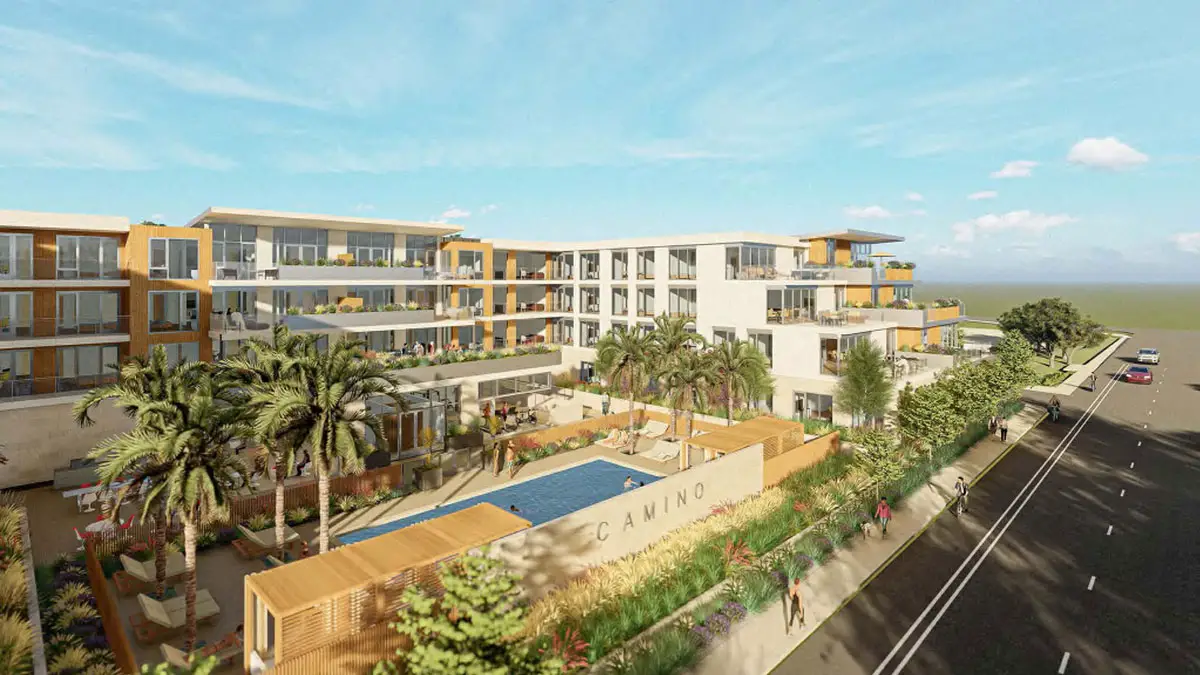
ENCINITAS — The Encinitas Planning Commission approved an 87-unit condominium project along El Camino Real, reviving a stalled apartment complex as for-sale housing after the developer was unable to secure financing for a rental proposal.
The commission voted 3-1 on Aug. 20 to approve a design review permit and tentative condominium map for Camino Condos, a four-story development proposed by El Camino Encinitas LLC and represented by Nolen Communities. The project site is a vacant 1.93-acre property east of El Camino Real and north of Garden View Road, between Armstrong Garden Centers and an office complex.
Commissioner Michael Quinn opposed the project, and Chair Stephen Dalton recused himself because his architectural firm, Stephen Dalton Architects, has received compensation from a client group that includes the project representative, Brian Grover of Nolen Communities.
Dalton said his firm’s previous work involved a separate project and had no connection to Camino Condos.
The project would include six studios, 42 one-bedroom units and 39 two-bedroom units. Of the 87 condominiums, 78 will be market rate, and nine will be reserved for very-low-income households.
The affordable units — one studio, four one-bedroom units and four two-bedroom units — will be distributed throughout the complex and will be comparable in size, appearance and quality to the market-rate homes.
The Camino Condos project is nearly identical in size and design to the Camino Apartments project unanimously approved by the commission in October 2024. The earlier rental proposal included 75 market-rate apartments and 12 units reserved for very-low-income households.
According to city staff, the developer could not obtain financing for the rental project and submitted a new application in October 2025 to build for-sale condominiums.
Since the new proposal includes a subdivision map, it does not qualify for the same by-right approval process as the apartment project. The condos are also subject to the El Camino Real Specific Plan, which the City Council adopted after the original apartment application was filed.
The property’s R-30 overlay zoning allows 58 homes, including nine affordable units required by the city. By reserving those nine homes for very-low-income buyers, the developer also qualifies for a 50% state density bonus, allowing 29 additional market-rate homes and bringing the project to 87 units.
Vice Chair Robert Prendergast questioned why the number of affordable units dropped from 12 to nine.
“What benefit is the city receiving under this new application?” Prendergast asked. “Sounds like we’re going backward.”
Prendergast also questioned the overlap between city and state requirements, which allow the developer to build 29 extra market-rate condos without adding more affordable units.
“This is a pretty large loophole, and we’re seeing no additional benefit,” Prendergast said. “I don’t know if that’s really the intent of the density bonus laws.”

Under state density bonus provisions, the project must provide at least 108 parking spaces — including 16 electric vehicle charging stations — significantly fewer than the 185 spaces normally required by the city.
The developer requested 12 waivers covering building height and the number of stories, private storage, front and side setbacks, tree planting, parking lot landscaping, landscape buffers, street trees, upper-floor stepbacks, building articulation, floor area ratio and retaining-wall design.
Prendergast objected to the staff report describing the project as compliant with Encinitas Municipal Code without also mentioning the requested waivers.
“You wouldn’t need waivers if it was consistent with the code,” Prendergast said. “I think it’s important for people to understand that this project would not be approved as presented unless they got the waivers.”
Under state law, the commission could reject a waiver only if it found the waiver would cause unavoidable harm to public health, safety, the environment or a historic resource.
Staff said those findings could not be made for any of the 12 requested waivers.
City standards generally limit buildings on the property to three stories and 35 feet, with up to 40 feet permitted for rooftop equipment.
For the Camino Condos, each unit would average 898 square feet, and the building would be 50 feet, 6 inches tall at its highest point, including a rooftop structure that conceals the air-conditioning and ventilation systems.
Amenities include a swimming pool and cabanas, indoor and outdoor fitness areas, a resident lounge, pedestrian paths and approximately 9,089 square feet of common open space, the last of which exceeds space requirements under the El Camino Real Specific Plan.
Plans call for 32 trees, or approximately 16.6 trees per acre, rather than the 58 trees that would ordinarily be required under the city’s standard of 30 trees per acre. The developer would also provide four street trees.
The project’s previous tree waiver proposal of 34 trees drew criticism when the commission considered the apartments in October 2024.
“We’re not doing it to save money,” Grover previously said. “If you can find somewhere in the site plan where we could plant more trees, we’ll plant them.”
The property has also been designated as being within a very high fire hazard severity zone, requiring the project to follow more stringent fire safety rules.
Senior Deputy Fire Marshal Jordan Villagomez said the updated requirements include maintaining separation between trees and evacuation routes.
“One of the tree-specific requirements that we did adopt last year is vegetation management … and that’s keeping the trunks of trees a minimum of 10 feet away from the edge of the road, so that we can keep fuel away from the roads during evacuations,” Villagomez said.
Villagomez said the project must also comply with other defensible-space rules, including new “Zone Zero” requirements restricting vegetation within 5 feet of structures.
The developer must also complete a fire protection plan approved by the Encinitas Fire Department before receiving a building permit.
Road access and traffic were also major topics during the hearing. The project would use two existing driveways along El Camino Real and add a 100-foot left-turn lane at the main entrance, shared with Armstrong Garden Centers. Drivers leaving the complex would be limited to right turns.
Commissioner Michael Quinn said left turns and U-turns near the entrance could create a safety hazard.
“I think that presents a problem for traffic, a dangerous problem,” Quinn said.
Resident Ron Dodge, who lives east of the site, supported the project but said the new left-turn lane would hold only about five vehicles and could back up during busy periods.
Dodge also noted that drivers leaving the development who want to travel south would first have to head north and make a U-turn at Town Center or Leucadia Boulevard.
“It may impact traffic, but this too will be survivable,” Dodge said.
For cyclists and pedestrians, the existing buffered bicycle lane would remain, and the developer would work with the North County Transit District on possible improvements to a nearby bus stop.
The project is exempt from review under the California Environmental Quality Act through Assembly Bill 130, a state law that took effect in 2025. City staff said studies found no significant problems involving traffic, air quality, noise, environmental effects, geology or drainage.
The commission unanimously approved the apartment version in October 2024 despite concerns about traffic, parking, density and design. Former Planning Commissioner Rubén Flores appealed, citing the removal of two planted Torrey pines, possible harm to migratory birds and what he considered inadequate scrutiny of the project.
The City Council considered the appeal in January 2025 but lacked the three votes needed to overturn the approval. The council took no formal action, leaving the commission’s decision in effect.
City staff said the site is not a significant wildlife corridor and noted that the two Torrey pines had been planted on a manufactured slope in the 1990s.
Commissioners also raised concerns about buyers using the condominiums as second homes or short-term vacation rentals. Commissioner Bridget Kimball asked whether the homeowners association could be required to include the city’s prohibition on short-term rentals in its governing documents.
Staff said short-term rentals are prohibited in multifamily developments.
The commission’s approval may be appealed to the City Council.
Related Articles:
- Election Q&A with Oceanside City Council candidates October 22, 2024
- The decades-long battle for Ponto reaches a crossroads July 7, 2026
- Election Q&A with Carlsbad City Council, city… October 23, 2024
- Weekly Crime Reports: Encinitas, Del Mar, Solana Beach August 10, 2024
- Del Mar mayor’s late disclosures raise flags in… June 18, 2025
- Weekly Crime Reports: Encinitas, Del Mar, Solana Beach November 13, 2023