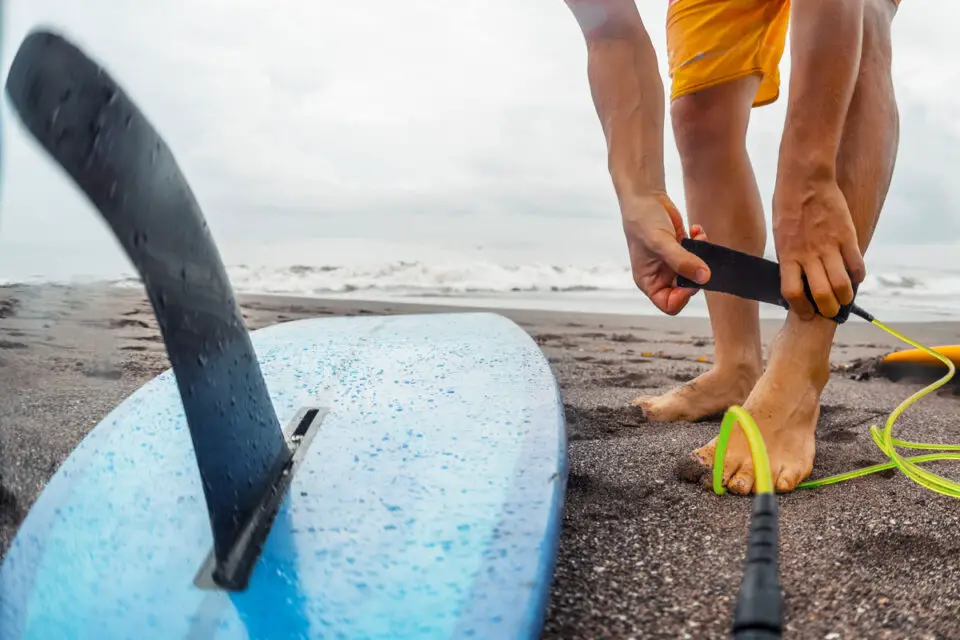
Whether a bodyboard from Costco or a Channel Islands four-fin from Surf Ride, most wave-riding vehicles sold today either come with a surf leash or an attachment for one.
While being within a few feet of your board after a wipeout seems like an obvious solution now, it was not always so. Many surfers resisted the first leashes, saying that they kept inferior surfers from paying their dues by having to swim after a mistimed takeoff.
Windansea surfers were especially slow to warm up to the idea of the leash. They were often called “zing strings” or “kook connectors,” and those wearing them had to suffer the verbal abuse offered by purists, who would say, “Leashes are for dogs.”
Legendary soul surfer Skip Frye never wore a leash, and that was reason enough for many of us, his followers, not to. As a soul surfer, Frye credits much of his fluid style to his surf hero, Phil Edwards. Edwards changed my entire attitude toward leashes forever when he showed me a board he owned, pointed to the leash on it and said, “I wish I had invented that.”
While I was a latecomer to surf leashes, I eventually began wearing them, not to keep me from swimming after my board, but to keep my board from being destroyed on the rocks.
Photo by Kevin Kinnear
Except for some puritanical fish and longboard riders, leashes are pretty well accepted these days. The history of the surf leash, however, is as strange as it is mysterious. While it is generally agreed that O’Neill Wetsuits CEO Pat O’Neill was the first to use a surf leash, some credit Con Surfboards founder Con Colburn with the idea. Others give the nod to Select Surf Shop founder Phil Castagnola.
The invention had barely achieved liftoff when Jack O’Neill lost an eye to a prototype surf leash. The trouble is that the first leashes were made of fly-in-your-face bungee cords and attached to the wrist, rather than the ankle.
The idea of those first leashes being on the wrist initially seemed sound to me, as this gave the rider more leverage when turning. I never tried attaching a surfboard to my wrist and am content to leave things that way.
This story took a weird turn when Chart House founder Joey Cabell dropped in. Cabell’s addiction to adrenalized adventure has brought him many places. In the early 1970s, one of those was Tahiti. There, he ranked among the few nonlocals pioneering those turquoise, island barrels. The waves were perfect, and the water was warm.
The only downside: A lost board could mean a painful introduction to the razor-sharp reef.
The surf leash was virtually unknown at the time, and, according to Cabell, “I had never seen a leash on a board until a local Tahitian paddled out with one attached at his ankle. When I asked about it, he said he had taken it from a pig he had it connected to. The pig was tethered to a stake in the ground by a cord.
“After detaching the cuff from the pig’s ankle, the Tahitian surfer untied the cord from the stake. He then fastened the cuff to his own ankle and tied the cord around his fin. That was the first surf cord I ever saw. Not long after that, a few people where I lived in Hawaii began using them.”
An entire chapter on Joey Cabell will be included in my upcoming coffee table book remake, “Good Things Love Water.”