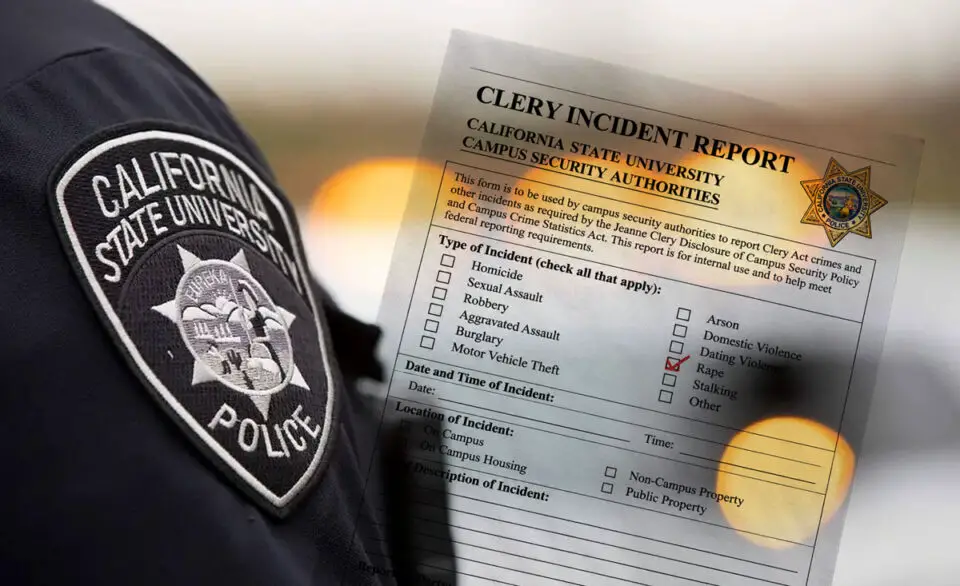
SAN MARCOS — California State University San Marcos said last week that a sixth rape was reported to campus police or the administration since the start of the fall semester, bringing the total number of reported rapes in 2026 to nine.
Campus police logs show three rapes reported during the spring semester. Campus police also took one report of sexual assault and one of sexual battery in 2026. The university recorded three reports of fondling.
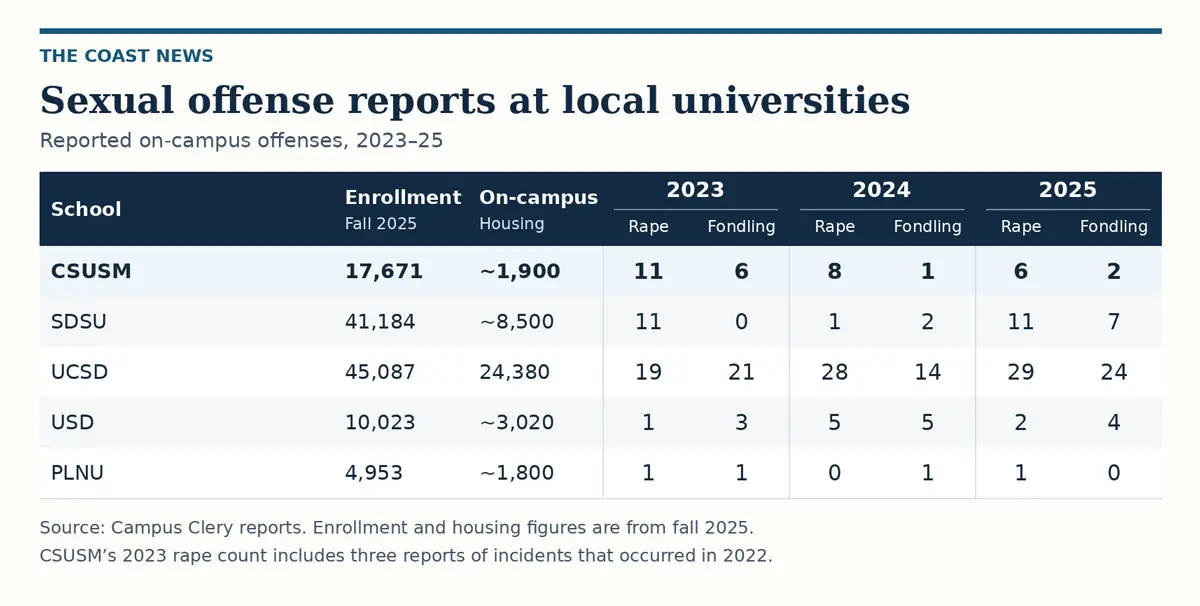
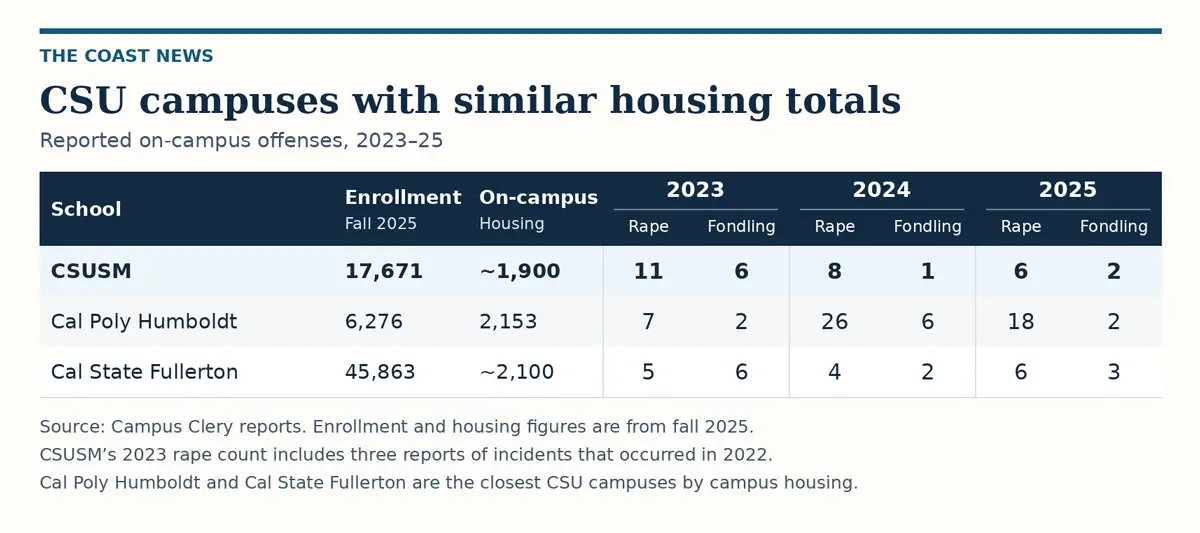
CSUSM recorded six reports of rape and two of fondling in 2025, down from eight reports of rape in 2024, when the university also recorded one report of fondling. The university’s Clery report lists 11 rape reports in 2023, including three for incidents that occurred in 2022.
Campus police logs capture only reports made to police. Some victims report sexual assaults to campus administrators. Fewer than half of victims of sexual violence make any kind of report, according to research cited by the National Sexual Violence Resource Center.
The university emails timely warnings to students, faculty and staff when officials determine that a reported incident meets the criteria for a warning under the federal Clery Act.
In response to a public records request from The Coast News, CSUSM officials disclosed that the university has issued seven Clery timely warnings this calendar year for reports of rape or fondling. Several incidents appear only in the warnings.
Asked about three spring semester incident reports that had no accompanying Clery timely warning, a university spokesperson said by email, “In those instances, criteria for a timely warning were not met.”
It remains unclear how many additional reports, if any, the university received that did not meet the criteria for a timely warning.
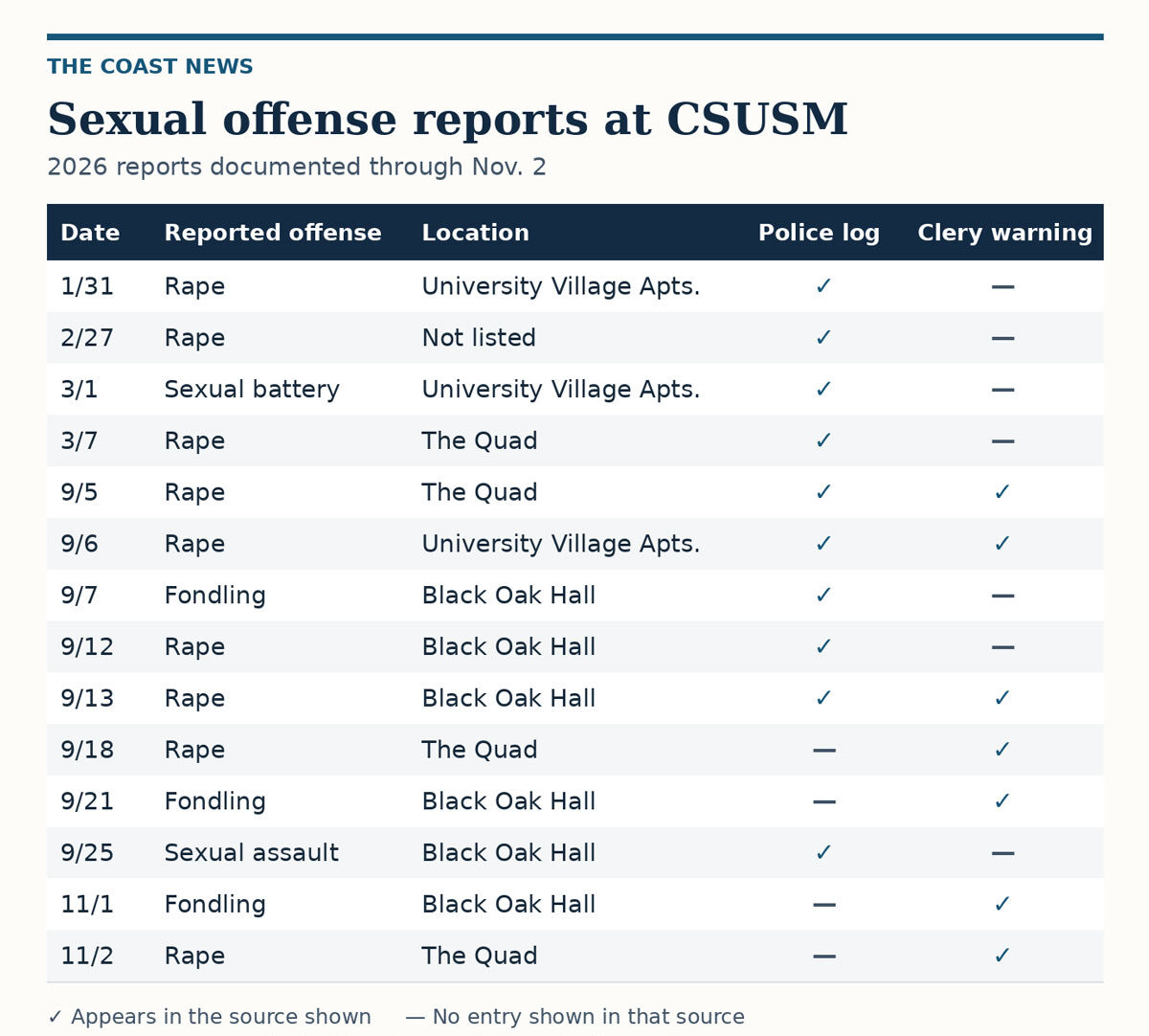
The rise in reports of sexual violence comes as the university has expanded on-campus housing. Eight of the nine reported rapes in 2026 were reported to have occurred in campus housing. The campus police report for the ninth lists the location as “unknown.” Victims reported knowing their assailants.
Black Oak Hall opened in August, adding more than 500 beds to on-campus housing and bringing the total to 2,487.
The increase in campus housing complicates comparisons with previous years because most of the reported rapes and other sexual assaults occurred in student housing.
At other major four-year universities in the region, nearly all reported on-campus rapes also occurred in student housing. The enrollment and housing figures are from fall 2025.
Some CSUSM students said they remain frustrated with the university’s response to the reports of sexual violence on campus.
Associated Students Inc., the elected student government, declined to comment and referred The Coast News to the university communications office.
Two students spoke with The Coast News, but asked that their last names be withheld.
“I think overall what we hear is that students are frustrated. We know that what’s happening is wrong, and people should not have to be afraid to be at school because of sexual assault,” said Haley, a senior CSUSM history major. “People are happy that at least the crime warnings are coming out in a relatively timely manner, but people wish there were more tangible resources.”
Haley said she was surprised that so few of her professors had broached the topic.
“There have been few discussions in her classes about the issue, but it is a hot topic outside of class,” she said. “My friends and I talk about it because a lot of us are finishing up college. And a lot of us don’t live on campus, but being around on campus and taking later classes in the evening, it’s something we’ve talked about more.”
The student said the issue has come up in only one of her courses, a women’s studies class.
“It doesn’t come up in other classes,” Haley said. “I wish it did — because I think it’s important to bring awareness of it. I think it would be great to be more aware of the resources that are available.”
Haley said the university’s planned shift from campus emergency call boxes to a smartphone app for requesting escorts or other assistance comes at a difficult time and that the university has done too little to tell students about it.
“The app is supposed to be easier, but I don’t know how many students know that,” she said. “I always thought the blue lights were more reliable because you know that they’re there and you can see them. If they’re in a parking lot, you can just go up and hit a blue light.
“They’re still on campus, but they have signs saying to switch over to the apps.”
Haley said she generally feels safe on campus but sometimes gets scared walking there at night.
“I’ve been here for four years, and I know how to navigate, and I personally know that I’m always paying attention to my surroundings. I try to stay off my phone on campus; I try to stay in a group when I can,” she said. “It’s scary walking around at night, even though I don’t live on campus, because there are so many reports. It makes you more apprehensive. I definitely think people are more prone to walk with groups now.”
Haley wondered how many students know they can request an escort and said the university should encourage more discussion about campus safety and publicize available resources.
“I think we need to keep talking about it. This is an issue that shouldn’t get swept away, because we are a community on campus and if we keep talking about it and bringing up resources, it gives students more ways to know how to protect themselves,” she said.
Haley also said mandatory training on sexual consent and boundaries should be more rigorous and reviewed at the start of each semester.
Shawn, a junior accounting student who lives on campus, spoke by phone as he walked a woman he knew to a nearby grocery store who felt unsafe crossing campus alone at night.
Shawn said he was upset by the repeated reports of rapes and sexual assault and that women’s fears had affected the mood on campus.
“I don’t like that my school is being known as a ‘rape’ school,” he said.
Shawn said he often discusses the reports with friends and overhears other students talking about them.
“The prevailing theme is feeling disappointment. It’s just shocking that even with the accounts that are reported, people are saying if this is how many are being identified, imagine the others that haven’t been reported.”
Shawn and many of his friends and other students are “feeling disappointed about the types of people who are here,” adding that the university administration should do more to act on student feedback.
“The people feel the school isn’t doing a good enough job,” he said. “It takes a lot more voicing to get our opinions across to get an actionable step from the university. I would say it’s a lackluster job from the university.”