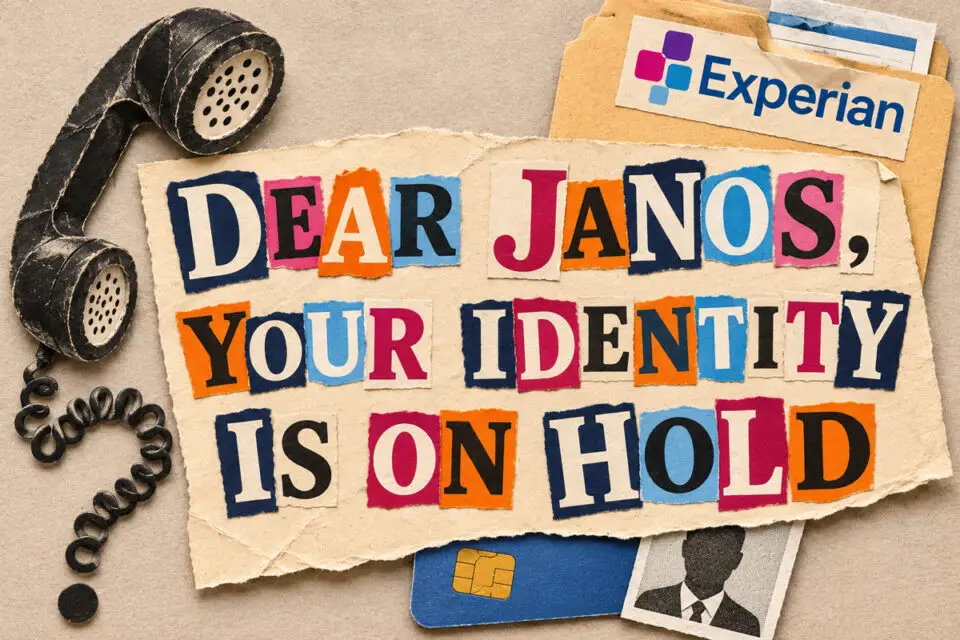
In April, I got an email that said, “Janos, check out the latest updates to your Experian account.”
OK, but my name isn’t Janos.
According to the Better Business Bureau’s customer review rating system, where one star is an “F” and five is an “A,” Experian, one of the “Big Three” credit bureaus in the oligopoly that generates credit scores, has earned an average of 1.07 stars.
That’s right, Experian gets an “F.” If it were a restaurant, it would have closed long ago.
Why all the mad hate? After describing my own experience with Experian and putting it into perspective, I’ll suggest the “F” is the result of a misunderstanding.
So I logged in to my account and, sure enough, there at the top was “Janos Tyller Totelli.” (Each name is an anagram.) The mailing address was in Orem, Utah, and the birth year was 1982. I have socks older than that. The freeze I had placed on new credit had also been lifted.
To secure the account, I changed the username, mailing address and password, then added two-step verification to my cell. Both the old and new passwords are uncrackable.
I was able to correct the address and renew the freeze, but there was no option to change back the birth year or the name on the account. So how had someone changed them?
I called Experian’s customer service department, where I was told its job was to address errors in credit reports, not to deal with “hijacked” accounts. They didn’t know how the changes had been made and couldn’t put my name and birth year back on my account. They advised me to call Membership Services.
When I called the number they gave me, I got a phone tree with options for forgotten passwords and membership IDs, things like that. I said, “agent,” “fraud,” and “representative,” but couldn’t reach a human being.
What to do? I filed a report with the Federal Trade Commission, then checked my accounts with the two other credit bureaus, TransUnion and Equifax. Both were fine.
The same day, I sent a letter detailing the problem, along with copies of my driver’s license, a utility bill, my Social Security card and the comprehensive FTC Identity Theft Report, to Experian’s dispute department by registered mail. Even though the signed receipt came back about a week later, proving they had received the letter, and the Fair Credit Reporting Act obligates them to respond to such disputes within 30 days, they never responded. Not a word.
Then, in July, another email came from Experian: “Janos, your Experian account info recently changed.” Despite the new security measures, someone had changed my mailing address back to Orem, Utah, and again lifted the freeze. How?
I downloaded my July 16 credit report. The name on this report is “Janos Totelli.” The birth year is 1982. The mailing address is in Orem, Utah. The Social Security number is still mine.
This July 16 report shows that someone using eight variations of the name “Janos Tyller Totelli” and seven versions of Utah mailing addresses had applied for credit many times, three successfully. The hijacker, using my credit history and Social Security number, had been issued three credit cards with a combined credit limit of $34,500.
I called Experian again, this time at their corporate headquarters, and chose “dispute credit report” on the phone tree. Eventually, I got through to Luis, a dispute specialist, who first asked me a slew of questions to verify my identity, then corrected everything on my credit account.
Just like that.
It occurred to me that the hijacker may have made a similar call to a dispute specialist, so I asked Luis how “Janos” had been able to log in to my account and alter it. Luis told me that only Membership Services could tell me that. I asked to speak to his supervisor.
Elijah, the supervisor, reiterated that only Membership Services could give me that information. When I told him that my previous call to Membership Services had been a robotic dead end, he acknowledged that in order to find out how “Janos” had hijacked my account, I would probably have to pay for an Experian membership.
Really?
Experian, without my permission, had gathered my credit information and put it into a supposedly secure account with my name on it. Then, months ago, they apparently handed the keys to this secure account to a hijacker who put someone else’s name on it. Experian then sold that fraudulent information to a lending institution that unknowingly loaned thousands of dollars to a criminal. And at last, with this call, I had succeeded in bringing the crime to Experian’s attention.
I honestly thought they would thank me for the tip, apologize for the inconvenience and then, on a pro bono basis, tell me how the account had been hijacked. I wanted to know how the deed had been done, primarily to learn how to prevent it from happening again, but I wasn’t prepared to violate my long-held personal policy of not paying ransom. If anything, they should pay me.
Elijah was very sorry that he couldn’t help me.
A local attorney who specializes in fraud passed on my case after he found out I had not yet lost any money. Thirty percent of nothing is nothing, I guess.
I filed a complaint with the Consumer Financial Protection Bureau. Couldn’t hurt.
Carlsbad police assigned a detective to the case. The detective alerted the FBI’s Elder Justice Task Force and the police in Utah. Well, OK.
The detective told me that, to pursue the case further, he needed a search warrant to access Experian’s records. To get one, he needed to show probable cause that “Janos Tyller Totelli” was not just another innocent victim whose name was being used by the actual thief. To show this, he needed either the IP address or phone number used to hijack the account. This contact information had to correspond to an identity in Utah, not to someone else in, say, Burma.
It seems that Experian is legally prohibited from divulging private information to “non-affiliated third parties” unless a search warrant is presented. I guess even membership isn’t enough.
So: (1) The IP address or phone number the identity thief used to hijack my account is almost certainly in Experian’s records, (2) Experian is not permitted to divulge this information unless they are presented with a search warrant, and (3) the police can’t get a search warrant unless they have an IP address or phone number establishing probable cause that they have identified the thief.
In other words, to get the contact information, you need a warrant, but to get a warrant, you need the contact information. Yes, a catch-22.
Since I spoke with the detective, Experian has sent me the following.
1. Thirteen notifications saying, “Your dispute results are ready,” for three different dispute numbers, but when I go to my account to view these results, I am told these results can’t be viewed online.
2. A message saying I have not established proof of my identity, even though I sent copies of all the documents by registered mail and successfully answered the slew of questions posed by Luis.
3. A message telling me that I have not provided all the details of the identity theft, even though I have sent them everything I have and their records are more comprehensive than mine.
In all three cases, when I try to call them to sort things out, I get a robot-only phone tree with no relevant options that actually hangs up on me after saying, “Goodbye.” The messages are unsigned and say, in place of a signature, “Please do not reply to this message.”
Experian also responded to my complaint to the consumer bureau with a two-page, single-spaced paragraph in 10-point type. It had all the classic stylistic earmarks of an AI-generated document. No fewer than three times it suggested that I call a toll-free telephone number if I had any questions.
I called the number and was told that my call had been erroneously routed to Experian’s promotions department, whatever that is, but that they would get me the right number. When they gave me the right number, I asked which department the number was for. Instead of answering me, they hung up. The number they gave me was 800-555-1212. Go ahead, call it. It’s a recording that says, “The number you have reached has been disconnected.”
Kafkaesque, right?
Let us step back now and view the pieces of this puzzle in perspective.
Over the past six months, it has slowly dawned on me that Experian may not actually be all that keen to help. Why? Here are some possibilities.
First, it is probably cheaper to send out computer-generated letters and emails that say “do not reply” and utilize phone trees that hang up on victims of identity theft than it would be to actually help them. (It even crossed my mind that Experian could be a giant computer with no human employees at all and that even Luis and Elijah are really bots.)
Second, if Experian provides information about “Janos” and he is just another victim, he might sue them for defamation; if they help establish probable cause that he is the hijacker, the ensuing litigation might show they unwittingly helped him commit the crime. Either way, the litigation could be a costly public relations nightmare.
Third, when an account is hijacked, Experian probably doesn’t actually lose any money, so maybe they don’t really care.
Each year, Experian spends a whopping $2 million on lobbying and direct political contributions to members of Congress, especially those on the committees overseeing consumer credit issues. Lobbying them to do what, exactly?
Given the above, it wouldn’t be surprising to find that, behind the scenes, Experian is quietly lobbying Congress to keep the industry’s hands tied regarding divulging information about identity thieves to “non-affiliated third parties.” If you were Experian, you might do the same. I probably would.
Think of it this way: If you sent a letter to your congressman complaining about Experian’s apparent lack of interest in identity theft and Experian sent him a check, which envelope do you think would be opened first?
In any case, I still haven’t been able to learn the IP address or phone number the identity thief used to hijack my credit account. For all I know, “Janos” is an abductee chained to a computer in a call center somewhere in Burma. I have learned one thing, though: I now know why Experian gets an “F.”
About that misunderstanding.
The people who gave Experian an “F” think they are the customers of Experian. They aren’t. They are no more the customers of Experian than sheep are the customers of the shepherd who gathers their wool and sells it. The shepherd’s customers are, of course, those who buy the wool. It is the customers who buy our credit scores that Experian must keep happy, not us. Not the sheep.
An unhappy sheep is just a bleating nuisance.
To stretch the analogy a bit, identity thieves are a bit like ticks. They plague the sheep, not the shepherd. The shepherd can just pass on the wool to the customer, ticks and all. The customer has little choice but to buy it. After all, there are only three companies in the wool cartel.
Stepping further back, such seemingly deliberate obfuscation, while understandable, may be shortsighted. If identity thieves were to learn that a credit bureau is, in effect, covering for them, wouldn’t their numbers grow? In time, these empowered ticks might become endemic in the database.
Hordes of deep-subprime deadbeats could be foisted off as upstanding, super-prime borrowers to unwary lenders. Then, as thousands of fraudulent loans ended in default, wouldn’t those lenders turn to the credit bureau for an explanation, if not reimbursement? Or would the lenders just consider it an unavoidable cost of doing business and simply bump up the interest they charge to us, the honest borrowers?
At some point, even the sheep may look up.
I have a dream that one day, when your credit account is hijacked, you will be able to call the credit bureau, which will (1) confirm your identity, (2) fix the account, and (3) call the police with the phone number or IP address of the party who committed the identity fraud.
Until then, I’m buying stock in Experian.
(Nov. 16 update: This article was sent to Experian on Nov. 9, 2026, along with a request for suggestions. They have kept shtum. Not a word.)
Scott H. Chambers is a cartoonist, co-author of “I, Spastic: The Autobiography of Neil Marcus,” and songwriter who lives in Encinitas.