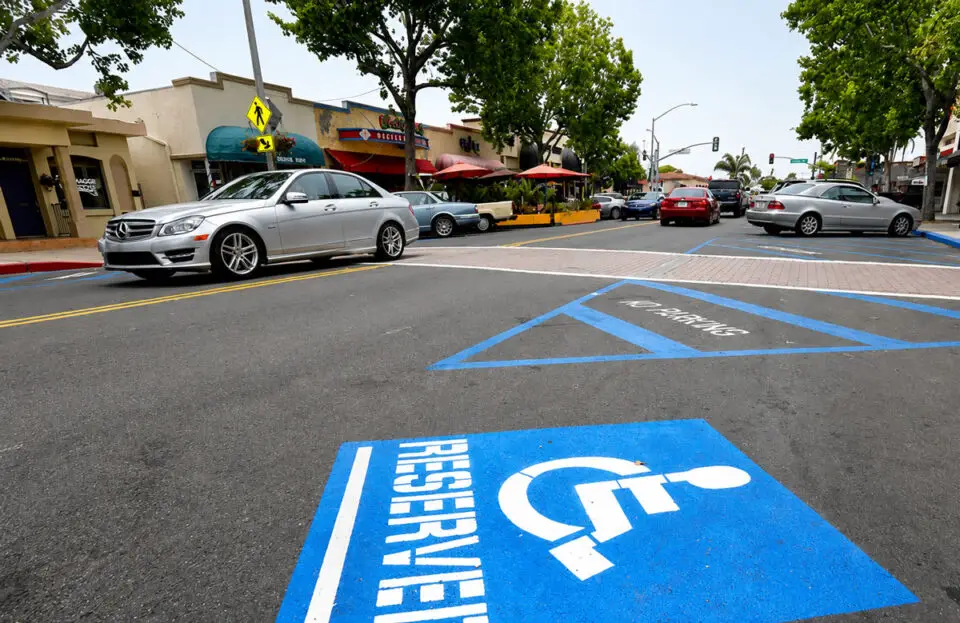
CARLSBAD — The city’s Traffic Safety and Mobility Commission agreed with city engineers’ assessment to leave several Barrio roadways unchanged rather than reconfigure them with diagonal parking.
The City Council directed staff and the commission to evaluate whether wider streets in the Barrio and Village areas — including Pine Avenue, Palm Avenue and Madison Street — could accommodate additional on-street parking through diagonal parking configurations as part of the city’s broader Barrio Parking Improvements Project.
Commission Chair Josh Coelho said the city faces an “uphill battle” in finding more parking in the increasingly popular and walkable downtown but agreed with staff that none of the concepts studied would meaningfully improve the situation.
“This isn’t a couple more problem,” Coelho said, echoing a public commenter’s point about the growth of multifamily housing in the area. “Lets look for dozens and dozens of parking spots because the problem’s not going to get better, it’s only going to get worse.”
Senior Engineer Miriam Jim presented several concepts to commissioners on July 6, including center-running diagonal parking on Madison Street, where vehicles would park in the middle of the roadway with traffic flowing on either side, as well as diagonal parking along one side of Pine and Palm avenues.
The study examined Madison Street between Oak Avenue and Magnolia Street, Pine Avenue between Tyler Street and Harding Street, and Palm Avenue between Madison Street and Harding Street. Staff evaluated roadway dimensions, existing driveways and red-curb areas, traffic operations and the number of parking spaces each configuration would gain or lose.
Jim said staff did not recommend center-running diagonal or center-lane parallel parking on Madison Street because pedestrians would have to cross travel lanes after parking.
An internal review by the city’s transportation, fire and police departments also found that two center-running parking concepts would not leave the minimum unobstructed roadway width required for fire apparatus access under the municipal code, eliminating them from further consideration.
Jim added that diagonal parking could reduce the effective sidewalk width because parked vehicles would overhang curbs and that mixing multiple parking configurations on the same street could create confusion for drivers.
Ultimately, staff determined that none of the remaining layouts would increase the overall number of parking spaces compared with the existing configuration. In most cases, converting one side of the street to diagonal parking would actually reduce the number of available spaces because frequent driveways interrupt the longer curb lengths needed for diagonal parking to be more efficient. Only one configuration on Palm Avenue avoided a net loss, but it also failed to add any new spaces.
John Kim, the city’s traffic engineer, was asked how many additional spaces would justify the cost and construction required to reconfigure a street.
“There’s no magic number, but it should be greater than zero,” Kim said.
All parking concepts that would have reconfigured Madison Street would have required removing painted bike lanes on one or both sides of the roadway.
Commissioner Pete Penseyres, an avid cyclist, said he would support that change in this area.
Penseyres said cyclists will “follow the paint,” believing it indicates safety, even when that may not always be the case, adding that on low-speed neighborhood streets, such as those in the Barrio, cyclists are “totally within the strike zone” of opening car doors next to parallel parking.
Commissioners were only asked to review one component of the city’s broader Barrio Parking Improvements Project.
Kim told commissioners the city continues to pursue other strategies to add parking following the City Council’s adoption of the Barrio Parking Improvements Project in December 2025. One project already underway would convert parallel parking to perpendicular parking on Chestnut Avenue east of Madison Street, while staff will finalize the Barrio Parking Study and present its findings to the City Council in the coming months.
Related Articles:
- Election Q&A with Oceanside City Council candidates October 22, 2024
- Election 2026: City Council candidates questionnaire October 14, 2026
- Election Q&A with Carlsbad City Council, city… October 23, 2024
- Weekly Crime Reports: Encinitas, Del Mar, Solana Beach August 10, 2024
- Weekly Crime Reports: Encinitas, Del Mar, Solana Beach November 13, 2023
- Election Q&A with San Marcos Unified school board candidates October 21, 2024