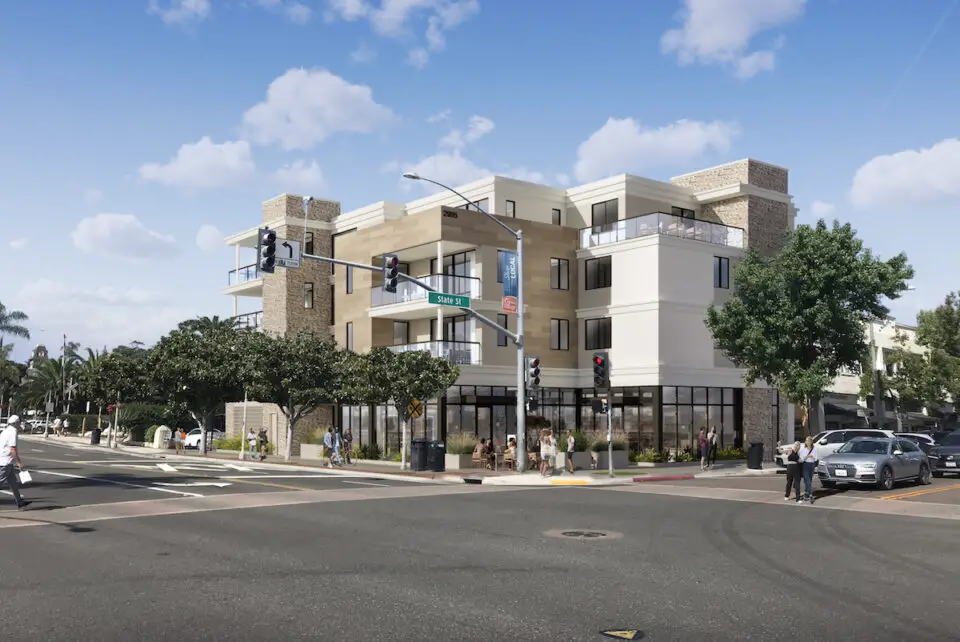
CARLSBAD — The Carlsbad City Council voted 3-1 on Nov. 10 to deny Carlsbad Village Square, a seven-unit, mixed-use development in the Village, despite city officials’ warnings of potentially significant consequences under state housing law.
The developers of the four-story project sought waivers under California’s Density Bonus Law that would allow them to build without commercial parking and modify the upper-floor design, among other changes.
Mayor Keith Blackburn recused himself, citing real estate business interests. Councilmember Teresa Acosta cast the lone dissenting vote, citing concerns about the consequences of violating state law.
Mike Strong, the city’s community development director, said the Housing Accountability Unit within the California Department of Housing and Community Development can ask cities to reconsider project denials or the conditions that led to them.
According to Strong, Encinitas, Elk Grove and San Francisco have recently received such notices.
“The threat is real and HCD has been proactively enforcing it and developers have been challenging cities’ actions to deny projects,” Strong said.
Strong also raised the possibility that the developer could pursue the “builder’s remedy,” which can allow qualifying housing projects to bypass local zoning and density limits.
City Attorney Cindie McMahon said violations of state law could also cost the city grant funding for law enforcement or community development projects.
“The ramifications are pretty broad and pretty painful,” McMahon said.
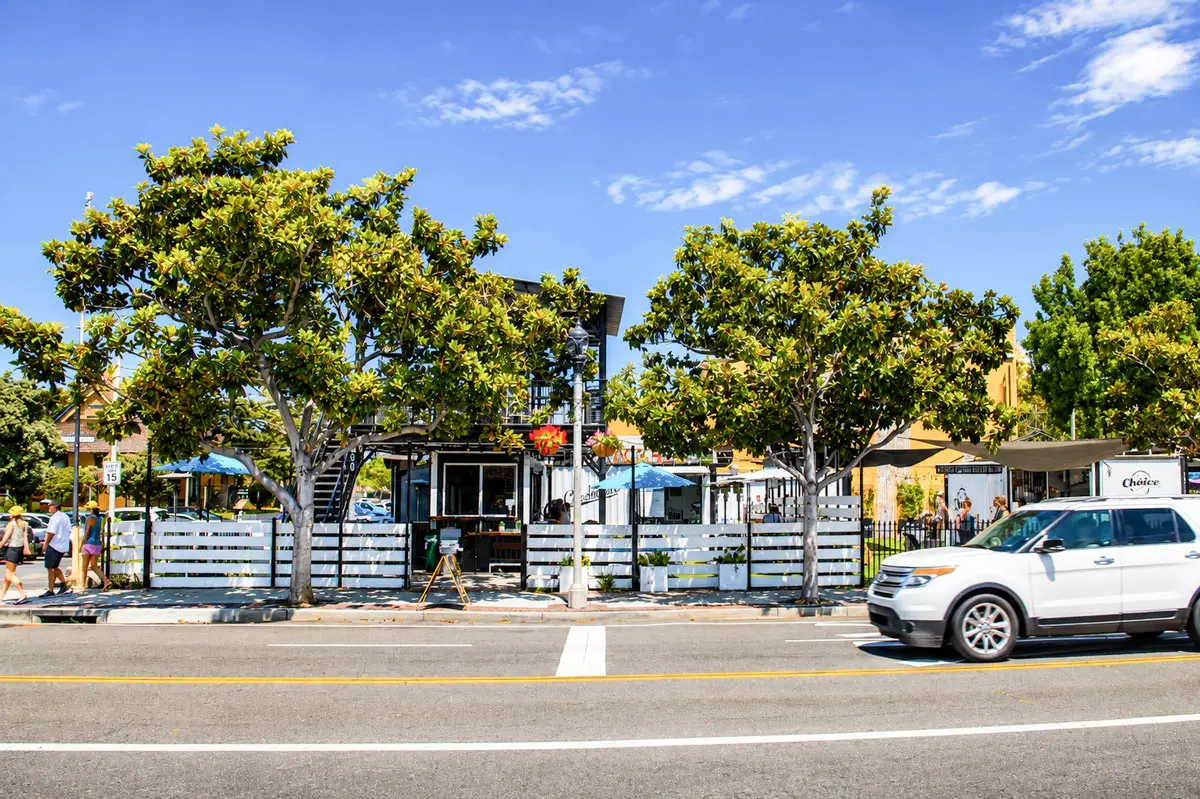
Councilmember Melanie Burkholder, whose district includes the site, said she was concerned about the project’s effect on parking and the character of the Village.
“It ruins the charm and the character of the village,” Burkholder said of the project. “This is a direct example of Sacramento’s umbrella approach to policies that do not fit the city of Carlsbad.
“Ultimately it doesn’t solve the problem that the geniuses in Sacramento created with affordability because these units are not going to be affordable. So it doesn’t solve any housing crisis problem.”
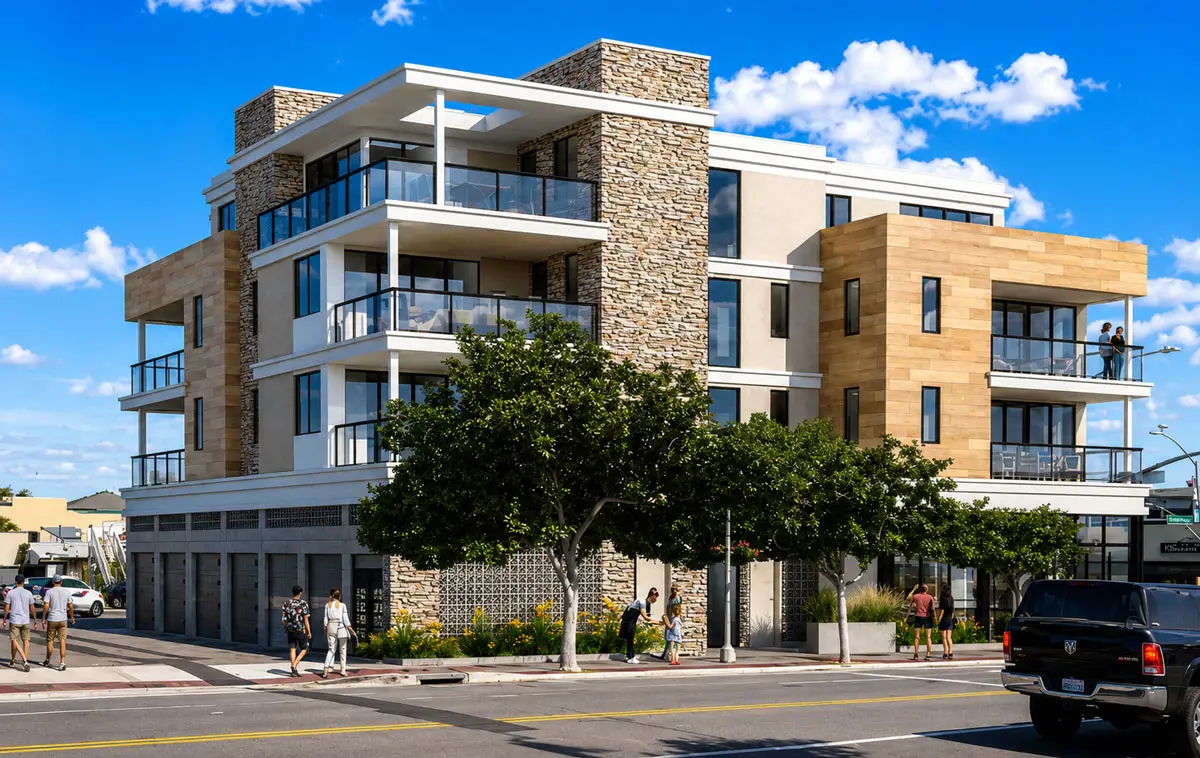
The proposal called for a 19,225-square-foot condominium building with 2,978 square feet of commercial space on a 0.172-acre site where two restaurants now operate out of shipping containers, according to city documents.
The plans called for nine residential parking spaces. Four one-car garages would use mechanical lifts to accommodate eight vehicles, and a ninth space would be accessible to people with disabilities.
The project qualified for the state density bonus because one of the seven units would be deed-restricted for a low-income household. The Carlsbad Planning Commission recommended approval in August.
Kirk Moeller, an architect who spoke on behalf of the project, said the owner bought the property in 1997 with plans to develop it eventually.
“He purchased it for development purposes solely,” Moeller said. “It had sat in a distressed state for many years and he purchased it to develop something nice for the Village at that time.”
Moeller said the owner planned to rent out the units and give the two existing businesses the first opportunity to lease the ground-floor retail space, which could be divided.
In response to a question from Burkholder, Moeller said the development team had yet to finalize construction and traffic management plans and would work with the city to minimize disruptions.
Strong said the city would consider the nearby farmers market and others who use the public right-of-way when reviewing the construction plan. The city’s code enforcement staff would handle violations of any approved plan, he said.
Strange antagonism
In emails and public comments, opponents said the building’s height and scale would be out of step with neighboring properties. Some also questioned whether former automotive businesses on the site had contaminated the soil.
Underground gasoline storage tanks had been removed, and the most recent soil testing took place in 1998 under a now-outdated standard. The staff report described the remaining risk as low and said the “majority of the contamination was removed.”
Christine Davis, executive director of the Carlsbad Village Association, said she worried about how construction would affect nearby small businesses. She pointed to a building facade project on State Street this summer that she said caused an estimated 30% drop in business at neighboring storefronts “due largely to inadequate planning.”
“These businesses have no control over the project yet they absorb the financial consequences,” Davis said.
Councilmember Kevin Shin said state housing laws create a “strange antagonism that we have to deal with.”
He raised concerns about accessible parking and questioned the logic of allowing denser housing along the coast because of its proximity to rail lines.
“We’re watching an erosion of our coastline and we’re going to try to build the most dense amount of housing right up along it,” Shin said.
Acosta said she shared her colleagues’ frustration with state housing laws but said “we cannot expose ourselves as a city to the liability” of potential multimillion-dollar lawsuits. She also said the consequences of the builder’s remedy could extend beyond the project site.
“We have to approve,” she said. “And I’m very frustrated and I’m very sorry, but it is something we have to do for the good of the whole city.”
Mayor Pro Tem Priya Bhat-Patel said the housing affordability crisis has affected a wide range of people, including friends who have moved out of Carlsbad because of housing costs. She said changing state laws that limit local authority would require public pressure across California.
“Tell your friends throughout the state especially,” Bhat-Patel said. “Of course we’re doing what we can here…but the residents of our state are going to be the ones who can make those things happen.”