SOLANA BEACH — For more than two decades, Deborah Freeman worked multiple jobs, flipped distressed properties and steadily built a real estate portfolio she hoped would support her retirement and provide financial security for her family.
Now, the 60-year-old Alpine resident says her life savings — more than $1.66 million — have vanished after she entrusted the proceeds from several property sales to a Solana Beach investment firm founded by Thomas Hinson III.
Hinson’s business dealings connect him to embattled San Diego developer Christian Spicer, whose ventures face at least three dozen lawsuits and contractors’ liens.
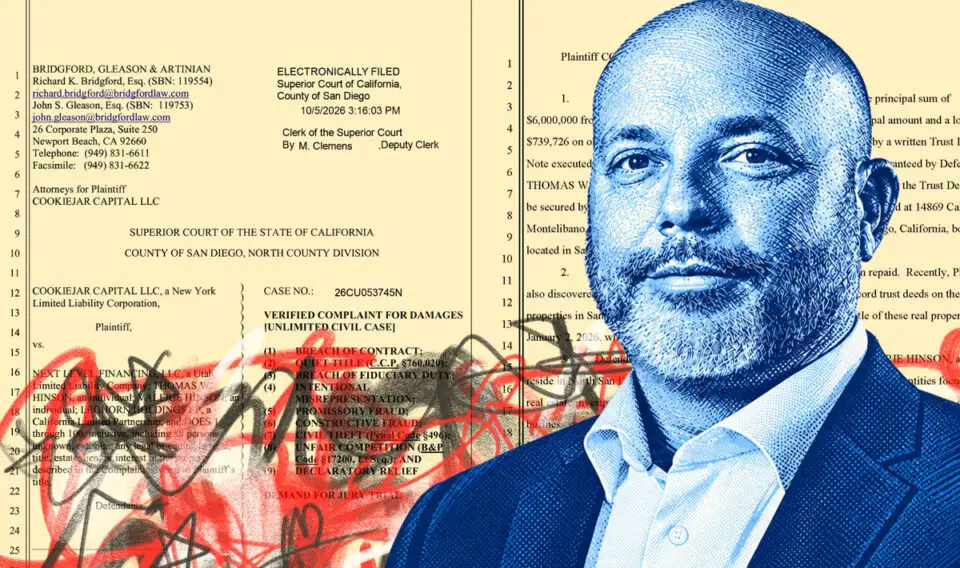
In a lawsuit filed Oct. 12 in San Diego Superior Court, Freeman accuses Hinson, founder and CEO of Investors 1031 Exchange and chief operating officer of Fletcher Cove Capital, of fraud, breach of contract, and unlawfully withholding money intended to purchase a 46-unit apartment complex in Imperial County.
The complaint alleges Hinson diverted the funds to support a large real estate investment operation and finance his lifestyle, leaving Freeman without her retirement savings and exposing her to potential tax liabilities.
“I’m freaking devastated, but I still have to work full time, raise my grandkids, take care of my family, and do all the normal stuff I’ve got to do,” Freeman told The Coast News. “If I work 16 hours a day, every day, until I die, I could not possibly make that up. The trajectory of my entire life has changed.”
Freeman, a licensed marriage and family therapist and nonprofit executive director, said she began investing in real estate in 2001, purchasing neglected properties, completing repairs herself and gradually exchanging smaller investments for larger ones.
She began working with Hinson about 10 years ago and completed as many as a dozen transactions through his company without any problems, she said.
According to court documents, Freeman sold four properties between May and August, including an El Cajon apartment building and properties in Calipatria and Yuma, Arizona. The transactions generated $1,661,026.32, which was transferred to Investors 1031 Exchange.
Under a Section 1031 exchange, a qualified intermediary temporarily holds proceeds from an investment property sale and transfers them toward another qualifying property, allowing the investor to defer certain capital gains taxes.
Freeman planned to use the money to purchase the apartment complex in El Centro. Instead, she alleges, Hinson and his company failed to transfer the funds despite repeated requests from Freeman, escrow officers and others involved in the transaction.
“I beseeched him to please return the money because otherwise I’m going to end up having to choose between medication and food, and he never responded,” Freeman said.
Freeman said Hinson initially blamed banking complications and promised to release the money. Eventually, he stopped responding.
When Freeman visited the company’s Solana Beach office, she found nobody there and contacted the Sheriff’s Office.
Without the funds, Freeman said, she was forced to abandon the apartment purchase.
In a Sept. 29 email included in her lawsuit, Freeman pleaded with Hinson to return her money, explaining that she had spent decades working long hours and reinvesting her earnings.
“I am 60 years old. I have worked very hard for a long time. I can’t afford to lose this money,” she wrote.
Freeman, who reported her missing funds to law enforcement and federal authorities, said she has no separate retirement account or savings sufficient to replace the money.
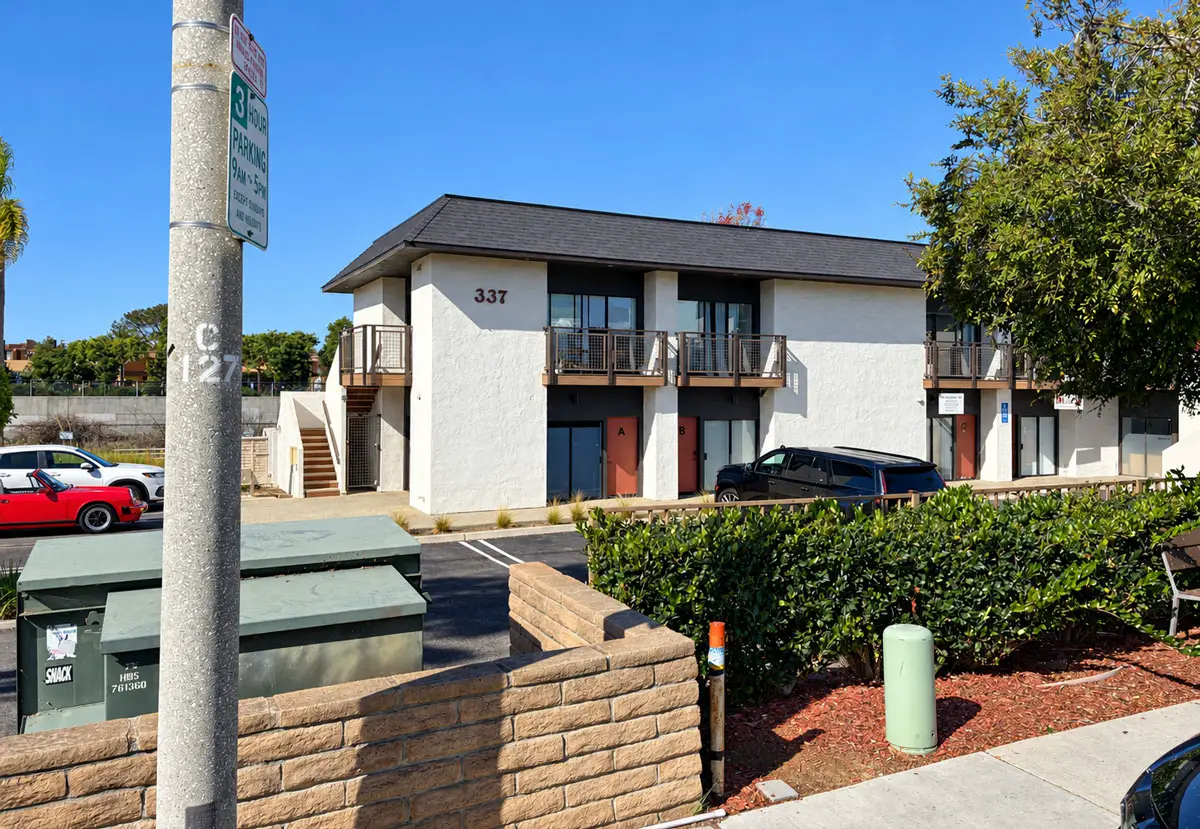
The Coast News made several attempts to contact Hinson through his businesses. One business phone line was disconnected. A secretary at Fletcher Cove Capital said she had been instructed not to take the call and asked the newspaper to place the company’s number on its “do-not-call list.”
The darkened office space of Investors 1031 Exchange along South Cedros Avenue had a desk and brochures, but no one was present on Oct. 26.
A widening trail of allegations
Freeman’s complaint adds to a growing number of allegations involving Hinson and investors whose dealings with Spicer, nicknamed the “King of ADUs” by the OB Rag, brought them into his business network.
Through Investors 1031 Exchange and Fletcher Cove Capital, both based in Solana Beach’s Cedros Design District, Hinson handled property exchange funds and solicited real estate investments, including opportunities tied to Spicer’s SDRE Homebuyers, according to legal filings.
Freeman’s complaint also describes Hinson working with SDRE representative Edward Stepanow to pitch investments in the newly formed Infill Innovation, which investors were told was the parent company of SDRE and its affiliated design, construction and property management businesses.
Pamela Begeal, a retired San Diego contractor, identified many of the complaints and business connections. Begeal has compiled lawsuits, property records and default notices on her website, ADUBonus.org, documenting claims involving Spicer, Hinson and their affiliated businesses.
At least 15 lawsuits have been filed against Hinson this year alone, adding to the legal claims surrounding Spicer and his business network over alleged investor deception, unpaid contractors and unfinished development projects.
As The Coast News previously reported, Hinson was named alongside Spicer in a lawsuit filed by retired teacher Martin Eder, who alleges he invested more than $812,000 in an accessory dwelling unit development that never broke ground.
Another investor, Elizabeth Tobias, told The Coast News she lost nearly $200,000 after Hinson recommended Lakeshore Landing, a proposed 320-unit apartment development in American Fork, Utah.
Marketing documents provided to The Coast News promised investors a 9% annual return and projected substantial profits. Tobias invested $199,367 in July 2024 through Investors 1031 Exchange.
But distributions stopped, and the property was foreclosed on in March, according to correspondence from Tobias and her attorneys.
Tobias said the project’s management, led by Carlsbad-based IMH Companies and executive Edward Monce, repeatedly failed to provide required financial statements or explain how investors’ money was spent.
“There was no paperwork. I received no paperwork; very little accounting throughout the entire investment,” Tobias said.
In an April 2025 letter to investors, Monce attributed the lack of distributions to economic uncertainty and financial pressures, saying the company was preserving capital but remained committed to protecting investments.
Tobias has not filed her own lawsuit.
Court filings also cite prior regulatory actions against Hinson, including a California order barring him from escrow activities over unauthorized disbursements from client trust accounts and a Financial Industry Regulatory Authority suspension for failing to disclose disciplinary actions.
In September, Hinson borrowed $1.3 million against his Rancho Santa Fe home through Val-Chris Investments, according to county records filed Sept. 18. The company assigned shares of the loan to six investors, with the home serving as collateral.
The home also figures in an Oct. 5 lawsuit by CookieJar Capital, which alleges Hinson’s Next Level Financing LLC borrowed $6 million in January, with Hinson personally guaranteeing repayment and pledging the house and a Leghorn Avenue property as collateral.
CookieJar alleges the required paperwork to secure the loan was never recorded and the money was not repaid by the July 1 deadline.
Employees invested, too
Among those seeking answers about investments in Spicer’s developments are former employees of his businesses.
In February 2023, Cameron Etienne, a former employee of ProCal Design and Engineering, invested $80,000 in a San Diego housing development after company co-founder Jesse Leon offered him an opportunity to participate alongside his employers.
Etienne told The Coast News the prospect of investing in projects they worked on was part of the appeal of joining the growing business, founded by Spicer and Leon. The company had just moved into a larger office in Kearny Mesa and appeared to be thriving, he said.
“I thought it was a respectable institution,” Etienne said.
The investment centered on 3346 Lockwood Drive in Serra Mesa, where the developers planned to renovate a single-family home and add rental units.
An early financial projection estimated a $3.23 million sale price, approximately $723,000 in investor profits and a 155% return on investor capital, documents show.
Etienne said the projected returns seemed unusually high, but he believed the investment could succeed even if the developers fell well short of their expectations.
“Even if they miss the mark by half, we’re still positive,” he said.
Etienne initially contributed $50,000 in February 2023, followed by another $30,000, according to a signed addendum to the project’s joint venture agreement. The addendum, obtained by The Coast News, listed nearly $299,000 in total contributions from Etienne, Leon and other participants.
Etienne said many of the contributors were fellow employees.
The underlying agreement, signed by Spicer for SDRE Homebuyers and Leon for JJL Investments, gave SDRE control over development and sale decisions. The documents warned that investors could lose their money.
Later marketing brochures described the Lockwood investment as a six-unit property featuring a renovated main house and five accessory dwelling units, or ADUs. Project costs rose to $2.53 million from an initial projection of $1.62 million.
The property was also refinanced. A February 2025 settlement statement identified SDRE Homebuyers as the borrower on a new $2.23 million loan and listed a refund of approximately $291,000 after the existing loan payoff.
The statement does not establish how that money was spent. An Infill Innovation investor portal statement dated March 31, 2026, listed Etienne’s $80,000 contribution and no distributions.
Roughly three years after his initial investment, Etienne received an email from Shane Katz, vice president of finance at Infill Innovation, saying the property sold for $2.45 million in April, but construction delays and cost overruns left the development at a loss.
“We lost a small amount on this development at disposition,” the email stated. “We are not requesting any additional capital to offset your portion of that loss, despite our documents that allow for such.”
Etienne said he was stunned by the reported loss and the suggestion that investors could have been asked to contribute more money.
“This is outrageous,” Etienne said. “How dare you even imply that you’re going to ask for more money?”
The company offered to transfer investors’ contributions into two other San Diego developments, 1902 Abbe Street and 1905 Burroughs Street, promising to repay their capital and deliver a minimum 8% internal rate of return when the properties sold.
Etienne said investors had already waited roughly three years and still lacked a complete accounting of the Lockwood project’s expenses and rental income.
“The fact that it made zero, the fact that we lost our entire investment, that’s crazy,” Etienne said. “It just didn’t really smell right.”
Spicer declined to comment for this story.
Karlee Ferris, a former investor relations manager at SDRE, told The Coast News that she and her husband, Michael, lost $20,000 invested in the Lockwood project. She said the company’s explanation left unanswered questions about its accounting, including proceeds from the refinance.
Ferris said their loss would not break them financially, but she worried about older investors who had committed far more.
“It’s just really unfortunate,” she said. “For some of these older people that invested, it just it makes me sick.”