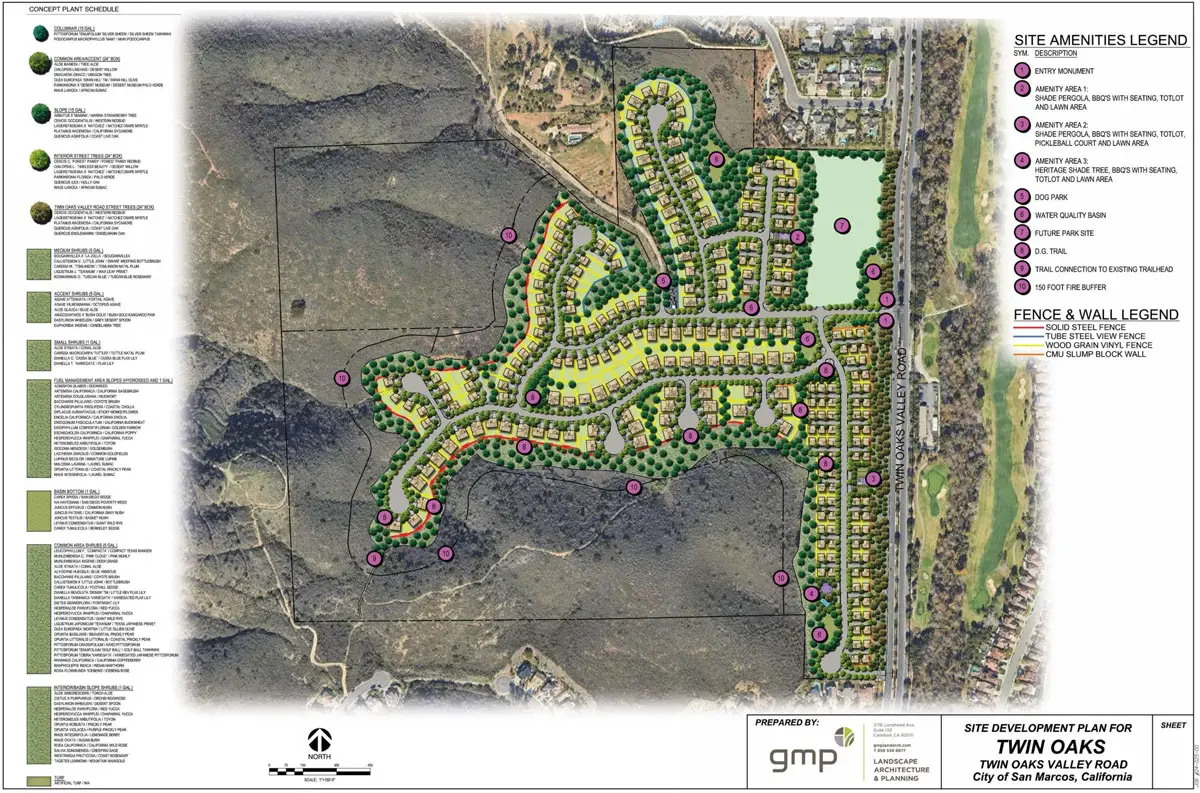
SAN MARCOS — The City Council voted on Nov. 10 to approve Oakcrest, a 257-home development by Meritage Homes of California on Twin Oaks Valley Road just north of Borden, about a mile from the San Marcos Post Office.
Councilmember María Nuñez opposed the plan, and Councilmember Ed Musgrove apparently recused himself.
The developer requested a General Plan amendment and adoption of a new specific plan to allow for the development.
The staff report, which recommended approval by the council, indicated that the Oakcrest proposal complies with the city’s ridgeline protection plan and will set aside more than a third of the total acreage as a wildlife preserve in perpetuity, along with providing bicycle and hiking access from Twin Oaks Valley Road to existing nature trails.
In addition, the developer would build and then deed a 6.2-acre public park to the city.
The development would require increased density to comply with the ridge protection protocols, and staff noted negative traffic impacts that would only be partially mitigated by requiring the developer to provide new timed traffic signals where Twin Oaks Valley Road meets Buena Creek and San Marcos Boulevard.
After the developer spoke, 10 residents — seven in attendance and three remotely — urged the council to deny the project. One noted that in addition to the 32 comments the city received during the environmental impact review, more than 600 residents had signed a petition opposing the project.
Many of the reasons offered for opposing the proposal were similar to those heard earlier in the meeting over the San Elijo Hills project, including fire evacuation and traffic congestion.
During council discussion after public testimony, Jones pointed out that if the City Council denied the project, the state could approve something with much higher density and no parks down the road.


San Elijo Hills condo appeal
Earlier in the Nov. 10 meeting, after more than two hours of hearing from staff, the developer and more than two dozen residents — most of whom opposed the project — the City Council tabled an appeal of the Planning Commission’s Oct. 5 denial of a proposed 31-unit condominium development in San Elijo Hills Town Center.
The staff presentation noted that the proposed building site is a wedge-shaped parcel where San Elijo Road splits into two one-way roadways, directly west of San Elijo Middle School.
The half-acre site would have 20 one-bedroom units and 11 two-bedroom units, including six units designated for low-income residents. A small first-floor parking garage would provide 10 spaces, with another 11 spaces in a lot.
City staff also noted that the project meets the state’s new Density Bonus Law requirements, which largely strip local jurisdictions of the authority to deny new housing projects that include designated low-income units.
Ahead of Tuesday night’s meeting, the city received a letter from the state Department of Housing & Community Development warning that if the project is denied, the state will review the denial — with the burden of proof on the city.
Rob Honer, principal of Encinitas-based Ambient Communities, gave the City Council a presentation much like the one he gave the Planning Commission in October. Honer said the developer would use fire-resistant materials to address residents’ concerns about fire danger, a move that would substantially increase construction costs.
The condos all have floor plans under 1,000 square feet, providing a lower price point than other housing in the San Elijo Hills community, Honer said.
Despite Mayor Rebecca Jones admonishing those in attendance to be respectful of all speakers, the developer was again jeered during his comments — although the crowd was noticeably more polite than at the Oct. 5 hearing. (Emails from the Consider SEH Voices group that organized the opposition, which were shared with The Coast News, had repeatedly urged attendees to be respectful over the past few weeks.)
After staff and developer presentations, a parade of residents opposed to the project spoke to the City Council, urging them to uphold the Planning Commission’s 4-2 denial.
The first speaker was Jamie Salter, a volunteer organizer with Consider SEH Voices. She repeated her concerns from the Planning Commission hearing that the proposed residential project’s location would negatively impact evacuation efforts during the next wildfire.
Other speakers cited traffic concerns, pedestrian safety near the adjacent San Elijo Middle School, ambulances’ ability to respond to medical emergencies during morning or afternoon rush hour, and the impact of heavy construction equipment on traffic.
And some expressed anger and indignation, with one speaker claiming San Marcos’ approval of multifamily homes over the past decade has changed the character of the city for the worse.
“San Marcos has done nothing for San Elijo Hills!” he told the council.
Another argued the General Plan itself is outdated, putting the developer in a tough spot — but then told council members that they should be willing to deny the project even in the face of state fines or a potential lawsuit: “Please don’t be afraid of litigation. Don’t be afraid of the state coming down on you.”
Following public testimony and final remarks from the developer in response to the opposition, Jones moved to table the item. In seconding Jones’ motion, Councilmember Ed Musgrove asked the city attorney to investigate whether the state’s Density Bonus Law (which both city staff and the developer cited in urging approval of the project) still applies to projects located within the state’s newly issued Fire Hazard Severity Zones. San Elijo Hills lies within a zone designated as “Very High,” the most dangerous.
Musgrove wondered whether that might overrule the Density Bonus Law’s exemption of infill developments from normal California Environmental Quality Act, or CEQA, review.
That motion, which was approved by the full council, postpones a final City Council decision until a future meeting. The council directed staff to collect testimony and evidence of traffic safety concerns, including the alleged use of a parking lot in an adjacent housing unit as a “cut through.”
In other business Tuesday night, the City Council:
- Increased ambulance fees from $202 to $1,374 for responding to a scene when the patient does not require or declines transportation, and bumped the cost of transportation to a flat $4,170 from the current rates of $1,846 for basic and $2,309 for advanced life support.
- Approved the sale of $11 million in California Municipal Finance Authority bonds to finance new construction for TrueCare medical buildings in the city.
- Finalized a new contract with City Manager Michelle Bender. The new agreement extends her employment to Sept. 14, 2032, and bumps her pay to $336,000 a year.