
REGION — A San Diego housing developer whose business activities extend into Carlsbad and Oceanside faces a growing number of lawsuits alleging he misled investors, failed to pay contractors and sold an ownership interest in an Oceanside property without holding title.
Christian Spicer, founder of SDRE Homebuyers (now Infill Innovation), and a network of businesses and associates are at the center of nearly three dozen lawsuits and mechanics’ liens involving millions of dollars in loans, investor contributions and unpaid bills.
The lawsuits include an Oceanside investor seeking to recover more than $705,000 invested in property the company allegedly did not own, and a retired teacher trying to claw back his $812,000 life savings invested to help provide for his disabled son.
Pamela Begeal, 67, a retired general contractor and builder with more than 43 years of experience, first noticed Spicer’s developments near her home in San Diego’s Clairemont neighborhood.
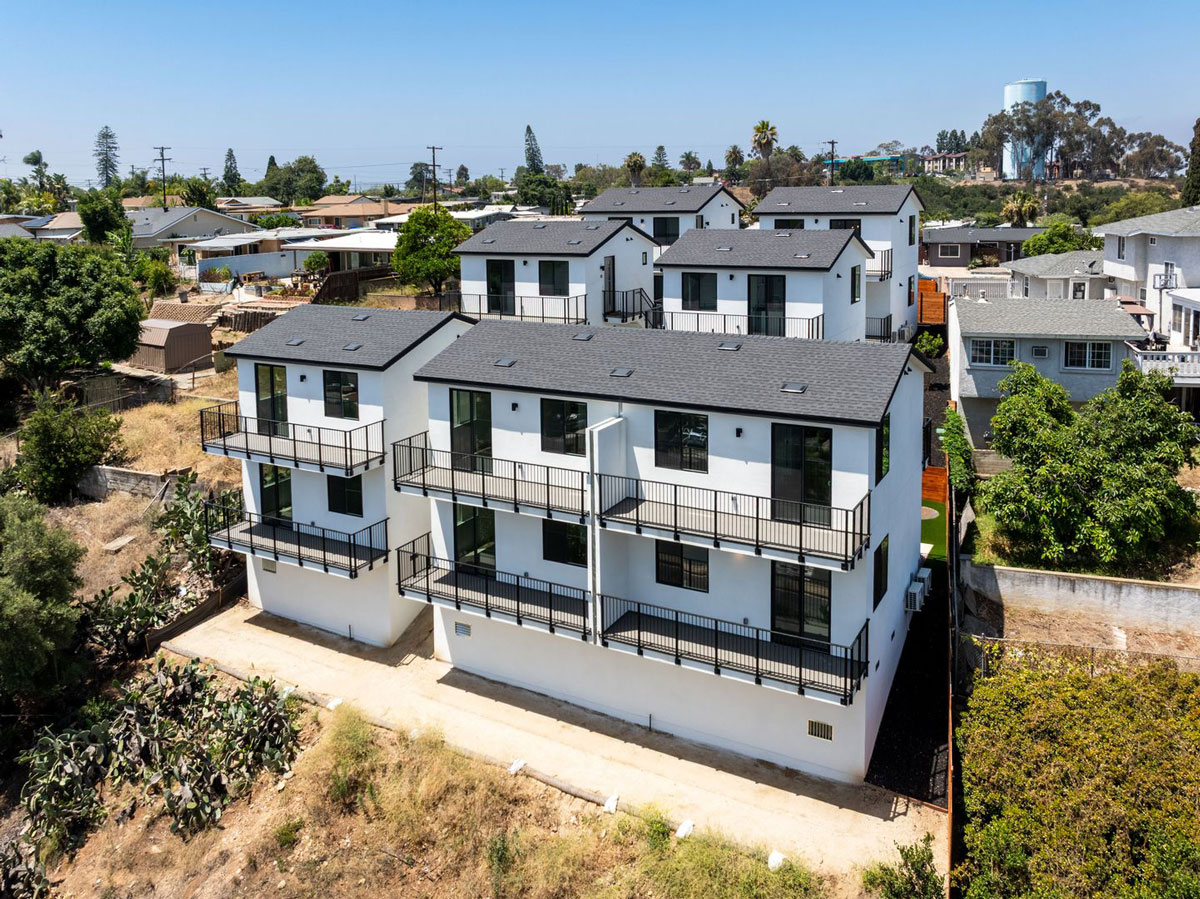
In 2024, Begeal said she was alarmed by SDRE Homebuyers’ 17-ADU project at 4601 Almayo Drive, so she began digging into Spicer’s businesses, spending the next year and a half compiling legal filings, property records and default notices on her website, ADUBonus.org.
“My fear is that many, many more people are going to be duped before this story gets out,” Begeal told The Coast News. “This is essentially a Ponzi scheme. Now, (SDRE Homebuyers) is duping new investors at the new office under a new name (Infill Innovation). “We’ve traced at least $684 million in loans from their top three lenders, plus amounts owed to six investors who are suing — not counting nearly three dozen additional lenders. Where did the money go?”
Brian Doyle, CEO of Infill Innovation, told The Coast News that Spicer is no longer the company’s CEO or a member of its board and has no governance responsibilities, although he remains a minority shareholder.
Doyle acknowledged the company is facing several lawsuits over past business activities and said he and Infill Innovation President and Chief Financial Officer Edward Stepanow are working to resolve the disputes.
“The majority of all of this will be resolved outside the courts,” Doyle said. “If we owe people money, we’ll pay the money. If there’s a misunderstanding, everybody is going to be clear about what we do and how we do it. Edward and I are working through taking care of all of this. We are very committed.”

Doyle declined to comment on active litigation, but said that Infill is working to recapitalize the company, which he said would allow it to pay outstanding obligations and continue its development projects.
Begeal rejected Doyle’s response.
“I don’t believe one word of that. Recapitalizing is a euphemism for garnering more money from unsuspecting investors,” Begeal said. “Between the lawsuits filed by investors, construction companies and suppliers and the amount of verified money that has been loaned to this business — with at least 92 being properties so far being traced to them and only 36 being built — it is clear something nefarious is happening in our county with this company. You do not get over 22 lawsuits filed against you in just a short three-month period if you are operating above board.
“They will never be able to pay back the money they have taken. Never.”
When contacted by The Coast News, Spicer said he no longer works for the company and declined further comment. California corporate records show Spicer identified himself as an officer of Infill Innovation Inc. when he signed paperwork registering the company to do business in the state on Jan. 9, 2026.
‘King of ADUs’
Begeal said her research began with concerns about large ADU developments in the Clairemont neighborhood.
“I told my husband we’re next,” she said, referring to projects she saw being built at the ends of nearby cul-de-sacs.
Retirement gave her time to investigate. Begeal compiled a list of at least 36 court cases involving Spicer, associated businesses (SDRE Homebuyers, Infill Innovation, etc.) and partners, including investor, contractor, tenant and landlord disputes.
In her research, Begeal found that Spicer built his profile through large accessory dwelling unit projects and earned the nickname “King of ADUs” from the OB Rag, raising millions from private investors through myriad property, financing and construction companies.
The potential scale of Spicer’s real estate activity is reflected by Elementix, a real estate data service that uses artificial intelligence to analyze recorded documents and identify business relationships. Elementix links Spicer to 218 properties and 50 holding companies, largely in San Diego, Carlsbad, El Cajon and Oceanside.
Elementix reported that, as of August, Spicer was associated with approximately $753.1 million in recorded mortgage exposure across at least 186 filings. The service attributed $600 million of that exposure to four Fortress Investment Group loan filings, $39.7 million to 24 Kiavi filings and $26.3 million to 15 Anchor Loans filings.
The figures do not show how much Spicer or his companies actually borrowed, received or currently owe.
Spicer previously drew favorable coverage from The New York Times, which featured his approach to building multiple accessory dwelling units on single-family lots in an October 2021 article, “Where the Suburbs End.”
Times reporter Conor Dougherty described the approach as “a vision for California’s future.” In an Oct. 1 commentary, San Diego journalist Kate Callen criticized the Times for not following up on Spicer’s mounting legal and financial troubles, saying she and fellow reporter Paul Krueger had repeatedly sent Dougherty documentation without receiving a response.
The same approach that drew national attention also fueled neighborhood disputes in San Diego, where residents challenged the size and potential impacts of several projects Spicer pursued through SDRE Homebuyers.
One of those controversial developments is Chalcifica, a proposed 136-unit project on two adjacent residential properties in Pacific Beach.
The project, now under Doyle’s leadership at Infill Innovation, has since been reduced to 125 units and relocated away from sensitive areas after neighborhood opposition and a lawsuit over its size and potential impacts on traffic, fire safety and culturally significant Kumeyaay lands.
Another SDRE project drew opposition in San Diego’s Redwood Village neighborhood, where the company pursued a 14-unit ADU development on Boren Street, a narrow residential cul-de-sac.
Neighbors raised concerns about parking, fire safety and emergency vehicle access, while the developer defended the project as much-needed housing allowed under the city’s ADU Bonus Program.
“I’ve been a housing developer for almost 40 years, the last 20 years in San Diego. I’ve built lots of infill projects,” Doyle said. “Every project I’ve ever done gets met with some amount of criticism and opposition because generally they don’t want new things in their neighborhood. But density is the only way you can build in places already built out.”
The Boren development and ensuing public backlash prompted the city to tighten rules governing bonus units on smaller residential lots. Doyle said the company still has the right to develop the project approved under the city’s previous ADU rules, but has tried to address residents’ concerns.
For Begeal, however, the neighborhood rifts over developments are only part of the story. As she began tracing the companies and people behind the ADU projects, she discovered a complicated web of lawsuits, investor disputes and unpaid bills related to Spicer and a number of associated companies.
In several complaints, plaintiffs allege overlapping companies and shifting responsibilities left investors chasing their money across a labyrinth of firms and executives.
“I actually even tried to pay real estate attorneys to sit down with me and explain it to me, and they would not,” Begeal said.
What began with concerns about construction near her own neighborhood eventually led Begeal to the investors and contractors who said they were owed money.
Missing ownership stake
In a complaint filed earlier this summer, Oceanside investor Fadi Atiya alleges he paid Spicer for an ownership interest he never received in two parcels near Ivy Road and Fire Mountain Drive.
On June 17, Atiya, represented by Steve Blake of Blake Law Firm in Encinitas, sued Spicer and Stepanow, alleging fraud and violations of California securities law.
According to the complaint, Atiya agreed in December 2025 to pay $705,061.43 for a 6.51% tenancy-in-common interest in the property. The agreement identified SDRE Homebuyers as the owner and said the company would transfer part of its ownership to him.
“SDRE currently owns the real property whose address and APN are described on the signature page of this Agreement,” the lawsuit states.
But Atiya alleges SDRE did not own the property when it accepted his money or signed the agreement. Instead, the complaint states that Albert and Carolyn LaCocq, owners of LeCocq Construction Company, held title to the Oceanside property.
Stepanow signed the agreement as SDRE’s chief financial officer on Dec. 4, 2025, and Atiya signed six days later, per court documents. Atiya alleges Spicer participated in the sales meetings and helped present SDRE as the property’s owner. The complaint says Atiya’s money was transferred through Investors 1031 Exchange, acting as his intermediary in a tax-deferred exchange.
Because the intermediary handled the payment, Atiya says he does not know who initially received the money. The lawsuit claims Spicer and Stepanow subsequently controlled and diverted the funds rather than holding them for his benefit, and that they failed to provide a full accounting.
“The only material information they have provided to Plaintiff is that they cannot refund the investment,” the lawsuit states.
The agreement includes a risk disclosure warning that investors could lose their entire investment and that returns were not guaranteed. Regardless of risk, however, Atiya alleges SDRE sold him a stake in property it did not own.
‘I might be in trouble’
Martin Eder, a 78-year-old retired teacher in San Diego, invested about $812,000 — most of his life savings — in a housing development by Spicer’s companies, Leghorn Holdings and SDRE Homebuyers, to support his disabled son, according to court documents.
In a June 18 lawsuit in San Diego Superior Court, Eder alleges Thomas Hinson, chief operating officer of Fletcher Cove Capital, persuaded him to invest in a project on Leghorn Avenue in San Diego’s Encanto neighborhood.
The complaint says Eder paid $812,241 in October 2024 for a 6.43% ownership stake after being promised an 8% annual return, paid quarterly, and completion within 36 months. Spicer allegedly signed the agreement on behalf of Leghorn Holdings and SDRE Homebuyers.
By the time Eder sued, construction had not begun.
“The plot is a green field; ground has not been broken in any sense of the term,” the lawsuit reads.
According to Begeal, Eder found her website while researching the businesses after Hinson allegedly denied involvement in the project.
“I found your website and I think I might be in trouble,” Eder told her.
The lawsuit names Spicer, Hinson and six companies, alleging fraud, breach of contract and violations of California securities law. Eder is represented by Aguirre & Severson, whose attorneys include former San Diego City Attorney Mike Aguirre.
A trail of unpaid bills
Beyond the investor lawsuits, other complaints allege the companies’ financial troubles extended to contractors and landlords. Begeal noted that 22 construction companies have filed lawsuits or mechanics’ liens against Spicer, SDRE Homebuyers and Infill Innovation, seeking nearly $2 million for construction work and labor.
In a Sept. 4 complaint, JB General alleges Infill Innovation, Vertical MVMT and several affiliated companies and executives, including Spicer, Doyle and Stepanow, owe it $79,250 for work on an ADU development at 6819-6821 Newbold Court in San Diego.
The contractor alleges the defendants “were embroiled in a dispute with a group of investors after blowing through millions of dollars without delivering the ADU projects promised to the investors.”
JB General claims the defendants exhausted loan funds before completing projects, fell behind on taxes, failed to pay suppliers and contractors, and were nearing default on the project’s construction loan.
“Defendants had no intention of making payment to JB General for its work,” per the lawsuit, which further alleges that the defendants “had failed to pay other suppliers and contractors.”
In another lawsuit filed Aug. 11, landlord Seville Plaza Propco LLC alleges SDRE Homebuyers and Vertical MVMT stopped paying rent and abandoned their Kearny Mesa offices before a 65-month lease expired. The landlord is seeking approximately $1.67 million in past and future damages.
“(SDRE Homebuyers) fled their offices in Kearny Mesa and popped up in Carmel Valley with a new name (Infill Innovation),” Begeal said.
The lawsuits were not the only signs of rough financial waters. Public records show SDRE also faced a multimillion-dollar loan default and thousands of dollars in delinquent taxes.
Seven notices of default recorded Dec. 30, 2025, show that a roughly $2.56 million loan secured by seven SDRE Homebuyers properties in San Diego was in default. The notices state that payments had been due since Aug. 1 and that the lender had started the foreclosure process.
One of those properties in default, 674 Leghorn Avenue, is the development at the center of Eder’s lawsuit.
Separate county records show seven certificates of tax lien were recorded against SDRE Homebuyers between November 2024 and August 2025 for approximately $23,300 in delinquent unsecured property taxes and penalties.
Several identify the taxpayer as SDRE Homebuyers LLC, care of Christian Spicer.
Begeal said she has spent the last 18 months gathering information she hopes will help protect future small investors who consider putting their life savings into these types of projects.
“I would like the information to get out before more people are hurt,” Begeal said.