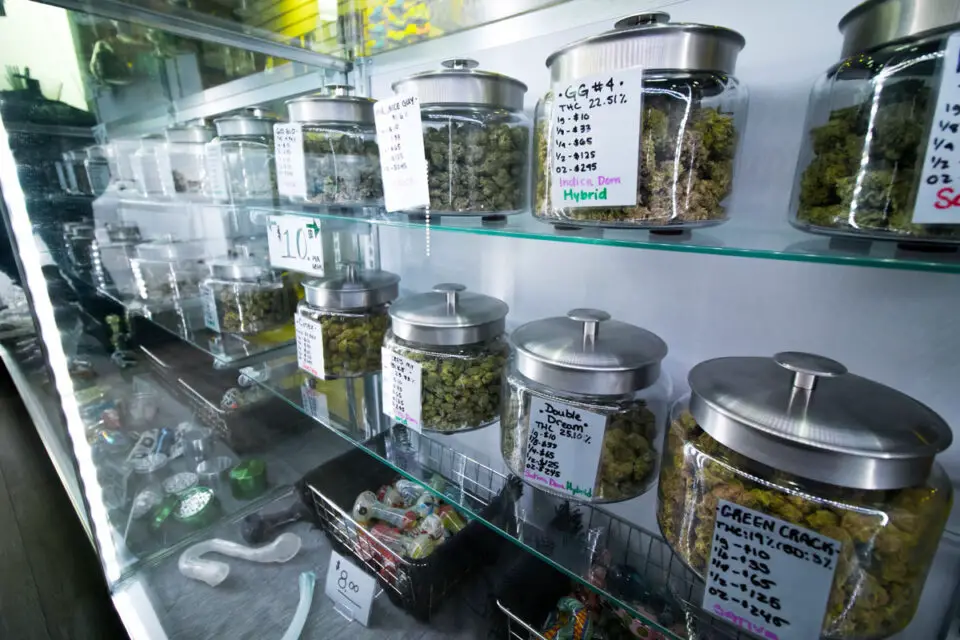
OCEANSIDE — After more than two years of discussions, a council majority has finalized its decision to allow up to four storefront cannabis dispensaries to operate within the city.
Staff previously presented the storefront cannabis licensing program in June, however City Council sent it back to the drawing board with a few modifications to the licensing process, which include:
- Eliminating the requirement to retain a future site during the licensing process,
- Rewarding businesses with a proven track record of abiding by collective bargaining agreements, and
- Instituting even stricter separations from schools than previously proposed.
Under the modifications, dispensaries will not be allowed in any case within 1,000 feet from a middle or high school, or 550 feet from other public or private schools.
Youth access to dispensaries was a particular concern for several council members as well as members of the public. Many also urged the council to consider prohibiting dispensaries from areas near where children tend to congregate after school as well.
“Access is especially an issue for me,” said Mayor Esther Sanchez, who was the lone vote against the ordinance on Aug. 6.
Councilmember Jimmy Figueroa, who voted in favor, was also concerned about access for youth.
Both Figueroa and Sanchez were also concerned about the placement of dispensaries in impoverished neighborhoods, noting how past anti-drug enforcement activity and current uses such as liquor stores have disproportionately harmed those communities over the years.
Councilmember Rick Robinson pointed out that access to illicit substances has always been a problem for the youth.

“If walking by a store is enough to cause someone to fall, they are going to fall anyway,” he said.
Figueroa noted when he worked as the executive director for Operation HOPE-North County, a homeless shelter for single women and families in Vista, the taxes from their operating dispensaries greatly benefited the shelter. He suggested a portion of the taxes generated from cannabis in Oceanside be used for drug-abuse prevention.
City Manager Jonathan Borrego indicated that staff plans to bring forward an item that would formalize how the city would spend tax revenue from cannabis businesses, which would dedicate a “significant amount toward prevention and youth programs.”
Oceanside’s cannabis retail business tax is currently set at 5%, which is slightly less than Vista’s 7% rate, which is collected from 11 dispensaries. Vista generated nearly $7 million from its dispensaries in 2023, according to city staff.
Applicants are also expected to donate a portion of their income to programs that primarily serve the youth.
Dispensaries will only be allowed in some commercial and industrial areas of the city, and prohibited from anywhere west of Coast Highway, in the downtown district and the Mission San Luis Rey commercial district.
Deputy Mayor Eric Joyce suggested the council consider opening up Coast Highway to dispensaries at a future meeting.
The ordinance also establishes application procedures, fees, and priority licensing for the city’s two existing operators – MedLeaf and Left Coast.
Applicants will be expected to pay more than $12,000 for the application process, which will include a completeness screening, application review, city manager review and city manager recommendation, and nearly $13,000 in annual compliance inspection and financial audits, among other fees. Non-operating license renewals would cost nearly $3,000, and operating license renewals will cost more than $3,000.
Applicants will also undergo background checks and a live scan by the Oceanside Police Department.
The two existing businesses will be fast-tracked for approval by skipping the city manager interview but must still meet the minimum qualifications. Should they fail to do so, their space in the application process would be opened to the public at a later date as determined by staff.
Dispensaries will be limited to signage that displays only their name, and prohibited from including images like green leaves or green crosses.
Staff plans to open the application window in the fall and winter and have licenses issued by spring. City Council is expected to review conditional use permits by Fall 2026, and businesses must become operational between 2027 and 2028.