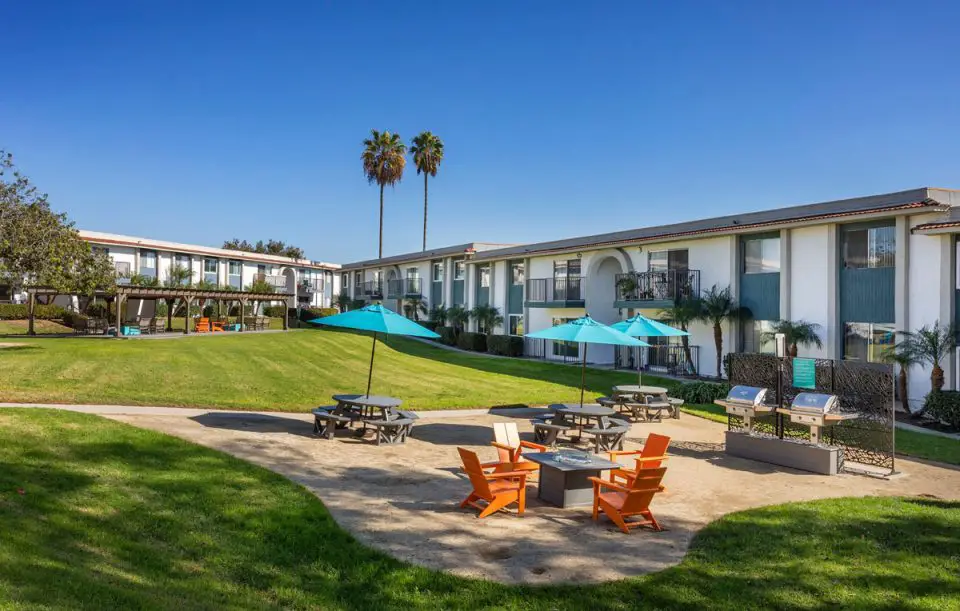
OCEANSIDE — The future owner of an existing apartment complex near MiraCosta College plans to convert its 240 units into affordable housing.
The city held a Tax and Equity Fiscal Responsibility Act (TEFRA) hearing on Dec. 17, during which the Oceanside City Council unanimously approved the issuance of up to $150 million in tax-exempt revenue bonds by the California Municipal Finance Authority to benefit Maple Housing Foundation, which will use the funds to acquire and rehabilitate the Sunterra apartments at 3851 Sherbourne Drive.
The apartments, built in 1974, have undergone various ownership changes and renovations over the years. While the complex, which consists mostly of two-bedroom units, is considerably more affordable than many other apartments in the city, it is not currently legally defined as affordable housing.
According to the developer, none of the current tenants will be displaced during the process. Many current residents will likely qualify as low-income and could benefit from future rental reductions, while those who do not qualify will still be able to remain in their homes. The process will naturally convert vacant units as tenants leave.
At least 20% of the units must be occupied by households with incomes at or below 50% of the area median income (AMI), which is approximately $82,700 for a family of four, or 40% of units must be occupied by households with incomes at or below 60% of AMI, which is $86,760 for a family of four.
Additionally, at least 75% of the units must be occupied by households with incomes at or below 80% of the AMI, which is $132,400 for a family of four.
Housing and Neighborhood Services Director Leilani Hines confirmed that converting the apartments to low- and very low-income affordable housing units will benefit the city’s Regional Housing Needs Allocation by increasing the number of affordable housing units in those categories.
The homes must remain deed-restricted as affordable housing for a minimum of 15 years, or for as long as it takes the borrower to repay the funds.
“As long as those bonds are there, it’s affordable,” Hines said.
Because the city is not providing direct funding to the project, it cannot extend the period during which the homes remain deed-restricted as affordable housing.
The CMFA will be responsible for monitoring project compliance, not the city; however, the city could help redirect future residents with potential complaints to the CMFA if necessary.
“Understanding that none of these units are currently regarded as affordable, this is certainly going to be beneficial to have affordable units for a minimum of 15 years — and potentially longer than that,” Mayor Esther Sanchez said.
Although the borrower needs city approval to use the bonds, the city has no financial or legal responsibility for the project or for repaying the bonds. There is also no fiscal impact to the city or the state.
According to staff, the city’s minor administrative and staff costs to prepare required reports and related documents will be reimbursed through a small portion of the bond issuance fee.