
Tackling the history of Los Angeles — the sprawling, chaotic, seemingly amorphous neighbor to the north — had to be as intimidating as the L.A. freeway system is to a visitor from Des Moines, but native Angelino, author and historian Paul Haddad has pulled it off.
“I didn’t invent the phrase, but Los Angeles is the city that shouldn’t exist,” he said during a phone call discussing his newly published “Inventing Paradise: The Power Brokers Who Created the Dream of Los Angeles.” “The Los Angeles River had the capacity to serve only 200,000 people, the city was hemmed in by the mountains and the closest natural harbor was 21 miles south.”
But it was the “human factor,” the enduring need to find Shangri La, to be at peace with our environment, that canceled out the roadblocks to creating Los Angeles.
“It’s almost in our DNA that we are always seeking the promised land or the perfect place — Eden,” Haddad added, and that’s how this piece of earth in Southern California was viewed and promoted.

Haddad’s extensive research (the book includes 68 pages of notes, maps, appendices, bibliographies, attributions and indexes) has yielded a tale of the forces that shaped Los Angeles from the 1890s to 1932 when the city hosted the Olympic Summer Games.
“That’s when the city achieved pretty much the square mileage it is now.” the author said.
Those forces include what Haddad calls the Mount Rushmore of Los Angeles: Henry Huntington (1850-1927), Moses Sherman (1853-1932), William Mulholland (1855-1935) and Harry Chandler (1864-1944) — magnates of the Gilded Age who recognized the paradise that Los Angeles could be.
“These men had careers that overlapped and they were all long-lived, but mostly they were business associates,” Haddad said. “They were enemies and frenemies depending on what was happening. They were not politicians but had a lot of sway with city hall.”

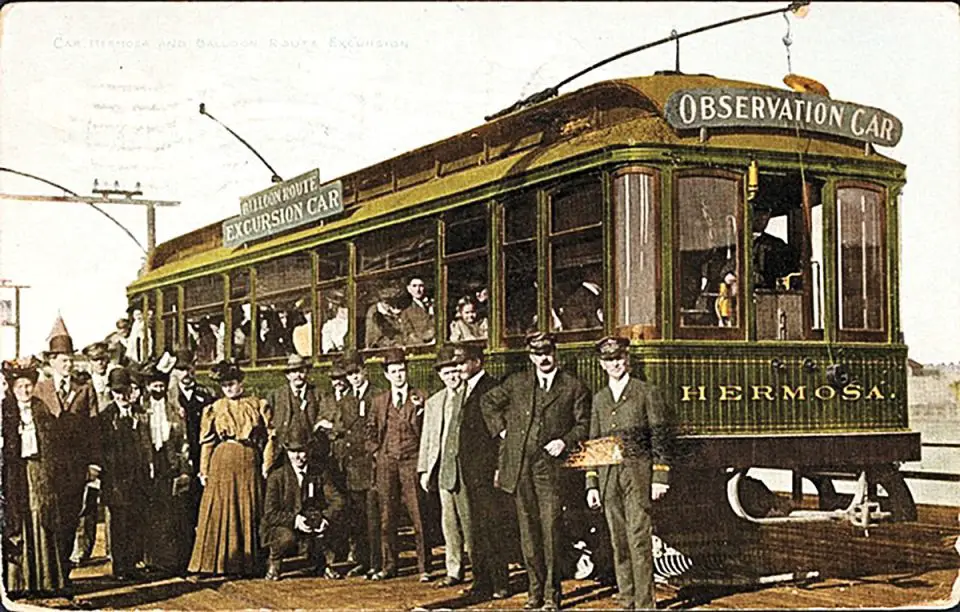
The Big Four controlled the big four: transportation, real estate, information and access to water, all of which helped propel the once small Spanish settlement of El Pueblo de Nuestra Senora la Reina de Los Angeles into today’s city of nearly 500 square miles, 4 million residents and a metro area of more than 12 million.
While some find Los Angeles overwhelming, Haddad sees the city and his Los Feliz neighborhood as places worthy of exploration and full of opportunity.
“I feel attached because I grew up here,” he said. “I’m able to look past the veneer of problems — high rents, homelessness, an inefficient bureaucracy and air pollution. I love the arts. You can find inspiration here any day. Yesterday I went to the (100-year-old, refurbished) Vista Theatre, which is within walking distance of my house, to see a movie that’s hardly ever screened.”
Others who seek out Los Angeles also “are similarly curious…and feel connected to the city by visiting its preserved places and taking advantage of the mountains and trails.”
And, as it so happens, Haddad has a book to help do just that: “10,000 Steps A Day in L.A.: 57 Walking Adventures.” The guide takes walkers to legendary locations as well as the more “hidden, unsung and quirky sites.” And always the historian, the author includes stories of the past.
“I wanted to debunk the notion that Los Angeles is a city hostile to pedestrians,” he said. “I take joy in upending narratives. You dig a little deeper and you find there is another side of things.”
Both books by Haddad are published by Santa Monica Press in Solana Beach.
In his 58 years, Haddad has seen immense change in his hometown.
“I grew up in Beverly Hills before it was a global center of business and ostentation,” he said. “It was a sleepy town before all the bling. I was a latchkey kid who grew up exploring around Mulholland Drive. My grandmother had horses in the (San Fernando) Valley. There were drive-in theaters. It was an idyllic upbringing.”
For more discussion and photos, visit www.facebook.com/elouise.ondash.


