ENCINITAS — In August, The Grauer School celebrated its 35th anniversary, marking more than three decades of dedicated work by teachers, faculty and students in shaping future citizens.
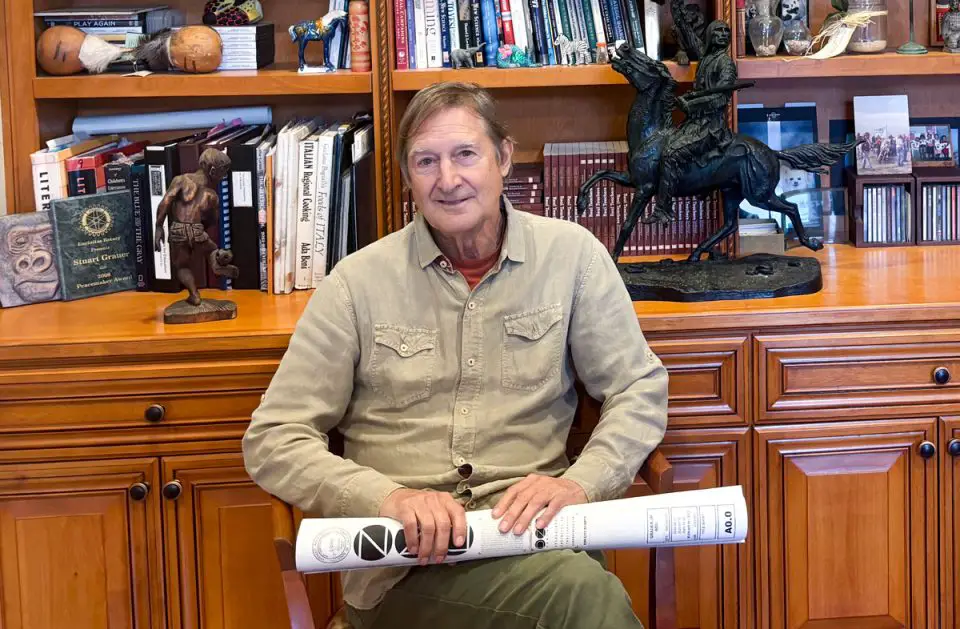
The Grauer School is a college-preparatory school that emphasizes pushing the boundaries of traditional education while instilling core values in students. The Coast News recently sat down with Stuart Grauer, founder of The Grauer School, to reflect on what it took to build the school and sustain its success.
Grauer, who holds a doctorate in education, founded the school to give voice to students who are often unheard and lack opportunities to express themselves in traditional educational settings.
“With The Grauer School, I wanted to create the more ideal conditions for learning, but in particular, to give kids a voice,” Grauer said. “And when I say kids, I also was referring to a specific set of kids, which is high school.”
What began as a progressive and unconventional approach to education drew criticism from some members of the community.
“People made up stuff like, ‘Oh, these kids are not making it in other schools,’” Grauer said. “So many teens are what I call diamonds in the rough; kids who needed to become who they were and maybe they weren’t doing that great in school.”
Despite skepticism, interest in the school continued to grow, along with enrollment.
“[I] had seven students right away, and finished that first year with 12, and next year grew to 24, and the next year grew to 36,” Grauer said.
Teaching philosophy
Grauer also sought to redefine what it meant to be a teacher and to care for students, emphasizing personal connection and engagement.
“I was hearing stories about kids waiting in line to have their questions answered from the teachers, and classes where the teacher really didn’t even know your name, and they couldn’t really read your writing seriously, and it wasn’t interactive, and that didn’t shore up with my definition of what a teacher was,” Grauer said.
For Grauer, teaching extends beyond academics to understanding each student as an individual.
“The paradox of adolescence is that you’re establishing an independent identity at the exact same time as you have a profound need to belong,” Grauer said.
He stressed that teachers must also see themselves as leaders within the classroom, each able to create a unique classroom setting based on their styles and personal experiences.
“If nobody’s following you…you are not a leader, and leader and teacher are the same thing,” Grauer said. “Teaching is leadership.”
Curriculum
Classes at The Grauer School are designed to be experiential, giving students hands-on engagement with subject matter rather than relying solely on lectures.
“Everything’s a lab,” Grauer said. “Every class should go outside; every class should have writing; every class should have a dose of the arts in it.
Learning also extends well beyond Encinitas, with students exploring the world together through travel-based educational experiences.
“Twice a year, the whole school goes away for weeks, and students can even propose where they want to go,” Grauer said. “Teachers propose where they want to go. If you want to go to Timbuktu, you write a proposal. And so expeditionary learning manifests itself through our expeditions program, once every semester for a week, we’ve been all over the world.”
Practice in core values
Additionally, students are taught by teachers who don’t just focus on their test scores, but also on who they are as individuals. Grauer has a unique set of school values that help grade students, taking pride in the fact that, despite the importance of scholarships, a person’s unique identity is a big part of their success.
“We grade and weight character development in accordance with our core values (Resourcefulness, Intellectual Curiosity, Perseverance, Compassion, Self-Advocacy, and Accountability),” Grauer said. “If a school has values and a value statement, then everything that you do has to be about that purpose.”
Those values are incorporated into students’ academic evaluations and culminate in a graduation requirement.
“When you’re a senior, you have to make a graduation defense, like a doctoral defense. You have to defend your right to graduate,” Grauer said. “It’s…moving to see seniors get up and say…‘This is what I’ve done to express compassion…This is how I’ve shown resourcefulness or compassion…’This is why I persevered.’”
Legacy
With fewer than 200 students in grades seven through 12, The Grauer School emphasizes close relationships and individualized learning, a model Grauer credits to a leadership-first approach.
“No matter where I am in the world, when somebody says what I do for a living, I always say ‘teacher,’” Grauer said. “I don’t say the Grauer School. I don’t say anything. I understand [saying a] ‘teacher,’ because that’s my identity.”
After 35 years of educating students, Grauer said his measure of success is not defined by numbers or credentials, but by reflection.
“At the end of it all, if you’re very, very lucky, you can go on a trip and end up underneath the stars and just be basking in how beautiful this world is, especially after you’ve gone through it all,” Grauer said.