When I was in third grade, my parents found a tiny cottage on Lake Michigan. The house was basically one that no one wanted. It was made from split logs, painted dark brown and nicknamed “The Stockade.” But we loved it and spent our summers there exploring the natural world around us.
During the first week of August, a phenomenon known as the monarch migration brought hundreds of monarch butterflies to the beach. There was no Google back then, and our television had one channel that received signals through a rabbit-ear antenna. We were determined to find out the origin of the migration.
My dad and I took walks along the one-mile dirt road that paralleled the beach homes. One day, we noticed a small shack built in an open field on property owned by the University of Wisconsin.
We later found out the people staying in the shack were students in the Department of Ornithology, whose job was to count birds inhabiting the lakefront and place small bands on migrating butterflies. They explained that the butterflies washing up on the beach had come from Canada and were on their way to Mexico.
Their job was to locate and tag the multitude of monarch butterflies migrating from Canada and passing over Lake Michigan. This was an arduous task. My father volunteered to be a tagger, and we were hooked on monarch butterflies. This was in 1968 in Sheboygan, Wisconsin, but the process continues all over the United States.
Continuing to Love Monarchs
Little did I know that one day I would be studying monarch butterflies on a coast far from Wisconsin, in Carlsbad, California.
In the large 20-foot raised beds of the Carlsbad Senior Community Garden, our garden group has planted three large milkweed plants that flourish in the full sun. We have waited patiently through June and July for the first sighting of female monarchs.
Sighting the Monarch in Our Garden
We spot one monarch flying from bed to bed. She tries a purple sage and moves on. She alights on a tall lavender shrub but continues flying. Finally, she lands on a milkweed plant and stays for 10 minutes.
After she leaves, we investigate and, sure enough, one tiny yellow egg has appeared on the underside of a leaf near the top of the plant.
According to Monarch Joint Venture, an educational organization devoted to the protection and conservation of monarchs, “Female monarchs only lay eggs on milkweed plants since monarch caterpillars only eat milkweed. The eggs will hatch in four days after they are laid.”
The Growth Process
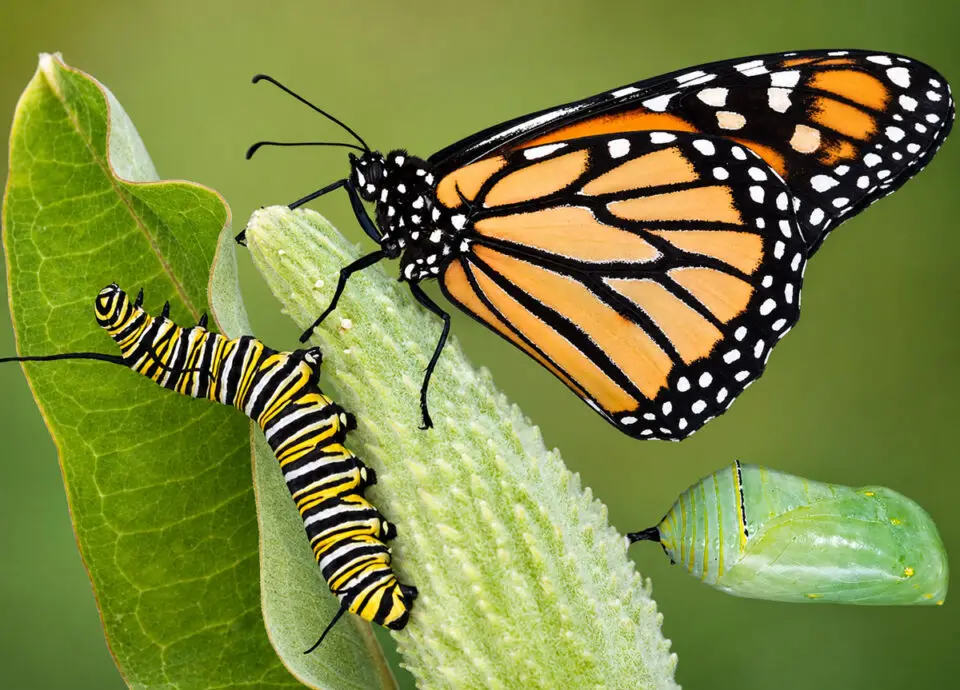
As we soon learn, eggs laid by the monarch develop through four stages: egg, larva (caterpillar), pupa (chrysalis) and adult.
Because the caterpillar’s primary goal is to eat and grow quickly, the milkweed provides food during its 10- to 14-day feeding phase.
When the caterpillar reaches full size, it climbs to a secure location, such as a twig or leaf, and attaches itself with silk. It then sheds its skin one last time to reveal a jade-green chrysalis.
Inside this protective casing, the insect undergoes a transformation called metamorphosis that takes nine to 14 days. (This metamorphosis can be seen on YouTube in “The Amazing Monarch Life.”)
When the butterfly is fully developed, the chrysalis becomes transparent, and the adult emerges. After a few hours of drying, it is ready to take flight, and the cycle begins again. (See Monarch Joint Venture for further details.)
The Local Monarch Butterfly Ambassador
I learned from Jay Klopfenstein, our local monarch expert, that if a family would like to observe this process in their home garden, they can purchase a butterfly tent from Amazon and find instructions on the Facebook page “How to Raise Monarch Butterflies.”
Jay and his group of butterfly enthusiasts have created the California Pollinator Collaborative, whose mission is to “increase the population of native pollinators that are essential for the reproduction of 85% of the world’s flowering plants.”
They travel to community gardens, farmers’ markets and schools, demonstrating the importance of milkweed plants and the migration of local and national monarchs.
They have also created a fundraiser for their projects, including the development of a California Pollinator license plate. Details are available at www.californiapollinatorcollaborative.org.
Another activity the group is promoting is a free screening of the film “The Little Things That Run the World” at Dove Library on Aug. 1. Contact the library for details.
Contact Jay through the California Pollinator Collaborative if you would like to become active in helping save the monarchs.
Jano Nightingale is a horticulturist in Carlsbad and also loves monarchs. Contact her at [email protected].