CARLSBAD — Local advocates said they were underwhelmed by a long-awaited Federal Aviation Administration webinar addressing noise and expansion concerns at McClellan-Palomar Airport.
The FAA hosted a public webinar on Jan. 22 to explain agency policies, present data, and answer residents’ questions.
Citizens for a Friendly Airport, a nonprofit watchdog group focused on the airport’s impact on Carlsbad and surrounding communities, currently has two lawsuits pending against the County of San Diego, one of which was later joined by the City of Carlsbad. The litigation centers on county-approved leases with American Airlines and United Airlines for commercial passenger service at Palomar Airport.
The group criticized what it described as a lack of transparency during the webinar.
“After two years of waiting and strong efforts by the City of Carlsbad, Councilwoman [Teresa] Acosta, and Congressman [Mike] Levin’s office, the FAA and County hijacked the plans for a roundtable discussion and turned it into a self-serving PR piece rather than a true community forum,” the organization said in a statement.
Rep. Mike Levin, a Democrat who represents Carlsbad in the 49th Congressional District, has long pushed for greater transparency from the FAA regarding the airport and asked several questions during the webinar.
“I was glad that the FAA and Palomar Airport finally held a virtual community meeting for residents to ask questions and express their concerns about noise disruptions. This was long overdue, and my office had been pushing for this for quite some time,” Levin told The Coast News. “Unfortunately, the FAA barred elected officials from participating, which limited the perspectives that the agency heard.”
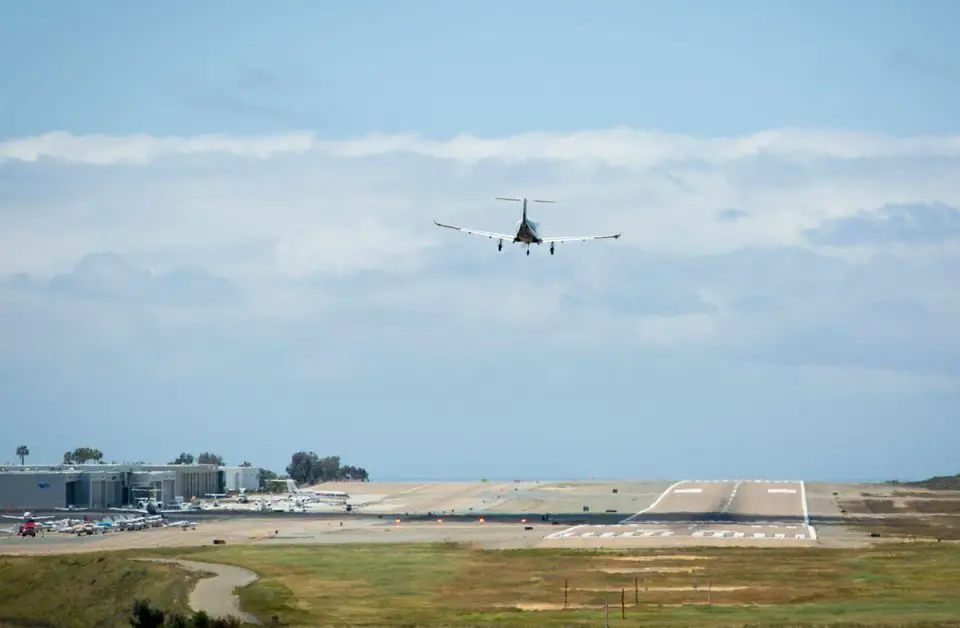
Much of the concern focused on aircraft noise affecting nearby neighborhoods, as well as long-term plans to expand the airport to accommodate larger, faster planes.
Jamie Abbott, the county’s director of airports, said during the webinar that the airport’s master planning process determined that “the ultimate design of the airport will eventually be D-III.”
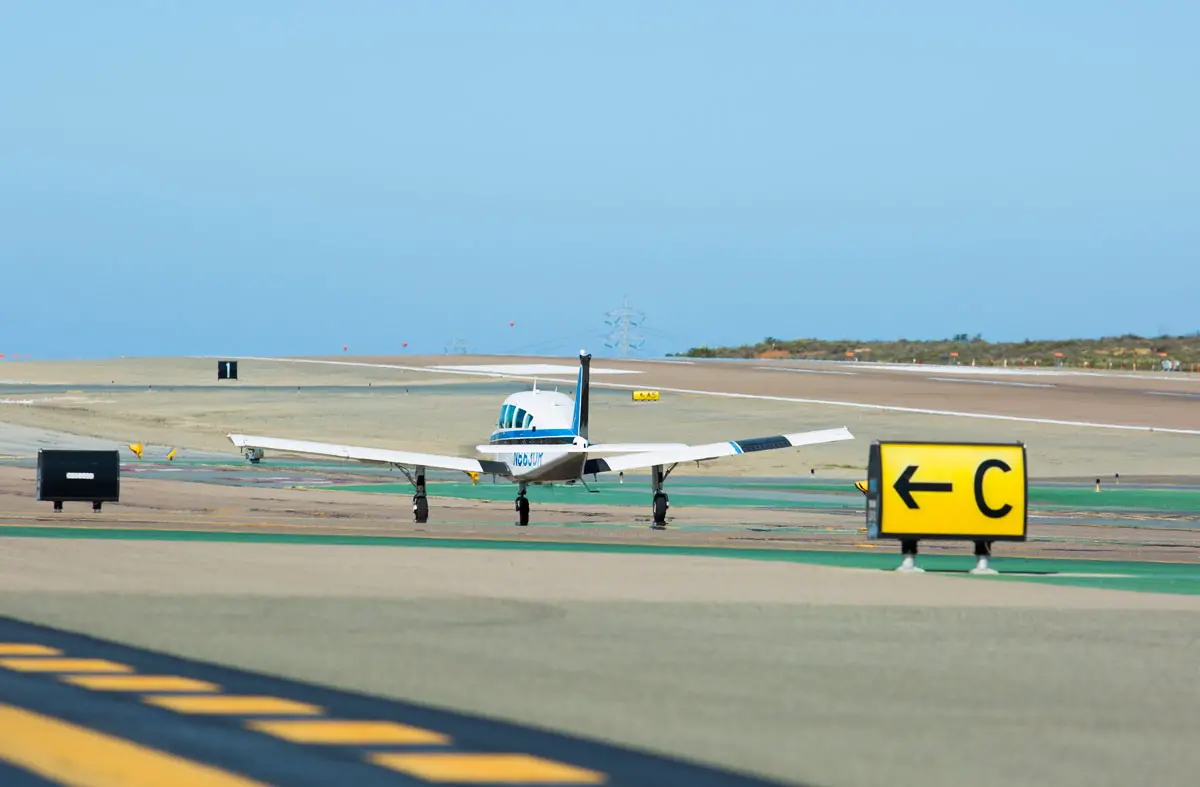
Airports are classified based on the types of aircraft they can support. The letter denotes approach speed, while the Roman numeral refers to wingspan. McClellan-Palomar Airport is currently rated B-II, allowing approach speeds between 91 and 120 knots and wingspans between 49 and 78 feet, typical of small business jets and turboprops, according to county records.
A D-III airport can accommodate approach speeds of up to 165 knots and wingspans of up to 117 feet, allowing for larger business jets and some commercial passenger aircraft, along with the longer runways, wider taxiways and expanded safety areas those planes require.
“We’ve been a B-II airport for decades and that’s not changing anytime soon,” Abbott said. “However, you know, we do have a responsibility to plan for the future and that was addressed and discussed in the master planning process.”
In a joint statement, Citizens for a Friendly Airport and the Palomar Airport Action Network compared the potential trajectory of McClellan-Palomar Airport to John Wayne Airport in Orange County.
“It also became clear that Carlsbad, North County cities and residents, are the last remaining defense for [ensuring] the quality of life, health and safety of Carlsbad and North County, when it comes to living with Palomar Airport,” the statement said. “The County is going full steam ahead with their commercial airline and airport expansion plans, residents and the City be damned.”
Advocates also raised concerns about the effectiveness of the Voluntary Noise Abatement Program, or VNAP, in reducing aircraft noise. The Airport Noise and Capacity Act of 1990 shifted authority over noise abatement from local governments to the FAA.
David Senzig, acting manager of the noise division within the FAA’s Office of Environment and Energy, said during the meeting that Stage 3 aircraft noise standards were introduced in 1989, lowering allowable noise levels compared with those for Stage 1 and Stage 2 aircraft.
In 2018, Stage 5 standards were introduced and are 17 decibels quieter than Stage 3, Senzig said.
The 1990 law also allowed airports to retain existing access and noise restrictions. Airports or cities seeking to impose new restrictions must complete a separate FAA approval process.
“To date, no one has completed the entire process and gotten approval from the FAA to impose any noise or access restrictions,” Victor Globa, an assistant manager with the FAA’s Office of Airports, said during the webinar.
Instead, airports may adopt voluntary programs such as VNAP. Raquel Girvin, regional administrator for the FAA’s Western Pacific Region, said that “by definition these are voluntary and therefor they cannot get mandated or enforced.” Compliance is left to pilot discretion, including in situations such as fog, when aircraft may need to fly lower.
Levin said that, in his view, “it remains clear that the voluntary noise abatement program is not being followed.”
“My ultimate takeaway is that, under the law, the next step is for the County of San Diego to initiate a formal process with the FAA to create mandatory noise and access restrictions,” he said. “This is what I have asked the County to consider, and when they do, I will advocate on their behalf with the FAA. The FAA must take this process seriously and must follow the law that allows for these restrictions to be put in place.”
The joint statement from the citizen groups also criticized the 1990 law itself, calling it a significant barrier to regulating flight paths and quiet hours.
“The law is written so vaguely and broadly, and the FAA given so much authority, it’s impossible for any community to pass the threshold for approval,” the statement said. “To us, that appears to be by design.”