
ENCINITAS — The algae that forced significant turf repairs at Encinitas Ranch Golf Course, along with the use of temporary greens late this summer, has led to a more robust plan for the future.
The last two temporary greens — on the 12th and 14th holes — are scheduled to be replaced by their permanent, originally designed counterparts on Nov. 21, returning the course to its intended layout.
Encinitas Ranch head golf professional Jeff Munak told The Coast News that keeping the publicly-owned golf course open through the challenges and developing a plan reflected the team’s values.
“We did things the same way we do things around here – hard work and a plan,” Munak said.
Staff noticed algae in the sprinkler heads in mid-June, and turf thinned as algae emerged on the greens by early July.
Munak said the algae affected only the Poa annua on the course’s greens, sparing the kikuyu and Bermuda grasses that make up the fairways and rough.
The algae created a layer that prevented water from penetrating the turf, giving the appearance of dead, brown greens.
“They were never dead, they just lacked the proper water and growing conditions,” Munak said.
In addition to an unseasonably warm summer, with temperatures pushing 100 degrees, the 18-hole championship course experienced water quality issues.
Encinitas Ranch uses 100% recycled water to irrigate its turf.
Erik Johnson, regional director of golf for JC Resorts, which manages Encinitas Ranch and other courses in Southern California, said the practice, rare in the industry, represents “an important commitment to regional water conservation.”
“While recycled water is a sustainable resource, its higher salt and nutrient concentrations present agronomic challenges, particularly for the predominantly Poa annua putting greens, which are more sensitive to water quality than the Bermuda grass covering the tees, fairways, and roughs,” Johnson said.
Recycled water can contain higher salt levels, leading to buildup on the turf. A process known as “flushing” involves applying significant amounts of water to leach out accumulated salts and bicarbonates.
However, amid the heat, getting water to the turf became a challenge because of a regional uptick in demand that began in May, according to Johnson.

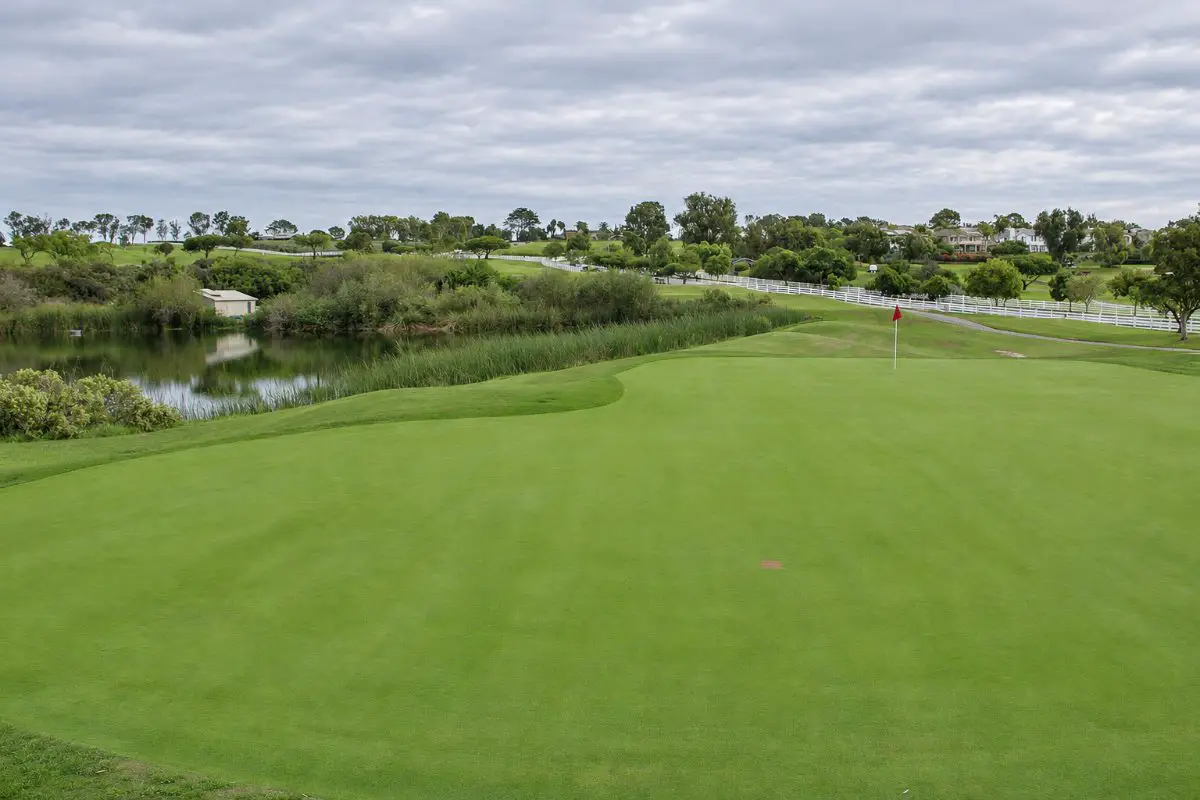

“Deliveries to Encinitas Ranch became increasingly limited and unreliable, with some days bringing substantially reduced supply and others receiving no new water,” he said. “Reliance on our remaining on-site reservoir further restricted our ability to flush accumulated salts.”
The United States Golf Association identifies 0.75 dS/m as the threshold at which salt levels become hazardous and measured levels four times that high at the irrigation lake next to the 17th hole during its on-site evaluation, according to city documents. Salinity measured 3.3 dS/m at the coupler, a level the USGA considers “too poor to support seed generation” and among the highest measured in the state.
Munak said heat and water use left the irrigation lake about 6 feet below its normal level, allowing extra contaminants from the bottom to enter the water supply.
He called the confluence of weather, water and other factors “a perfect storm.”
‘Nice plan in place’
The management and maintenance teams had to close their first green, on the fifth hole, in late August. By September, all the greens were affected.
Encinitas Ranch never closed completely, instead cutting temporary greens in front of the existing greens.
“A lot of operations would’ve shut down in that time,” Munak said. “We had a nice plan in place.”
The maintenance team began watering the greens with potable water, hauling three 500-gallon tanks on trailers to ensure clean water reached the turf.
Watering by hand is labor-intensive, requiring crews to refill the tanks regularly at the course’s maintenance shed throughout the day. All the greens were watered daily, using up to five tanks per day, according to city documents.
The course also replaced six of its 18 greens — Nos. 1, 2, 3, 7, 15 and 17 — with Centennial bentgrass left over from a reconstruction project at Spanish Hills Golf & Country Club in Camarillo, according to Munak.
The remaining 12 greens were reseeded, with seven receiving the treatment at least four times, according to the city.
“That’s how proactive we were,” Munak said. “And JC Resorts allowed that to happen.”
In response to the reduced playing conditions, Encinitas Ranch cut its green fees by 35% to keep money coming in.
Financial records indicate the course made nearly $200,000 less in September 2026 than in September 2025, with revenue falling to $229,841 from $428,387.
Munak said the course typically sees 220 to 250 rounds per day during that period, but conditions reduced that number to 65 to 85.
The range remained open but also saw a 28% drop in revenue compared with the same month a year earlier.
Munak said some staff hours were cut in response to lower demand.
Payroll was about $20,000 below budget for golf operations staff and about $2,000 below budget for maintenance staff, according to city documents.
Munak added that staff found ways to pitch in, with pro shop employees helping maintenance crews with upkeep and other work needed to bring the course back into shape.
He said “a lot of loyal customers” stopped in to buy meals at the restaurant or hit extra balls on the range to help during the financial slump.
“Everyone stepped up, which was a cool part of the whole process,” Munak said. “Everything we did was to make sure the golf course had time to heal.”
At the Oct. 20 meeting of the Encinitas Ranch Golf Authority, the board voted to move forward with an irrigation project recommended by the USGA to bring potable water to all the course’s greens.
Munak said the project would help the course withstand future challenges while easing the burden on staff who water by hand.
The project is estimated to cost about $500,000, with final estimates and designs expected by January 2027, according to city documents. The goal is to complete the work and deliver potable water to the greens by May 2027.
Starting Saturday, however, the course will once again play as it did when it opened in 1998.
“Our staff has worked tirelessly through an exceptionally difficult period, and we are proud of the progress being made,” Johnson said. “We remain committed to restoring Encinitas Ranch to the playing conditions our patrons expect while implementing meaningful improvements to protect its future.”