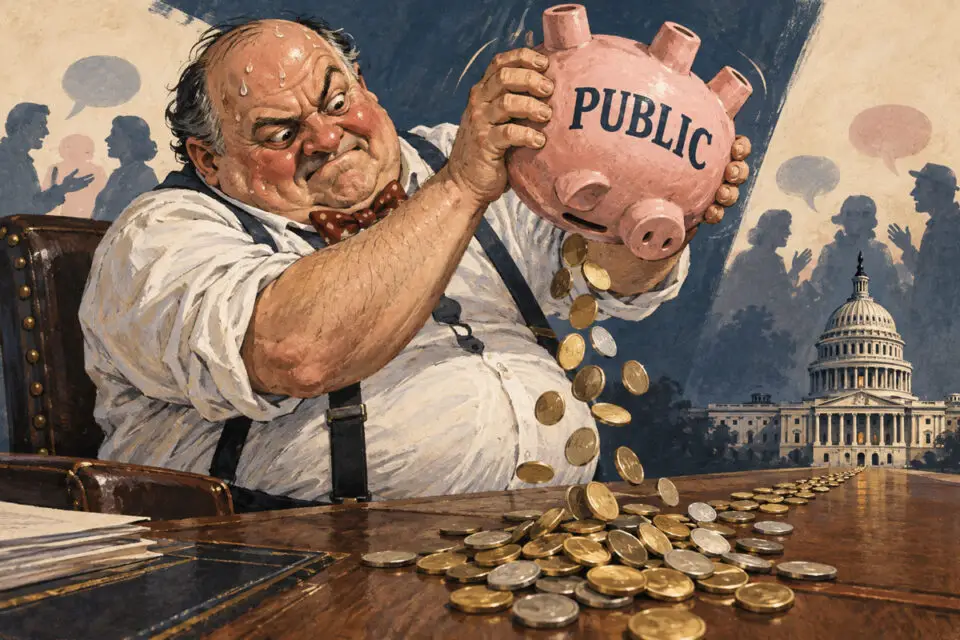
We Americans spend a great deal of time complaining about the influence of money in politics.
We complain about corporations, billionaires, unions, developers, tech executives and special interests. We watch the interviews, forward the articles and gather with people who already agree with us. We discuss what elected officials should do, what the legislature should do and what somebody should do.
Then we go home.
The organizations we oppose remain funded. The lobbyists remain in the Capitol. The attorneys continue filing briefs. The political consultants keep shaping public opinion.
And the organizations representing our own concerns struggle to pay for a website.
We tell ourselves that the difference is money. They have it. We do not. But that explanation is becoming difficult to defend.
In 2010, the Supreme Court decided Citizens United v. Federal Election Commission. The Court held that corporations and unions could spend money from their treasuries to support independent political advocacy. The decision became shorthand for everything Americans believe is wrong with money in politics.
A second decision, issued two months later, receives far less attention.
In SpeechNow.org v. FEC, the federal appeals court in Washington struck down contribution limits for organizations that make only independent political expenditures. Those organizations must remain independent of candidates and campaigns, but they may accept unlimited contributions from individuals, corporations and labor organizations. The modern Super PAC followed.
Together, the decisions changed American politics. But they did not give corporations and wealthy individuals a right that ordinary citizens were denied. They opened the door to everyone, including us. The organized interests walked through that door. Most of us citizens did not.
That distinction matters because this is not only a story about unequal wealth. It is also a story about unequal participation.
Major donors identify common interests, establish organizations and fund them. Businesses pay dues to trade associations. Unions collect dues from members. Industry groups retain attorneys, researchers, lobbyists and communications professionals. They do not wait until a crisis appears on the city council agenda. They build the machinery of influence and keep it operating.
Citizens usually do the opposite.
We wait until a project is approved, a law is passed, a school is failing, or a treasured place is threatened. Then we become angry. We organize a meeting. We circulate a petition. We write a letter. We speak for three minutes at a hearing.
When the meeting ends, most participation does too.
The other side returns the following morning with paid staff.
This does not require a conspiracy. It requires a budget.
Someone researches the legislation before most citizens know it exists. Someone meets with elected officials while the language is still being written. Someone commissions the economic study. Someone prepares the legal analysis. Someone builds the voter list and delivers the message repeatedly.
Those people are not necessarily smarter, more committed or more numerous. Often they are a small minority, but they are funded.
Meanwhile, millions of Americans who can financially support a cause never contribute. We may spend hundreds of dollars each month on subscriptions, coffee, restaurants, entertainment and purchases we barely remember.
Yet a recurring contribution to protect something we claim to value feels optional. Then we return to our preferred echo chamber and express surprise that nobody is listening.
Consider the arithmetic.
Two hundred people contributing $20 each month produce $48,000 a year. One thousand people produce $240,000. Ten thousand people, drawn from a city, region or national constituency, produce $2.4 million.
That can fund research. Legal representation. Public education. Professional communications. Candidate recruitment. Ballot measures. It can place informed citizens in the rooms where decisions are actually made.
None of this requires a billionaire. It requires participation, emotional and financial, by all of us.
Think about your credit card bill. A bunch of small purchases that add up to an intolerable total. Small contributions made consistently can produce big outcomes. Outrage is emotional. Organization is durable. One produces conversation. The other produces capacity and action.
This is not an appeal to support my political position or my nonpartisan organization. Choose your own cause. It may be environmental protection, public safety, civil rights, education, housing, taxation, any subject you are passionate about. Just know that, at the state level, the one thing you may be most passionate about will be poorly served by mere conversation.
Voting matters. Speaking matters. Volunteering matters. But we should stop pretending that political influence can be built without financial participation.
Citizens United and SpeechNow did not make organized political participation unnecessary. They made the failure to organize more consequential.
We are not powerless. We are simply leaving our power unused.
Mike Lewis is the co-founder of California Stewardship Alliance.