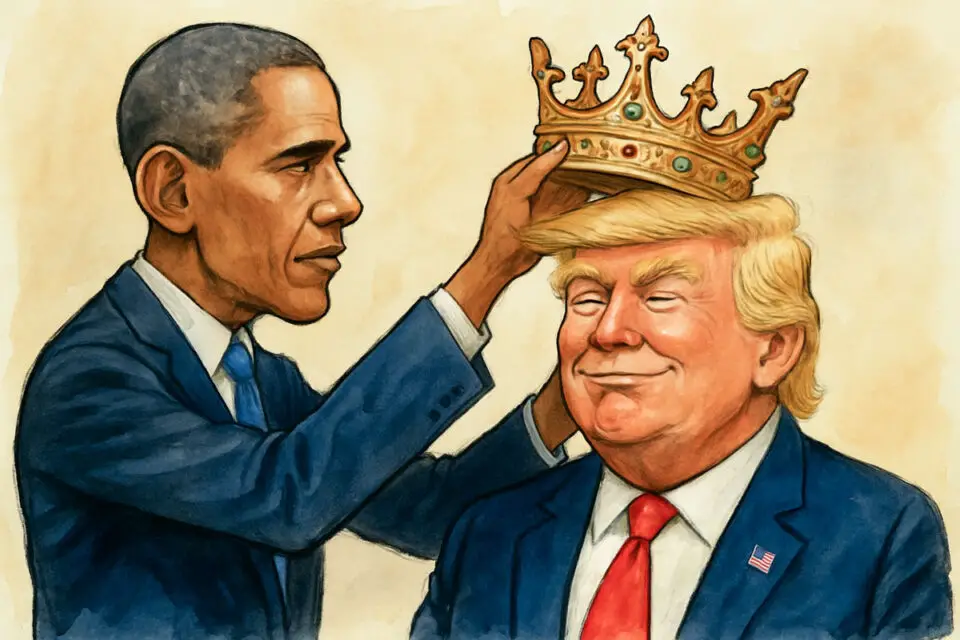
In America, we don’t care much for kings. It isn’t so much the robes and crown, it’s more the idea of too much power in the hands of one person.
To ensure that this country would never have anything like a king, the Founders divided the government so that the laws would be made by Congress, interpreted by the Supreme Court, and only executed by the President. In essence, the president doesn’t make the laws; he enforces them.
In 2010, President Barack Obama recognized these limits when he said, “I’m president, I’m not king. There’s a limit to the discretion that I can show because I’m obliged to execute the law. I can’t just make the laws up myself.”
While the three branches usually stay within these boundaries, each has been known to stray. Every president has occasionally become frustrated with the other two branches telling him what he could and couldn’t do. Every now and then, a president will take the law into his own hands.
The following will compare and contrast two such occasions.
Not long ago, the president decided that the immigration law was preventing him from doing what he thought needed to be done. He wanted the law changed, but couldn’t get Congress to change it. So he did it himself.
It was 2012, and President Obama had become frustrated when Congress wouldn’t pass the Dream Act, which would have suspended the deportation of undocumented immigrants brought into the country as children, a.k.a. the Dreamers. His solution was to have Secretary of Homeland Security Janet Napolitano send a memo to her department heads ordering them to suspend such deportations.
In other words, the law mandated the deportations, and it was the president’s job to enforce the law. He didn’t want to, and Congress wouldn’t change the law, so he stopped the deportations anyway.
Sounds a bit like a king, doesn’t it?
And yet, after this memo was sent, people didn’t fill the streets shouting, “No kings!” Why didn’t they?
Perhaps because they were considering two different things: the objective and the method used to achieve that objective.
I’ve never met anyone who thought it was a good idea to deport a hard-working Dreamer who spoke only English, was married with children, and whose only crime was to have been illegally brought into the country as a baby.
So it could be that people didn’t take to the streets because they agreed with the clearly humane objective and were therefore willing to excuse the royal method used to achieve it. In other words, they were willing to let the end justify the means.
Perhaps the silent message was: “I don’t really care if a president acts like a king, provided that he does things I agree with.” Or maybe even, “I’m good with a good king.”
President Obama insisted he was exercising prosecutorial discretion, but changing the legal status of more than 700,000 people by inter-office memo hardly seems discreet. In effect, the memo rested on the assumption that the president has the power to unilaterally decide which part of the law will be enforced and which will not.
Today, the fate of the Dreamers is still being sorted out in the courts and Congress.
In 2012, many expressed concern that this royal memo tactic might be used as a model and precedent by some future administration to do something less popular than helping dreamers. They didn’t have long to wait.
In 2021, Secretary of Homeland Security Alejandro Mayorkas sent out a similar memo advising that, contrary to statute, undocumented immigrants should no longer be detained just because they had been convicted of aggravated felonies.
To be fair, it is unclear whether President Biden ever actually signed off on this memo.
In any case, by 2024, there were more than 400,000 undocumented immigrants with aggravated felony convictions living in the country who had not been detained.
Once again, the streets did not fill with people shouting, “No kings!” Why not?
Were those who had supported the Dreamers now quietly supporting this new memo? Maybe, but the following events suggest that not deporting innocent Dreamers was far more popular than not detaining undocumented immigrants who were also convicted aggravated felons.
Throughout 2024, crowds flocked to Trump rallies where they were being promised that the law would be enforced, meaning such felons would be detained and deported on an expedited basis.
In April of 2024, the House of Representatives impeached Secretary Mayorkas for failing to enforce that law. In a party-line vote, the then-Democratically controlled Senate dismissed the case, thus avoiding a trial.
That November, Trump’s election suggested that many voters approved of his promise to enforce the law.
In January of this year, the new Congress passed the Laken Riley Act, which expanded the detention mandate to include undocumented immigrants convicted of, or even arrested for, non-aggravated felonies. President Trump signed the act into law.
All of this suggests that Secretary Mayorkas’s objective wasn’t widely popular, which helps explain why the royal nature of his memo was not as easily excused as Secretary Napolitano’s.
The unspoken message was something like, “Who made him king?”
(It makes you wonder whether the 2024 election would have turned out differently if Mayorkas had never sent the memo. The road not taken, I guess.)
It was then that President Trump began enforcing the immigration law once again. And it wasn’t long before people poured into the streets shouting, “No kings!”
Looking back, it is understandable that people would protest when (1) a law long thought to be a dead letter was suddenly revived, (2) the Dreamers, while not being deported, were still caught in legal limbo, and (3) immigrants who had entered the country illegally were suddenly subject to deportation even when they had been convicted of no other crime. But even in this context, to shout “No kings!” misses the mark.
After all, it wasn’t President Trump who sent out the royal memos to unilaterally change the law. He was simply enforcing duly enacted immigration law, whether we like the law or not. By enforcing the law, he was just doing his job as president, whether we like him or not.
To sum up, when a president refuses to enforce a law, he is acting like a king. If we think it is a bad law, we may think he is a good king, but he’s still acting like a king. On the other hand, when a president enforces a law that we think is bad, we may think he’s a bad president, but that doesn’t mean he’s acting like a king.
In any event, October’s Harvard/Harris poll showed that 78% of Americans actually support deporting immigrants who are here illegally and have committed crimes. Meanwhile, the number of undocumented immigrants with aggravated felony convictions who haven’t been detained or deported has fallen by about 85% over the past year, to something like 60,000. So there’s that.
It could be that these shouts of “No kings” were in response to some other action taken by President Trump. He may very well have crossed the line between being a president and a king elsewhere.
In case you hadn’t noticed, this president is not troubled by the need to be consistent.
Scott Chambers is a cartoonist, author and songwriter in Encinitas.