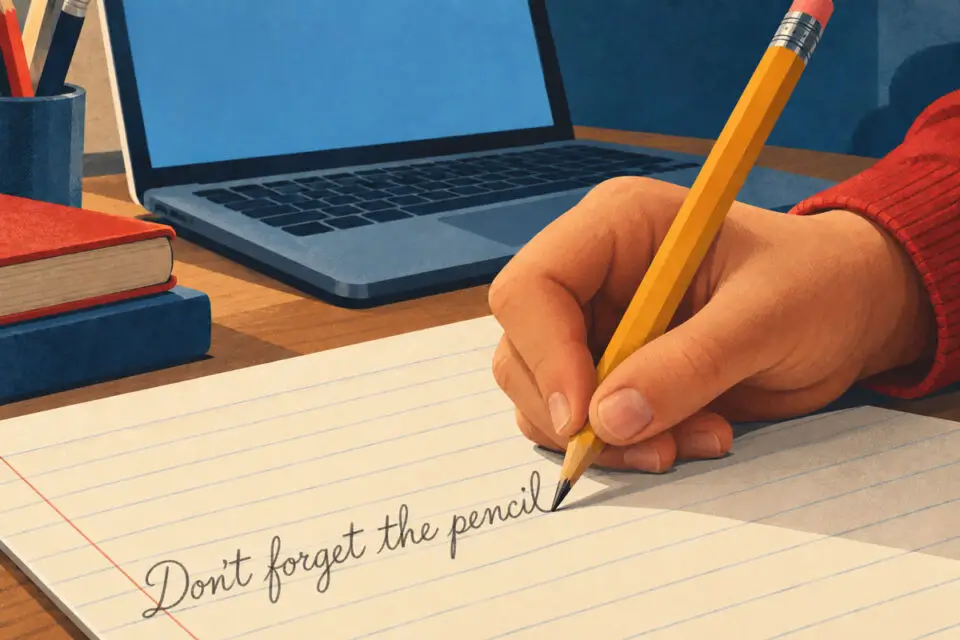
Our children are growing up in a world where keyboards and touchscreens increasingly replace pencils and paper. As technology becomes more central to how students learn, it is reasonable to ask whether cursive handwriting still deserves a place in the classroom.
I believe it does. In fact, as our world becomes more digital, I argue that protecting foundational skills like handwriting becomes even more important.
In early 2024, California made cursive writing instruction a requirement in schools, joining at least 24 other states that require some form of cursive instruction. That decision reflects something educators have long understood: handwriting is about far more than producing neat letters. It develops fine motor skills and hand-eye coordination, engages the brain in ways typing does not, and gives children an opportunity to practice something increasingly rare in our digital world: slowing down, working through difficulty, and creating something themselves.
I know this because I struggled with cursive myself.
I learned to write cursive in third grade, and I wasn’t particularly good at it. I struggled with the letters, had to practice a lot, and my handwriting still doesn’t get many compliments. But with practice, something that initially felt awkward became familiar. Eventually, I wasn’t thinking about how to form each letter; I was simply writing.
That experience has stayed with me, not because learning cursive was difficult, but because it taught me how children learn: practice builds competence, competence builds confidence, and skills that once felt challenging can eventually become second nature.
That lesson extends well beyond handwriting. As educators and parents, we should be careful not to abandon foundational skills simply because technology offers us a newer or faster alternative. At The Rhoades School, we never stopped teaching it because we continue to see its value firsthand.
Research supports the value of handwriting. Researcher Dr. Karin James has used brain imaging to demonstrate that forming letters by hand activates areas associated with reading in ways that typing or simply observing letters does not. Writing also activates neural networks associated with language, memory, attention, and learning in ways typing does not.
There is a reason for this. Learning to write requires children to coordinate what they see, what they hear, and how they move. Effective handwriting instruction goes beyond copying letters. Students trace, skywrite, say sounds aloud, and then form letters on paper. These multisensory experiences reinforce the brain’s understanding of language and strengthen learning.
This is not an argument against technology. Our students absolutely need strong digital skills, and schools have a responsibility to prepare them to use technology effectively and responsibly. But preparing students for a digital future does not mean replacing every foundational practice with a technological one.
We don’t stop teaching reading because students have access to audiobooks. We shouldn’t stop teaching handwriting because students have access to keyboards.
Sometimes, the slower and less convenient approach is exactly what learning requires.
Handwriting offers something increasingly rare: an opportunity to slow down. Writing by hand takes more time, and that can be an advantage. Research on note-taking has found that students who type are more likely to record information verbatim, while students who write by hand are more likely to process and synthesize what they hear. The slower pace can encourage students to think about what matters rather than simply capture everything in front of them.
I see this every day at The Rhoades School. I see a fifth grader carefully showing every step of a math problem, a fourth grader revising an essay in the margins, and a kindergartner proudly writing their name on a card for the first time.
These moments are about much more than handwriting. They give students opportunities to think, plan, revise, persist, and create. They are also opportunities for children to discover something invaluable: they can do hard things.
Our students need to be prepared for a digital world. They need to understand technology, use it responsibly, and develop the skills to thrive alongside it. But preparing children for the future should not mean abandoning the experiences that help them become confident, capable learners.
Every parent wants their child to believe, “I can do hard things.”
Sometimes that lesson comes from learning to read. Sometimes it comes from solving a difficult math problem. And sometimes, it comes from sitting down with a pencil, practicing something that doesn’t come easily, and eventually realizing, “I did that.”
In a world filled with screens, that may be one of the simplest and most valuable things we can give our children.
Josh Henriquez is the elementary school principal at The Rhoades School in Encinitas.