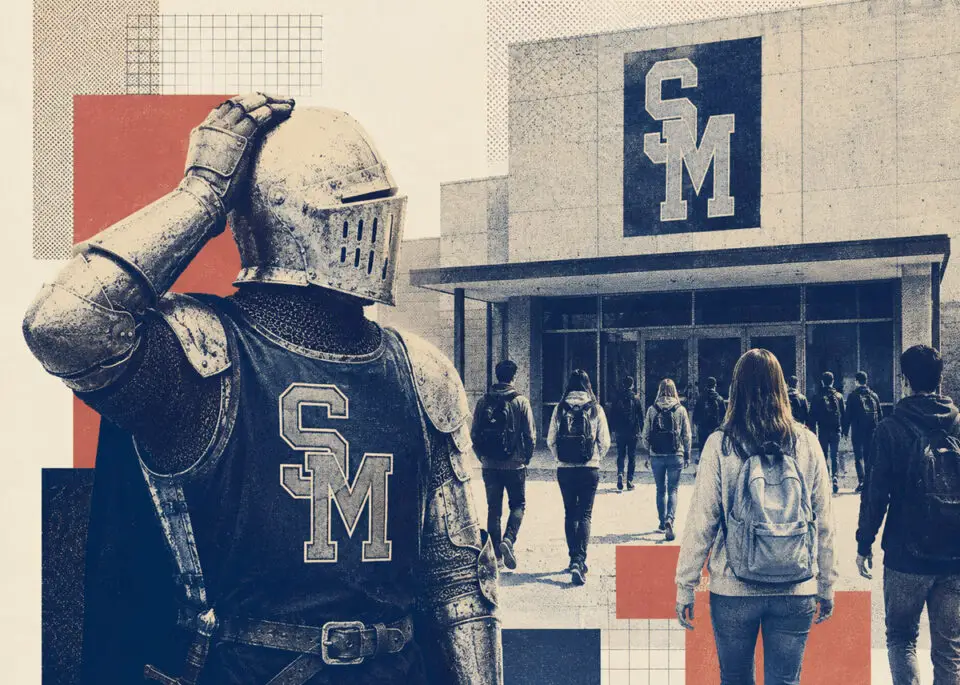
If you’re driving past San Marcos High School, you can see huge metal letters on its east wall that spell out the name “Knights.” The school’s teams are, of course, the Knights of San Marcos.
If you’re exploring the narrow streets of Venice, you can find, not far from the basilica that houses the remains of Saint Mark the Evangelist, the current headquarters of l’Associazione dei Cavalieri di San Marco, in English: the Order of the Knights of San Marcos.
Maybe someday, as part of an enriching overseas experience, San Marcos High School’s baseball team will visit them and play a friendly game.
This duplication of names may seem like a glitch in the matrix, but there’s a simpler explanation.
Over the centuries, the word “knights” has been used in so many different places and in so many different ways that it has acquired many different meanings.
After sorting through several meanings of “knights” from the fields of history, legend, current events and fantasy, the use of “knights” as a team name for a California high school will be considered.
A good place to start might be Britain in 1066, when the conquering Normans began formalizing the feudal system. It worked like this: The king owned all the land and granted portions of it to high-ranking noblemen and clerics, who then granted smaller fiefdoms to lesser nobles, such as knights.
Peasants, many of them serfs who were bound to the land by law, worked these fiefdoms. The knights’ job was to protect the kingdom, collect the king’s taxes and enforce the king’s laws. (They could also be asked to participate in Crusades.)
It may sound harsh, but in a way, the king and high-ranking nobles were the enslavers, the serfs were the enslaved people, and the knights were the overseers who cracked the whip.
Feudalism wasn’t equitable.
By 1607, when Jamestown was founded, serfdom in Britain had ended, but almost all the wealth and power, and about three-quarters of the cultivated land, remained firmly in the hands of the nobles and the church. Most people were still poor tenant farmers and laborers who had to work the land of the upper classes.
Unsurprisingly, hundreds of thousands of British subjects went to America hoping for land of their own and a way out from under the thumb of the landed gentry. Many found both. The American Revolution marked a break with the British hierarchy, notwithstanding chattel slavery.
When the founders included the phrase “No Title of Nobility shall be granted by the United States” in the Constitution, they didn’t just mean “No Kings!” They also meant “No Knights!”
While the colonization of Mexico was quite different, there were similarities.
Most of the viceroys of New Spain were knights. Many of them were members of the Order of the Knights of Santiago, as were the conquistadors Hernán Cortés and Francisco Pizarro. (Santiago Matamoros was St. James, the Moor Killer.)
In those days, the Order was very strict about the purity of its knights’ blood (limpieza de sangre), admitting only nobles with no Jewish or Moorish ancestors and those who had never been found guilty of heresy by the Spanish Inquisition. (Interestingly, as part of the effort to co-opt Indigenous royals, a few mestizo descendants of Moctezuma were admitted to the Order.)
The viceroys implemented and oversaw the operations of both the encomienda and hacienda institutions, in which lesser nobles, the hidalgos and hacendados, exploited the Indigenous and mestizo people of Mexico for centuries, first through forced labor, then through debt peonage. Like the viceroys, these lesser nobles were generally of Spanish origin. This essentially racist feudal exploitation of poor Mexicans only ended in the 20th century due to the efforts of revolutionary leaders like Emiliano Zapata.
Article 12 of the Mexican Constitution is clear: “No titles of nobility … shall be granted in the United Mexican States.”
So, Mexico was also fed up with knights.
King Arthur’s knights may be the most famous of all, but the Arthurian legend is almost entirely fiction. While there may have been an Arthur, the historical record suggests he was probably a Romano-Briton warlord fighting in the ultimately unsuccessful effort to hold back the invading Anglo-Saxons. The fanciful tales of the “Knights of the Round Table” with wizards and magic were made up centuries later, primarily to amuse the aristocracy.
In the world today, there are fewer knights, and knighthood is very different. In the U.K., you’ll find Sir Mick Jagger and Sir Elton John. In the United States, three American presidents have been granted honorary knighthoods by the British Crown: Eisenhower, Reagan and Bush (H.W., not W.).
In Mexico, the only recent order was the Knights Templar (Caballeros Templarios), a drug cartel in Michoacán that was broken up less than 10 years ago with the help of groups of armed civilian vigilantes called autodefensas. The Order of the Knights of San Marcos, the one in Venice, is actually more of a service organization, sort of like the Knights of Columbus or the Independent Order of Odd Fellows.
Most knights today exist only in the realm of fantasy. There’s the Dark Knight, a.k.a. Batman, who fights strange bad guys in a make-believe city called Gotham. Then there are the Jedi of “Star Wars” fame, various human and humanoid knights with magical powers. More recently, in the series “Game of Thrones,” there are the knights who failed to live up to their chivalrous ideals as they propped up their planet’s brutal feudal system, all while dodging fire-breathing dragons.
So what should we picture when we call the San Marcos High School baseball team “Knights”?
Should we picture the actual feudal overseers of Britain? Or the historic conquerors of the Aztecs, like Hernán Cortés? Or the very real gachupines who owned the encomiendas and haciendas?
Or should we picture the imaginary Knights of the Round Table, so ably mocked by Monty Python? Or old rock stars, dead Republican presidents, defunct narcotraficantes, or the tail-twister at a Lions Club meeting? Or should we think of Yoda, Ser Boros Blount or the Caped Crusader? Or should we picture the delusional Don Quixote at bat, with an old barber’s basin on his head?
Let’s face it, the name “Knights” has lost much of whatever luster it once may have had.
The good news is that team names can be changed. For example, in 2021, after a petition was circulated by students, Junípero Serra High School in Tierrasanta changed its name to Canyon Hills. At the same time, its teams’ name was changed to the Rattlers. They had been the Conquistadors.
Think about it. More than half of the students at San Marcos High School are Latinos, and about a third are Anglos. Should they have to play and cheer for teams named after their ancestors’ oppressors? No, they deserve a name that celebrates their ancestors’ fight for land, liberty and independence.
Both the flag of Mexico and the Great Seal of the United States of America feature the same majestic bird.
The teams of San Marcos High School should be the Eagles.
S.H. Chambers is an author, musician and cartoonist. He lives in Carlsbad.
Related Articles:
- USK coaches, athletes hit restart button after… May 17, 2024
- CSUSM sophomore makes DII history playing softball,… April 9, 2024
- Opinion: Politics over pupils for Vitale, Oceanside… March 17, 2025
- Friday Night Lights: North County prep football preview August 21, 2024
- From Tijuana to Palomar: Ochoa crosses border to… March 11, 2026
- Op-Ed: Ethnic Studies shouldn’t replace 9th grade English April 18, 2025