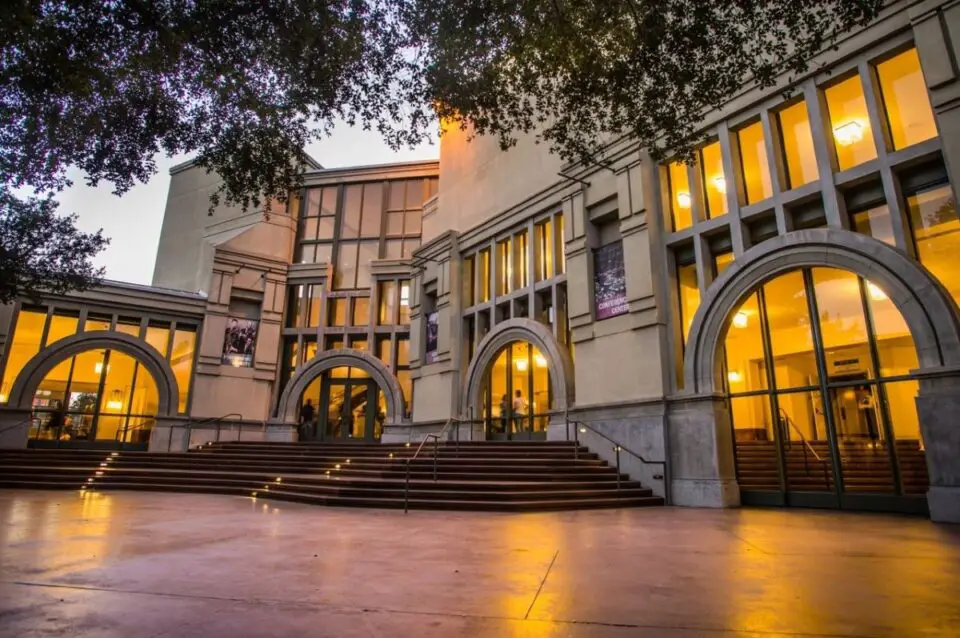
ESCONDIDO — The California Center for the Arts, Escondido, is looking to build on its solid footing from the past two years with new ventures and ideas for the future.
Gina Lopez, the center’s CEO, said at a public meeting Jan. 20 that while the center has posted positive financial returns over the past two years, her team is continually looking for ways to expand its offerings and deepen connections between the community, art and artists.
“There’s so many things that we can do to connect everyone together and we really need to do that. It’s what makes us human,” Lopez said. “I know we have deficiencies, because we want to do so much more.”
The center recorded positive net income in both fiscal years 2023-24 and 2024-25, according to CCAE data. Financially, operations were in the black by about $720,000 and $135,000 during the two periods, respectively. The largest sources of revenue came from facility rentals and ticket sales.
The center expects to generate more than $7.8 million in the current fiscal year, putting it more than $500,000 in the black.
The CCAE opened in October 1994 as a community hub for art performances, exhibits and classes on a 12-acre campus adjacent to City Hall and Grape Day Park, according to its website.
Lopez said that while the center maintains a close relationship with the city of Escondido, the foundation operates it as a separate entity. The city pays a management fee to the foundation — $660,000 for each of the past two years — and that same amount is budgeted for the current year.
In addition, the city pays about 70% of the center’s liability insurance, all utilities and any major maintenance projects that arise, according to Lopez. Altogether, the city contributes roughly $2.5 million annually to the center, though not all of that funding is reflected in the center’s revenue and expense figures.
“It’s the city’s facility, it’s the citizens’ facility,” Lopez said. “We are the stewards of the facility, we are the management team.”
Escondido City Councilmember Consuelo Martinez said that at the city level, “we are very supportive of the foundation.”
Lopez and other members of the leadership team, including the board of trustees, spoke and answered questions during Tuesday’s town hall meeting. The foundation presented a series of prompts to gather feedback, either through audience questions or written ideas submitted on slips of paper.
Leila Sackfield, CCAE board chair, said that last year, more than 70 slips were submitted, and each received an individualized response from the foundation.
During the open discussion portion of the meeting, Alma Plancarte, an arts center volunteer, asked about expanding programming geared toward teenagers.
Lopez said she agreed, emphasizing the importance of providing safe spaces for teens to express themselves.
“You’re either going to be creative or disruptive,” she said. “And if you’re creative, you can’t be disruptive.”
However, Lopez said she would prefer to rely on a youth advisory council to guide decisions when developing meaningful programming for younger audiences.
“One thing that I’ve learned running arts centers is if adults try to program for teens, it doesn’t work,” she said.
Other suggestions from attendees included using artificial intelligence to translate spoken English and Spanish — possibly via a video board — during presentations or performances, creating a sculpture garden, and exploring art as a tool for behavioral health.
Access — and how to expand it — emerged as a major theme of the discussion.
“One thing I’ve heard since day one is the facilities are too expensive,” Lopez said. “I hear you, they’re expensive. They’re expensive for us to open our doors to do anything, hence we’re here tonight [in a conference room] instead of in a concert hall like we were last year. It costs us five figures to open those doors for anything, even for ourselves.
“We realize that’s a barrier and we’re here to remove barriers.”
Sackfield highlighted free events hosted by the center throughout the year, as well as the newly acquired mobile Rotary Centennial Stage, which she said should help increase the number of accessible events the foundation can support.
“We are really trying very hard as a board and as an organization to respond to the needs of the community,” Sackfield said. “Because we are stewards of your place. We want art to live here, but we want the art that you want to live here.”