REGION — Proposed regulations for short-term rentals in the cities of Del Mar and Encinitas can now go into effect following approval by the California Coastal Commission at its meeting on Thursday in Half Moon Bay.
Del Mar has been attempting to implement regulations for short-term rentals, also known as STRs or vacation rentals, for several years, a process that has sparked contention and legal challenges from STR operators.
The Thursday meeting marked the second time that Del Mar has brought an STR ordinance before the commission. The city banned new STRs in 2016 and then adopted a restrictive ordinance in 2017, which the commission ultimately rejected, sending the city back to the drawing board.
Following delays due to the COVID-19 pandemic and legal challenges, the city began drafting a new ordinance, which was adopted in 2024.
“It’s been over 10 years that we’ve been working on this, so this is a huge milestone for us to be here before you like this,” Del Mar Principal Planner Amanda Lee told the commission.
The ordinance, approved by the commission in a 7-2 vote, requires all short-term rental owners to register with the city and obtain a permit. It also caps the total number of STR permits in the city at 129, including several neighborhood-specific caps: a maximum of 77 STRs in the North Beach area, 32 in the South Beach area, and 19 in the Hills area.
All short-term rentals must be operated from a primary residence where the owner lives for at least half the year, and non-hosted rentals are not permitted. All STRs are required to have a three-night minimum stay.
Lee said the three-night minimum is based on the average length of stay at STRs in Del Mar and neighboring cities like Solana Beach. Two commissioners favored reducing the minimum to two nights — in line with what was adopted for the city of Encinitas at the same meeting — to serve families who may only be able to go away for one weekend.
“When we focus on equity, we don’t look at the average. We look at those folks with the highest need,” said Commissioner Christopher Lopez.
However, the commission ultimately chose to maintain the proposed three-night minimum, stating that it makes sense for a city with fewer than 4,000 people, such as Del Mar, where other hotels and motels provide accommodation.
“This is a very small city, wholly within the coastal zone, and there’s a lot of existing visitor-serving accommodations and hotels and motels around it, compared to Encinitas,” said Commissioner Ann Notthoff.
Short-term rentals are allowed in condominium buildings in both residential and commercial zones, and in apartments only in the commercial zone.
In condominium buildings, only 10% of the total units can be used as STRs. Residents at the Costa Del Rey condo complex, where 12 of the 16 units are currently STRs, have asked to be exempt from this rule but were denied.
Costa Del Rey resident Gina Mattern said two-bedroom units in the complex are rented as STRs for around $300 a night, which is far less than the citywide average of $630 per night. She added that having multiple STRs centralized in one complex has less impact on a neighborhood than having them spread across multiple homes.
“Eliminating STRs here would not increase affordable housing, and it would decrease affordable coastal access,” Mattern said.
All existing rentals were given the opportunity to be grandfathered in, allowing them to continue operating without complying with the new regulations until their permit expires, is not renewed, or the property is sold.
A total of 150 existing STRs have registered with the city to be grandfathered in and are not subject to the citywide cap of 129. However, no new rentals will be allowed to apply for a permit until the number drops below the cap.
While they will still be able to operate, many existing owners still shared major concerns about the ordinance’s impact on new operators, particularly the primary residence requirement.
Kimberly Jackson, a vacation rental property manager in Del Mar, noted that most existing rental owners do not live in the homes they rent out. She said the new rules are a “de facto ban,” as most people cannot or will not operate an STR out of their main home.
“This will attrition units out of the marketplace, thus driving up the cost for visitors to access the coastline in Del Mar,” Jackson said.
Lee said the city needs the primary residence requirement to show the state that it is maintaining housing units wherever it can. Del Mar has an extremely high vacancy rate of 25%, which she said is partially due to STRs.
“It’s to keep them as the primary use for housing. It doesn’t mean owners can’t do STRs moving forward, it just means we get to still count those toward our total housing, and provide housing stock for future residents,” Lee said.
Voters in Del Mar approved a ballot measure in 2024 to charge a 13% transient occupancy tax, or TOT, for STRs in the city.
Encinitas regulations
The Coastal Commission also approved Encinitas’ STR regulations on Thursday. Encinitas currently has limited regulations for STRs, limiting them to single-family homes and duplexes and requiring a three-night minimum stay for non-hosted STRs.
The new ordinance sets a percentage-based cap on the amount of STRs allowed in the city, a distance requirement between STRs, and parking requirements. Under the direction of the commission, a proposed three-night minimum stay for non-hosted STRs was also reduced to two nights.
Citywide, non-hosted STRs will be capped at 2.5% of the total residential units. This means there could be around 654 total non-hosted STRs citywide, 358 more than there are today.
There is a separate cap for non-hosted STRs west of Interstate 5, which is in the Coastal Zone and houses the majority of the city’s STRs. In this area, the cap will be 4% of the total residential units, equal to 376 STRs. This cap allows for 147 more non-hosted STRs west of I-5 beyond what currently exists.
Encinitas previously considered caps of 3% and 5% before settling on 2.5% and 4%. City staff said that as housing in the city grows, the cap prevents the city from being overrun with STRs.
“Today, we don’t have any caps. We have no regulations or limitations on short-term rentals generally, and so when we were looking at establishing those caps, it was on the basis of the feedback we received,” said Assistant Director of Community Development Meagan Openshaw.
The cap also excludes units in the private Seabluffe residential community in northwest Encinitas, which has historically been used for short-term rentals. Currently, 57 of the 255 units at Seabluffe are operated as STRs.
Commissioners said the city’s proposed cap may be too generous, given the number of STRs that could still be added and the potential for further unwanted impacts on neighborhoods and the city as a whole. However, they said they chose to defer to the city’s preferences.
“Your number’s a little overly generous, but … it’s a local control municipal issue that I’m not gonna try to impose my thoughts on,” said Commissioner Raymond Jackson.
Hosted STRs will not be subject to a cap.
STRs are permitted only in single- and two-family homes, and non-hosted rentals cannot be within 200 feet of each other. This is to prevent oversaturation of STRs in a single neighborhood, city officials said.
Resident Nicole Jackson said the 200-foot distance requirement is too restrictive for the Cardiff area, where she operates two boutique rentals in a duplex because the lots are very small.
“In Cardiff Village, it’s incompatible with how the city has laid it out,” she said. “It is an effective ban in the neighborhood that will restrict entire blocks for one permit.”
Community members and commissioners also pushed back against the proposed three-night minimum, noting that few other hotels and motels offer affordable accommodation for visitors.
Commissioner Ariel Kelley said many people cannot afford a three-night vacation and that this provision would restrict those who want to stay in the city without having to stay in a more expensive hotel.
“That, to me, is an inequity in this construct,” Kelley said. “There are a lot of people in our state who can’t take a three-day weekend, or hotel stay when they want to, because they are the working people of the state, and we have a two-day weekend and a five-day work week.”
There will be no minimum number of nights for hosted STRs.
While all new STRs must comply with the new regulations, existing rentals in Encinitas that operate outside these parameters can continue to operate as “legal nonconforming” STRs, according to the city.
All short-term rentals, however, must obtain a permit and pay TOT to the city.
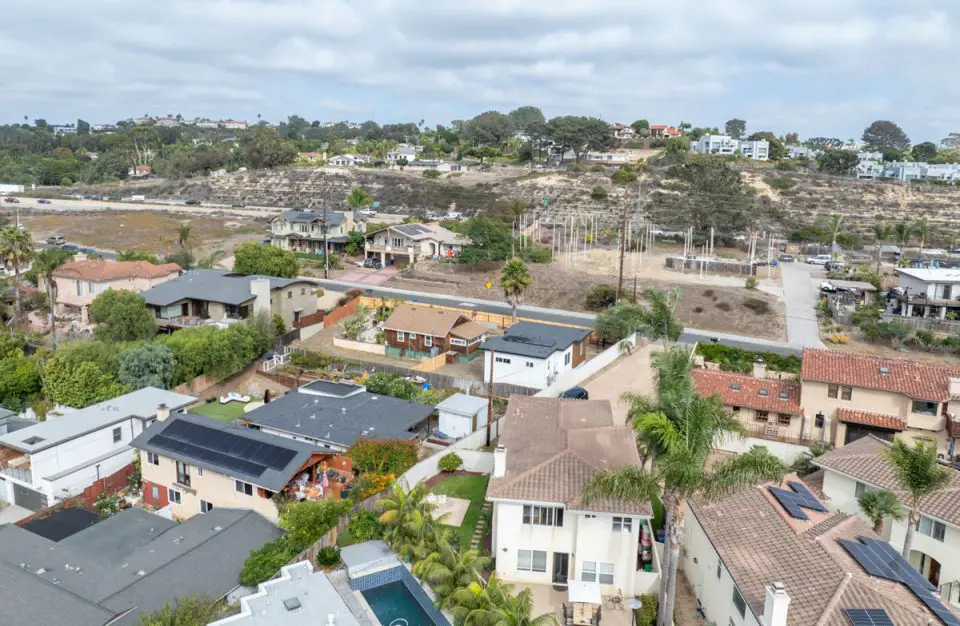
CORRECTION: A previous photo that ran with this article depicted a condominium complex just outside the city of Del Mar and would not be subject to the city’s STR rules.