
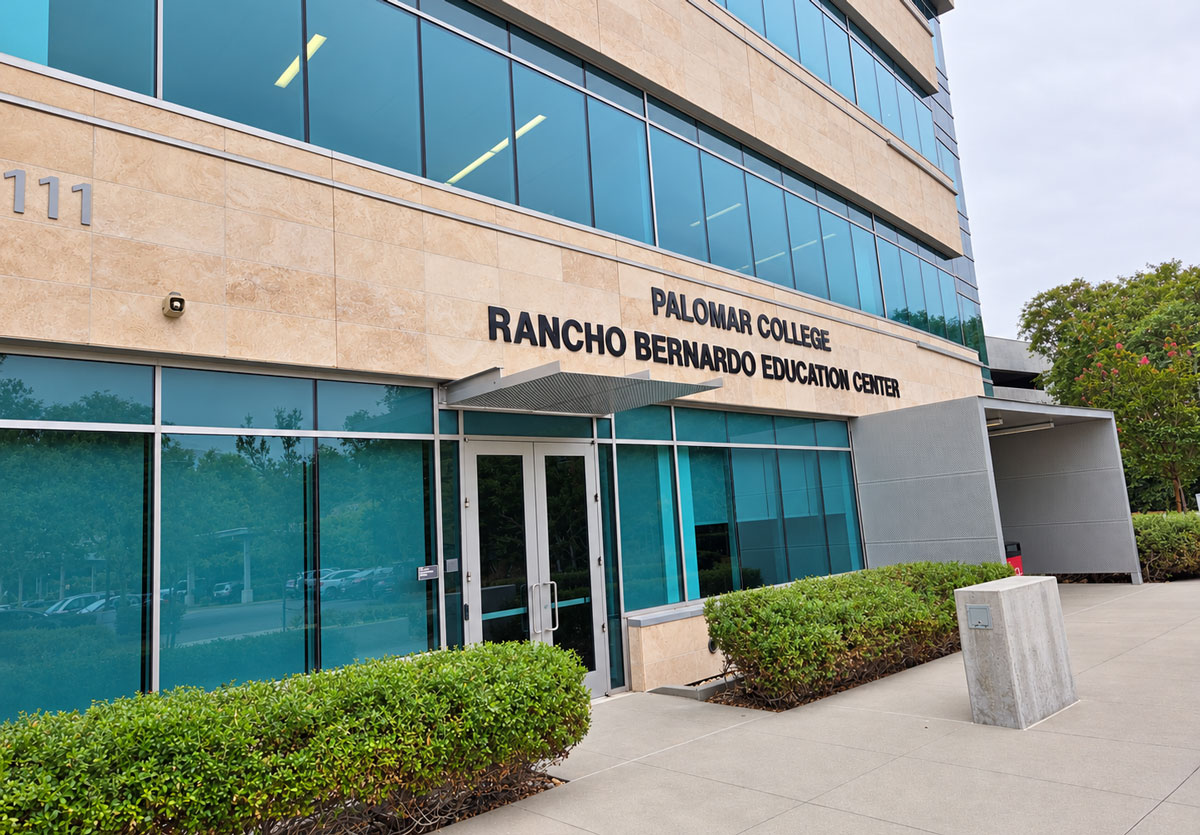
RANCHO BERNARDO — Eighty years after Palomar College admitted its inaugural class, the school has reached another milestone: the first class of juniors is working toward a bachelor’s degree this semester at the Rancho Bernardo campus.
Only 12 years ago, the state Legislature opened the door for community colleges to offer four-year degrees. Until 2014, only California State University and University of California campuses could offer bachelor’s degrees among the state’s public schools.
MiraCosta College in Oceanside began offering its first bachelor’s degree, in biomanufacturing, in 2017.
Building on its associate degree programs in architecture and interior design, Palomar’s new Building Performance & Environmental Design (BPED) degree lets students focus on either field or on construction management.
Architecture professor Joseph Lucido, who co-leads the BPED program with interior design professor Jessica Newman, said an affordable architecture degree program was needed.
Many students interested in architecture lack the desire or ability to absorb the $150,000 cost of a bachelor’s degree in the field. At Palomar, upper-division classes cost more than freshman- and sophomore-level courses, but the total cost is closer to $15,000.
At the same time, architecture and interior design firms consistently told the college that the graduates they hired were not properly trained in how design work is conducted in a professional setting, requiring them to spend time and resources helping recent graduates adjust.
Lucido said Palomar’s entire program is “based on what we heard from our teaching firms.”
Those “teaching firms” are another distinctive part of the program. Palomar has partnered with two local architecture firms, Sillman Architects and HMC Architecture, drawing on their input to shape the curriculum and classroom environment.
During their final year, students also work in the firms’ offices as part of a mentorship.
Newman explained that internships can be expensive for businesses because someone must assign and supervise interns’ work and, in California, often pay them as employees. Under Palomar’s mentorship model, firms provide students with a desk where they can work on their senior projects every Friday.
“We ask that the students attend staff meetings,” she said. Spending time in an office each week also teaches students soft skills that are harder to teach in a classroom: “How to dress, how to talk.”
Palomar’s first bachelor’s degree program is structured differently from programs at many four-year campuses, where students progress from freshman year through graduation after being admitted. The two-year BPED program requires a separate application, and students must first earn — or be on track to earn — an associate degree in architecture or interior design.
To prevent bottlenecks that could delay graduation, the program accepts only 24 students per semester. Everyone takes the same classes at the same time and follows the same schedule.
“When you get accepted, you will get your classes,” Lucido said.
Lucido and Newman said putting architecture, interior design and construction management students in the same classrooms helps them learn about one another’s fields as well as their own.
“We get more versatile practitioners,” Lucido said. As Newman pointed out, in the professional world, “No one is ever working on a building by themselves.”
The program also offers an annual study abroad component. Next summer, students will spend several weeks in Germany learning how design and materials differ there. These opportunities help students understand different methods, Lucido said.

Palomar worked with the teaching firms to identify the software used across the industry and uses those same platforms in the classroom.
Students also sign a performance contract with faculty each semester, modeled on the contracts architecture firms sign with clients. The students’ design plans must follow industry standards, so by graduation they will have four complete sets of designs — one from each semester — to share with potential employers.
Newman said architecture graduates often leave with impressive portfolios, but their work sometimes lacks the foundational design behind the attractive exteriors.
“They have beautiful renderings, but nothing about the process of how they got there,” she said. “The pretty design has to match the functionality (at Palomar).”
Lucido said work that can seem overwhelming in an isolated classroom setting becomes clearer when it is part of an integrated design process.
“Foundation details are boring – but when it’s for your building, it’s different!” he said.
Kailee Fitzgerald, a junior from Poway, came to Palomar as a freshman to study orthodontics. But after taking a drafting class as an elective, she fell in love with the subject and decided orthodontics was “maybe not my passion.”
She switched to interior design, earned her associate degree and said she hopes to design community spaces after graduation. “Social media is separating people.”
Frank Montoya is focusing on architecture. He grew up in Rancho Bernardo and was a mechanical engineering major as a freshman. Like Fitzgerald, he became fascinated with drafting, switched majors and now hopes to design residential medical care facilities after graduation.
Evienne Till, like Montoya, is focusing on architecture. Unlike her two classmates, she entered the architecture program as a freshman. Till now hopes to pursue the emerging field of neuroarchitecture, which combines architecture and psychology.