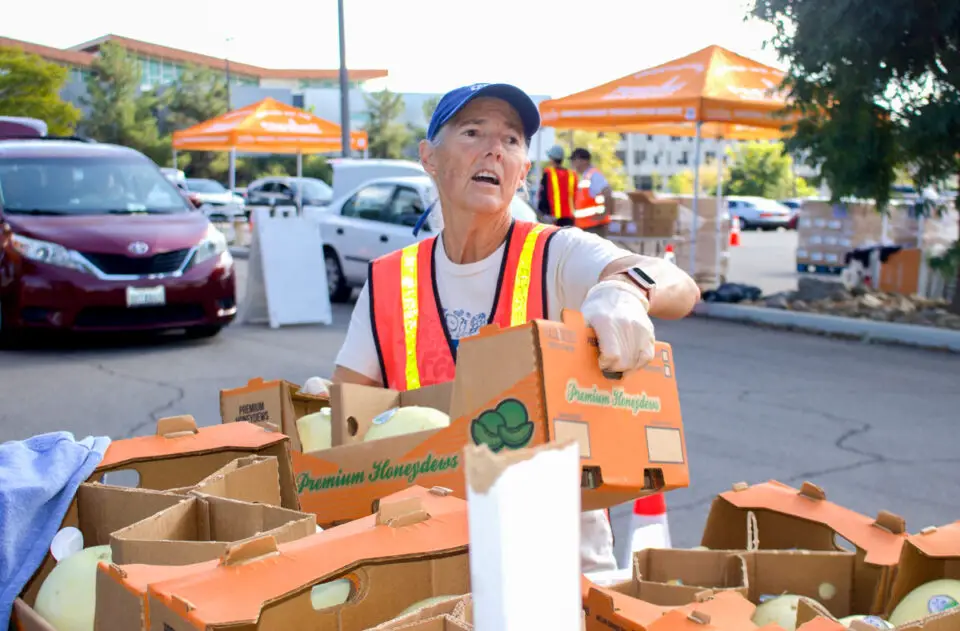
SAN DIEGO — The San Diego County Board of Supervisors unanimously approved a $1 million pilot program Thursday to partner with two regional food banks on emergency food distribution events in communities most affected by recent federal benefit cuts.
Sponsored by Vice Chair Monica Montgomery Steppe, the program will be administered by the county’s Health and Human Services Agency and is intended to address rising food insecurity stemming from recent changes to CalFresh eligibility.
The initiative directs the county’s chief administrative officer to:
- Carry out emergency food distribution events for one year through partnerships with the San Diego Food Bank and Feeding San Diego in 16 “high-impact ZIP codes.”
- Provide two progress reports detailing the number of households served, service gaps, program funding, CalFresh benefit losses and enrollment trends.
- Determine that funding emergency food distribution and related hunger relief services is necessary to meet residents’ health and welfare needs.
County officials identified 16 communities where families have been hardest hit by CalFresh eligibility changes.
“While local food banks and community pantries work incredibly hard to provide access to food, there are still gaps in coverage that leave too many families vulnerable,” county staff said.
Food distribution events are expected to begin as quickly as possible at county community and family resource centers and library branches.
Before the vote, Montgomery Steppe said access to healthy food is essential.
“We know these wraparound services are crucial to assisting families looking for long-term food security and stabilization resources, during a time of significant change,” she said.
“It’s both a moral and just action to support our neighbors in their time of need.”
Supervisor Joel Anderson praised the proposal and asked county staff to consider including additional high-need communities in his district.
The program drew broad public support.
Sam Duke, program director for Feeding San Diego, said the organization served roughly 500,000 residents last month.
“The families we serve can’t vote on this today, but they are counting on your leadership,” he said.
Natalie Raschke, a resident who has experienced homelessness, told supervisors, “If you can’t eat, it literally deteriorates your mind. … We have to support each in this rough spot, no matter how we got here.”
Another speaker said many active-duty military families also rely on food banks.
The pilot program stems from a March directive instructing Chief Administrative Officer Ebony Shelton to develop a response to CalFresh eligibility changes that took effect June 1.
It also builds on the board’s approval last November of a proposed Safety Net Bridge Program in response to federal budget cuts.
According to county documents, changes in federal policy established through House Resolution 1 imposed stricter work-reporting requirements for public assistance programs, creating what Montgomery Steppe’s office described as an immediate crisis for vulnerable residents.
County estimates indicate about 93,500 San Diego County residents could lose some or all of their CalFresh benefits, while roughly 314,000 people may face new Medi-Cal work requirements that could jeopardize their health coverage.