CARLSBAD — An ongoing dispute is reaching a head between a Carlsbad homeowner and the California Coastal Commission regarding requirements for public access on his property, after the city of Carlsbad asserted in a letter that the state commission has no basis for several of its claims.
The central disagreement of the multiyear controversy is over the terms of a 1998 Coastal Development Permit, which was granted to property owner John Levy for the construction of his home, known as Levyland, along the Buena Vista Lagoon near the Carlsbad-Oceanside border.
Levy, who spent many years living in New Zealand and has since moved back to Carlsbad, built his house in 1999 and was required by the California Coastal Commission to abide by several conditions to protect the environment due to the site’s proximity to the lagoon.
Levy said that he was found to be in compliance with all of the permit conditions soon after his house was complete. More recently, however, Levy said the Coastal Commission has been claiming that he has been out of compliance for years, and started to threaten major fines.
“I well and truly met all of those conditions 27 years ago,” Levy said, noting that he has provided documentation to the commission showing that he has complied with the conditions.
The commission first began reaching out in 2017, when they learned that Levy had been allowing weddings at the property. He ceased wedding operations at the site soon after, but said the commission continued reaching out and alleging other issues.
The most recent notice came in October, with commission staff alleging that Levy has violated several conditions outlined in the original 1998 Coastal Development Permit. These alleged violations include blocking public access to the lagoon and installing an unpermitted pickleball court.
Commission officials also said Levy failed to remove invasive plant species in the area, revegetate the wetland buffer area, or install light-shielding fencing as required.
“Nearly all of the Coastal Act violations at issue here have been outstanding for many years, and they involve not only unpermitted development, but also violations of the permit conditions of two [Coastal Development Permits], and of the terms of two recorded public access easements,” Commission Executive Director Kate Huckelbridge said in the notice.
Lagoon access
The issue of public access at two different locations has been the principal focus of the commission’s recent enforcement against Levy, with commission officials claiming that he has permanently locked gates that are supposed to be open to the public.

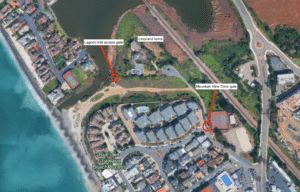
When the commission approved the permit for the house, Levy was required to implement a small 300-foot lagoon public access trail that would be accessible via a gate from dawn to dusk. The site is located along the lagoon at the north end of the main North Beach trail area, within a 100-foot wetland buffer west of the Levyland house.
Levy was also required to make an offer of dedication of this lagoon access trail to the city of Carlsbad; however, Levy said that the city of Carlsbad has never accepted the dedication of the lagoon access trail, meaning no one has taken responsibility for maintaining or operating the trail.
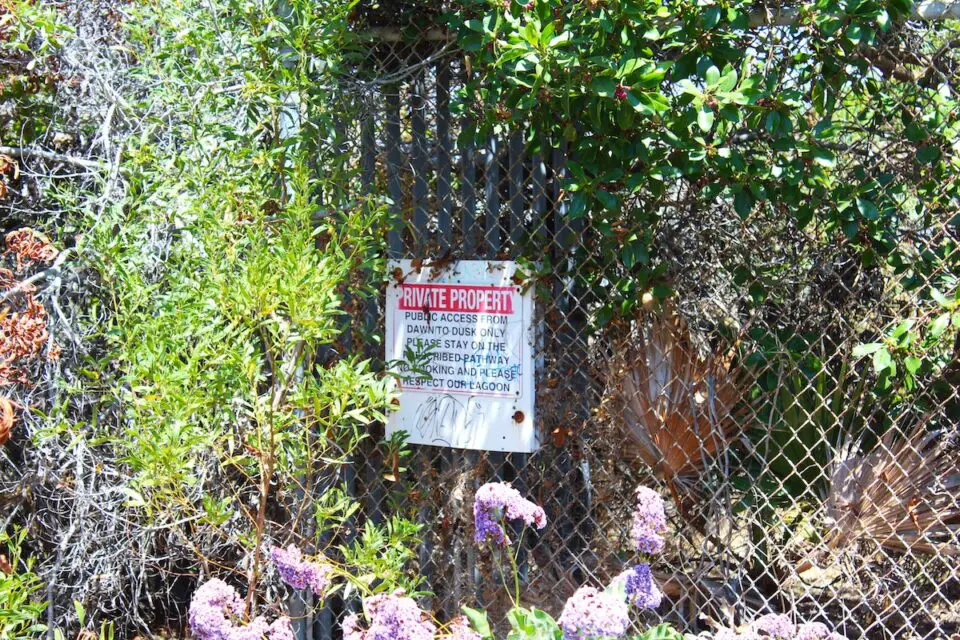
While a gate was put into place, it has remained locked and has never been opened to the public, and vegetation behind the gate has become overgrown due to a lack of maintenance.
The commission has demanded Levy to open this gate to provide the required public access, but Levy said the city would first need to accept the dedication in order for the public to use the trail.
He described himself as the “ham in the sandwich” between the city and the Coastal Commission in this situation.
“This whole notion that I’m blocking public access is just absolutely untrue,” Levy said. “I know I’m well within my rights of what’s happened here, and I know the city knows that too.”
To assist him in his battle against the Coastal Commission, Levy asked the city earlier this year to issue a certificate attesting that he is in compliance with the terms of the Coastal Development Permit for his property.
Rob Moddelmog, an attorney for the Coastal Commission, urged Carlsbad leaders not to find Levy in compliance, stating in a May letter that doing so would make the city “a party to the many violations at issue” and would “create a variety of difficulties.”
In an Aug. 1 letter in response to the Coastal Commission, Carlsbad Community Development Director Jeff Murphy agreed with Levy that there is no current public lagoon access being blocked in violation of the permit.
Specifically, Murphy said the city has never accepted Levy’s offer of dedication of a trail easement for the lagoon access site, and that until it is accepted, the city is not responsible for maintaining the site or adopting it into its public trails network.
“In this case, there is no written record of city manager or City Council acceptance of the Lagoon Public Access Trail IOD [irrevocable offer of dedication], let alone city manager acceptance of such IOD into the citywide trail system,” the city said on Aug. 1.
Murphy also stated that Levy’s property is in compliance with all but one of the permit conditions, which requires him to record a deed restriction over the wetland buffer setback area for open space and public access uses only.
Murphy added that there may be other improvements and impacts on the site that have taken place since the permit was issued, which could require a separate coastal development permit as required by the Coastal Commission.


Along with the lagoon access gate within the wetland buffer, the Coastal Commission has also raised issues regarding a separate vehicle gate above the Levyland property along Mountain View Drive near Normandy Lane, which leads down to the larger North Beach trail and lagoon area.
Levy utilizes this locked vehicle gate to access his property, and the city also has access for maintenance of the North Beach Trail as well as emergency access to the beach.
In an October notice to Levy, commission staff said that this locked vehicle gate constitutes another violation, as an existing pedestrian access easement at the site of the gate requires it to be opened so that the public can access the area.
However, this appears to contradict statements from a 1998 commission staff report from when they were considering Levy’s permit. The staff report said the implementation of an electronic vehicle gate as requested by Levy would not change the existing public access availability as there had already been a gate at that location for some time.
The report also did not state requirements for the Mountain View Drive gate to be open at any certain times, and recognized that there is adequate public access to the beach down the street — around 500 feet away along Ocean Street at Rue de Chateaux.
Levy and city officials have also cited this in their responses to the commission.
“The Coastal Commission has not provided any authority for this position, and it is inconsistent with the Coastal Commission’s prior findings and decisions. It is also inconsistent with the language of the easements, which do not require removal or timed opening of the gate upon acceptance,” the city stated in its Aug. 1 letter.
The city’s letter also stated that the land where the gate is located is owned by The Beach Homeowners Association, which operates an adjacent condominium complex.
Carlsbad officials said the commission has the authority to set new terms for the use of the gate to address the public access issue, but that these terms must be created in consultation with The Beach Homeowners Association.


Public scrutiny
The situation at Levyland has drawn scrutiny from local environmental advocacy groups, including San Diego Surfrider Foundation, Preserve Calavera, and Buena Vista Audubon Society.
At a July 15 Carlsbad City Council meeting, Buena Vista Audubon President Patti Lengan emphasized that the trail access gate is supposed to be open from dawn to dusk for public access.
“The North Beach Trail is part of Carlsbad’s city trail system, but the public is intentionally prevented from accessing the trail running between Levy’s property and the lagoon,” Lengan said. “We urge the city of Carlsbad to actively support the California Coastal Commission’s efforts to restore the site to compliance.”
Adding further confusion is the city’s own trail website page. In its list of publicly accessible trails in the city, the page highlights the small out-and-back lagoon access trail as an offshoot of the North Beach Trail, despite it not being currently accessible.
Coastal Commission staff said the inclusion of this area on the city website is indicative of the city accepting the trail into their trail network.
The city’s trail page also indicates that residents can access the North Beach Trail via the vehicle access road at Mountain View Drive.
Disagreements regarding the terms of the Coastal Development Permit go back decades. In 1998, one of the then-Coastal Commission members filed an appeal of Carlsbad’s approval for the project due to concerns about public access, with commission staff recommending that the appeal move forward.
However, the commission ultimately did not move approve the appeal, and instead would consider and approve the Levyland project and associated Coastal Development Permit at the end of 1998.
At this time, the Coastal Commission said they are hoping to resolve this issue with Levy via a settlement, to avoid having to address it during a contested commission hearing.
Levy said that as a longtime surfer and foiler (a sport that involves riding a board atop the water via a hydrofoil), he believes strongly in the importance of public access; however, he sees the threat of fines from the Coastal Commission as a form of extortion, and said their attempted enforcement has sullied his name in the community where he has lived for 30 years.
“They’re making it like, ‘rich guy blocks public access,’ and that’s just not the deal,” Levy said. “Really, what’s transpiring is this is a hit job by the Coastal Commission, trying to litigate this in the court of public opinion.”