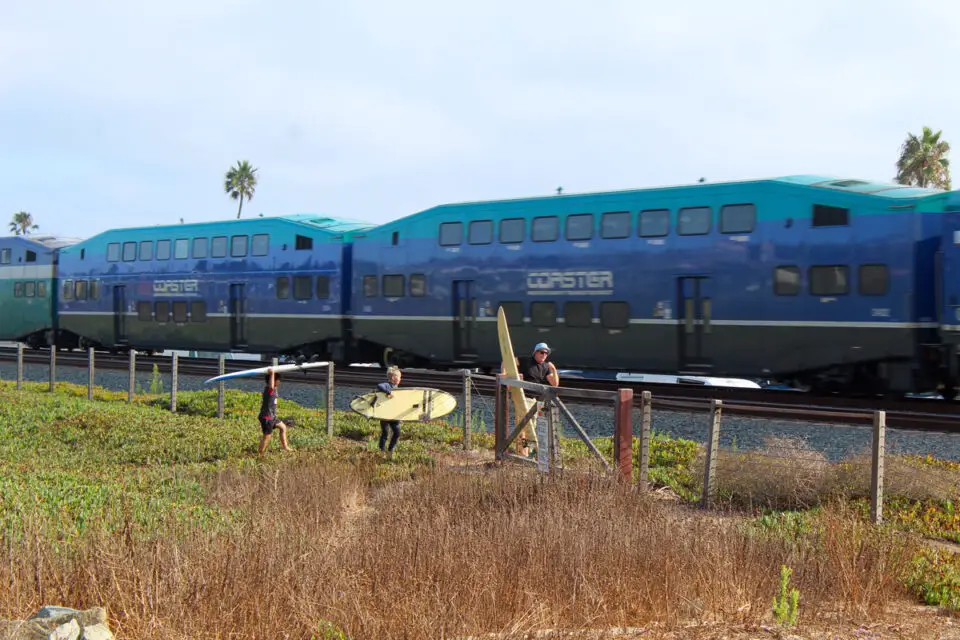
ENCINITAS — Seeking to improve rail safety throughout the city, the Encinitas City Council has directed staff to pursue federal grant funding that could exceed $30 million for a trio of projects.
The effort is considered a gamble, as the grant process is costly and highly competitive among municipalities nationwide. The city will spend $77,000 to submit applications for all three projects, according to city documents.
The Federal Railroad Administration, part of the U.S. Department of Transportation, announced in September that more than $5 billion is available for eligible projects aimed at improving safety, reducing repair backlogs, expanding passenger rail service or enhancing system performance.
The grants would cover up to 80% of project costs, with applicants responsible for the remainder. No more than 20% of total funds may be allocated to a single state. Applications are due Jan. 7, 2026.
The council voted unanimously on Oct. 22 to include the following three projects in the city’s grant application:
- The Leucadia At-Grade Crossings Project would construct pedestrian and cyclist crossings at Grandview and Phoebe streets, connecting Coast Highway 101 with Vulcan Avenue. The project is estimated to cost between $6 million and $6.5 million and is about 30% designed, city records show.
- The Citywide Quiet Zone Improvements Project would add safety features at five existing at-grade crossings to reduce the need for train horns. The city has already secured funds for design and technical studies, according to documents. The total project cost is estimated between $12.5 million and $13.5 million.
- The Verdi Underground Improvements Project, already designed and approved by the Planning Commission in August, would create a grade-separated pedestrian and cyclist undercrossing connecting Cardiff Elementary School to San Elijo State Beach. The project is expected to cost between $17 million and $18 million.
Matt Widelski, principal engineer for the City of Encinitas, said all three projects will be submitted under one application, but each will be judged individually by the FRA, allowing the agency to approve one or two projects while denying others.
“It’s less paperwork for us, less paperwork for the FRA to look at,” Widelski said. “They appreciate that.”
Some residents argued during public comment that the odds of securing funding were slim, calling the effort a potential waste of time and money. Others said that improving safety and quieting trains rolling through downtown Encinitas would be a significant win for quality of life in the more densely populated area.
Deputy Mayor Joy Lyndes said safety was her top concern.
“The more we can get people across the tracks safely, the better the rail will run,” Lyndes said, adding that “we’re never going to have this opportunity again” with federal funds redirected from other programs.
Councilmember Jim O’Hara called train noise a public health and safety issue affecting thousands of residents and businesses along Coast Highway 101.
Councilmember Marco San Antonio, who owns a downtown business, said he’s also experienced the impact.
“Those things are gnarly,” San Antonio said. “Those horns are sizable. I live in Olivenhain; I can hear the train from there. So I can only imagine sleeping here in Encinitas or right by the train.”
Councilmember Luke Shaffer said the low marginal cost of adding multiple projects — $55,000 for the first and $11,000 for each additional — made the risk worthwhile.
Mayor Bruce Ehlers asked RailPros project manager Blake Loftus about the city’s chances of success. Loftus said the projects have “a compelling story” since they improve safety along an Amtrak corridor.
“There’s a dollar figure for every train you stop up and down the corridor every time there’s an accident,” Loftus said. “Looking at that return over 30, 50 years, there’s a really compelling case for this particular grant on these projects.”
O’Hara expressed concern that the city may not be able to afford its 20% match if multiple projects are awarded, such as the quiet zone and Verdi Avenue undercrossing projects.
“Maybe I’m more of a gambler than I thought,” Lyndes said. “But winning all three projects is a problem I want to have.”