It’s been over 40 years since the late, great Donald Takayama requested I announce the 2nd annual Oceanside Longboard Surfing Club Contest and Beach Festival.
From then on, for decades, I ranted and raved my way through hundreds of heats, most of which were quite boring, while others featured legendary surfers like Takayama himself, David Nuuhiwa, Herbie Fletcher, Dale Dobson, Ben Aipa, Nat Young, Jericho Poppler and Joyce Hoffman were the opposite.
One thing I loved about the Oceanside event is that it celebrated the return of longboarding’s past. There, you might find yourself surfing alongside Hawaiian greats Buffalo Keaulana and Rabbit Kekai. But, the event did not stop there. It also rang in the future, something that was never done more effectively than when then- 13-year-old Joel Tudor walked on water and began creating a 30-year legend.
I recall that day clearly. Tudor was in his parents’ van, suffering from a 104-degree temperature before he defied his parental advice, paddled out and served notice that longboarding had a new leader on the West Coast.
At that time, I was on the announcer’s stand with Nuuhiwa. We watched, slack-jawed as young Joel paddled out, hung ten, kicked five and drove into a stylish and deep cutback. I had seen Joel before and so had some idea of what to expect, but Nuuhiwa sat in stunned disbelief, before turning to ask me, “Who is that little kid?”
Longboard surfing was stumbling back to its feet after being dead since the mid-60s when the shortboard revolution kicked the entire art form to the curb.
It was indeed back, but headed in the wrong direction, away from its traditional roots and into a progressive mode. As such, it was becoming little more than an extension of shortboard surfing, where super-light, 9-foot thrusters were being forced into slower versions of boards 3 feet shorter in length.
Joel, who had memorized Nuuhiwa’s every move in Dale Davis’s movie, “The Golden Breed,” took to heavier single-fin surfboards, faded, swung off the bottom, ran up, ran back and did drop-knee cutbacks, before cross stepping again and landing with both feet dangling off the tip.
It is my contention that without Joel’s persistence, longboarding would be a sideshow where long shortboards did little more than mimic their big brothers.
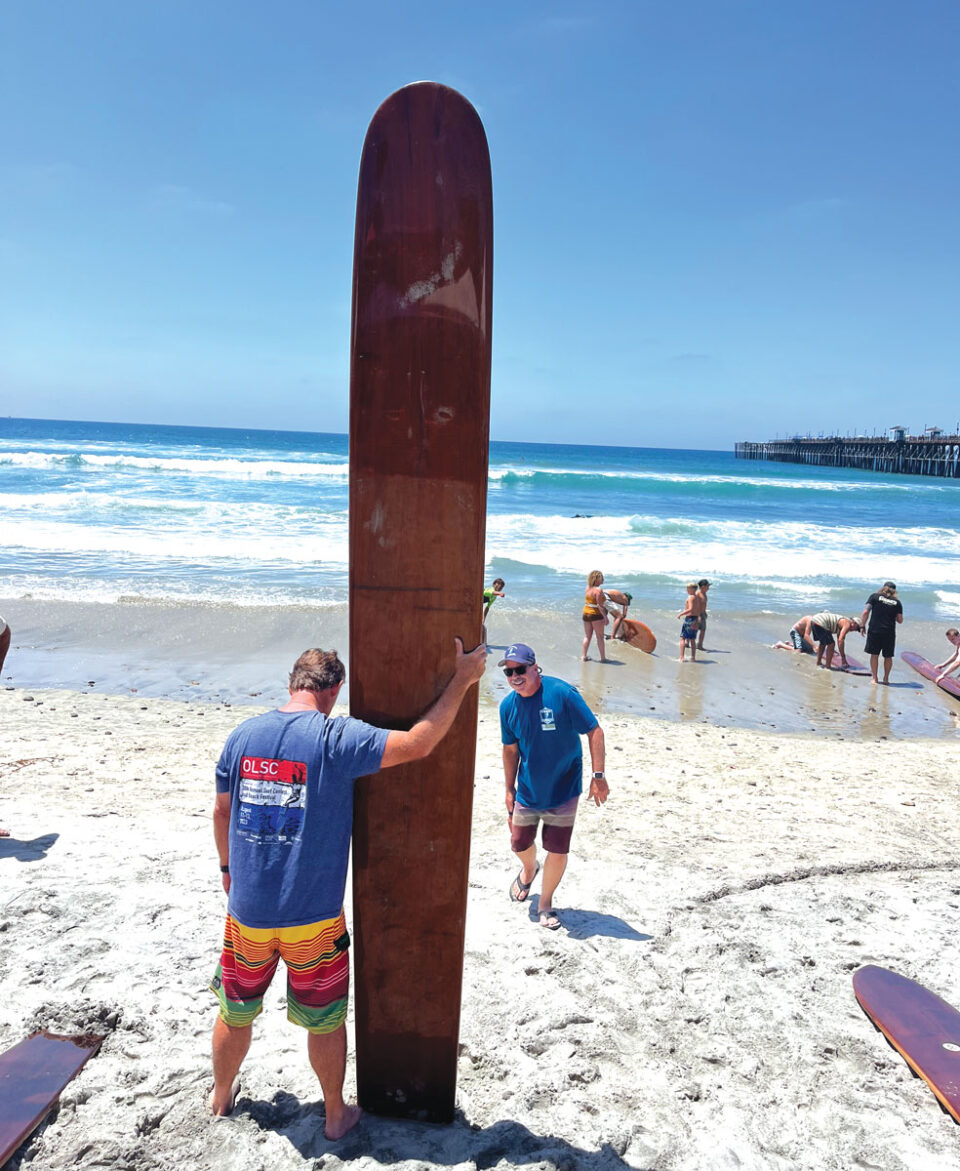
This year, the Oceanside Club took things back even further than the ’60s, all the way to the mid-1800s, when surfboards were made of heavy wood, and some of them weighed over 200 pounds.
As I mentioned in a previous column, Santa Cruz surfboard builder Bob Pearson recently handcrafted several Hawaiian surfboard replicas, placing them dead center in the California Surf Museum. While the boards were nice to look at, it seemed only vaguely possible that any modern surfer would be able to ride them.
But ride them they did at the Oceanside club event, on a 2- to 3-foot day at the Pier.
One of the boards, a 240-pound olo, was ridden successfully by former Oceanside Club president Bingo Cosby Jr. While Cosby’s ride lasted only a few seconds, standing on a board like this one is the equivalent of riding a rodeo bull.
Shorter, lighter, alia surfboards were also in play, and one surfer, whose name I never got, managed to ride effectively from the outside into the shore break, pulling off a pair of 360 turns.
If you missed the show, be certain to swing by the California Surf Museum, where these fine art pieces will be on display for a while longer.